Many custom options...


And formats...



Not what you want?
Try other similar-meaning words, fewer words, or just one word.
Remember Japanese in Japanese...
Buy a Remember Japanese calligraphy wall scroll here!
Personalize your custom “Remember Japanese” project by clicking the button next to your favorite “Remember Japanese” title below...
See also: Selections of just Japanese Kanji Calligraphy
1. Remember
2. Remember What Is Important To You
3. Mindfulness
4. Pain is Weakness Leaving the Body
5. Tiger
6. Day
Remember
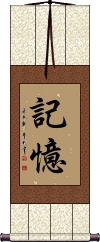
記憶 is a Japanese Kanji, old Korean Hanja, and Chinese word that means “to remember.”
This can also be translated as memory, to recall, recollection, or remembrance.
Remember
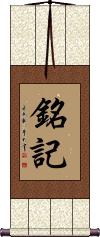
銘記 means to keep in mind, to take note of, or simply to remember, in Chinese characters and Japanese Kanji.
The first character means to engrave, inscribe, or carve an inscription.
The second character means to remember, note, mark, sign, record, history, chronicle, or annals.
When used in the context of a person, this means to engrave on the heart or to inscribe a memory in one's mind. In short, it's the idea of deeply remembering something, some event, or someone forever.
Remember What Is Important To You
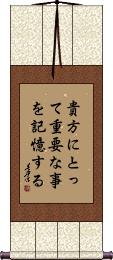
貴方にとって重要な事を記憶する means “Remember What Is Important To You” in Japanese.
Note: Because this selection contains some special Japanese Hiragana characters, it should be written by a Japanese calligrapher.
Mindfulness
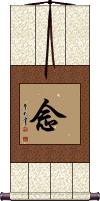
念 is the simplest way to write “mindfulness” in Chinese, Japanese Kanji, and old Korean Hanja.
念 can be defined these ways: To read; to study (a degree course); to read aloud; to miss somebody (keeping them in your mind); idea; remembrance; sense; thought; feeling; desire; concern; attention; recollection; memory; to think on/about; reflect; repeat, intone; a moment.
Obviously, the context in which the character is used determines which definition or meaning is perceived. As a single character, it's open and perhaps ambiguous. Thus, it can be read with any or all of these meanings.
念 is used in a Buddhist context (often written as 正念 or “right mindfulness”) with similar meanings of thought and contemplation.
In Japanese, this character is sometimes used as the name “Nen.”
See Also: Buddhism | Enlightenment
Pain is Weakness Leaving the Body
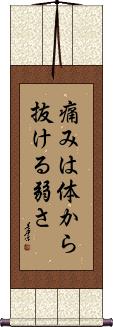
痛みは体から抜ける弱さ is how to write “pain is weakness leaving the body” in Japanese.
I remember this being shouted a lot during U.S. Marine Corps boot camp.
Note: Because this selection contains some special Japanese Hiragana characters, it should be written by a Japanese calligrapher.
Tiger
Year of the Tiger / Zodiac Sign
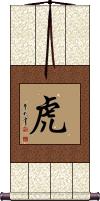
虎 is the character for tiger in Chinese, old Korean Hanja, and Japanese Kanji.
Since you already know what a tiger is, here's some trivia: If you look at the Japanese pronunciation, you might remember a movie called “Tora Tora Tora” which was the code word used to initiate the attack on Pearl Harbor. It simply means “Tiger Tiger Tiger.”
In Chinese culture, the tiger is considered to be the king of all animals (in much the way we see the lion in western culture).
From the Chinese Zodiac, if you were born in the year of the tiger, you . . .
Have a strong personality.
Are full of self-confidence.
Love adventure
Don't like to obey others.
See also our Chinese Zodiac or Tiger Calligraphy pages.
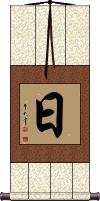
This is how to write “day” in Chinese, Japanese, and Korean Hanja.
This can also mean “Sun,” the star in the middle of the Solar system in which we live. In Japanese, it can also mean “sunshine” or even “Sunday.”
When writing the date in modern Chinese and Japanese, putting a number in front of this character indicates the day of the month. Of course, you need to indicate the month too... The month is expressed with a number followed by the character for the moon. So “three moons ten suns” would be “March 10th” or “3/10.”
Note: This is also the first character for the proper name of Japan. Remember that Japan is “The land of the rising sun”? Well, the first character for Japan means “sun” and the second means “origin” so you get the real meaning now. Sometimes, in China, this sun character can be a short name for Japan or a suffix for something of or from Japan.
Fall Down Seven Times, Get Up Eight
Always rising after a fall or repeated failures
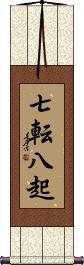
七転八起 is a Japanese proverb that relays the vicissitudes of life, with the meaning “seven times down eight times up.”
Some would more naturally translate it into English as “Always rising after a fall or repeated failures” or compare it to the English, “If at first, you don't succeed, try, try again.”
The first Kanji is literally “7.” The second means “fall down” (sometimes this Kanji means “turn around,” “revolve” or “turn over” but in this case, it holds the meaning of “fall”). The third is “8.” And the last is “get up,” “rouse,” or “rise.”
Basically, if you fail 7 times, you should recover from those events and be prepared to rise an 8th time. This also applies if it is the world or circumstances that knock you down seven times...
...just remember that you have the ability to bounce back from any kind of adversity.
Note: This can be pronounced in two ways. One is “shichi ten hakki” or “shichitenhakki.” The other is “nana korobi ya oki” also written, “nanakorobi-yaoki.”
Special Note: The second character is a Kanji that is not used in China. Therefore, please select a Japanese calligrapher for this title.
This in-stock artwork might be what you are looking for, and ships right away...

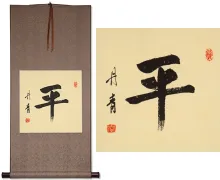
Gallery Price: $65.00
Your Price: $39.88

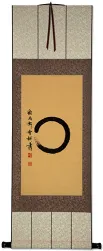

Gallery Price: $106.00
Your Price: $58.88
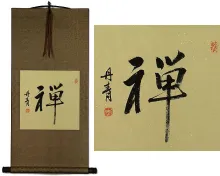

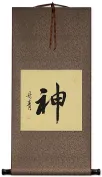


Gallery Price: $200.00
Your Price: $98.88

Gallery Price: $65.00
Your Price: $39.88
The following table may be helpful for those studying Chinese or Japanese...
| Title | Characters | Romaji (Romanized Japanese) | Various forms of Romanized Chinese | |
| Remember | 記憶 | kioku | jì yì / ji4 yi4 / ji yi / jiyi | chi i / chii |
| Remember | 銘記 | mei ki / meiki | míng jì / ming2 ji4 / ming ji / mingji | ming chi / mingchi |
| Remember What Is Important To You | 貴方にとって重要な事を記憶する | anata ni totte jyuyou na koto wo kioku suru anata ni totte jyuyo na koto wo kioku suru | ||
| Mindfulness | 念 | nen | niàn / nian4 / nian | nien |
| Pain is Weakness Leaving the Body | 痛みは體から抜ける弱さ 痛みは体から抜ける弱さ | itami wa karada kara nukeru yowasa | ||
| Tiger | 虎 | tora | hǔ / hu3 / hu | |
| Day | 日 | hi / nichi | rì / ri4 / ri | jih |
| Fall Down Seven Times, Get Up Eight | 七転八起 | shichi ten hakki / nana korobi ya oki shichi ten haki / nana korobi ya oki | ||
| In some entries above you will see that characters have different versions above and below a line. In these cases, the characters above the line are Traditional Chinese, while the ones below are Simplified Chinese. | ||||

Successful Chinese Character and Japanese Kanji calligraphy searches within the last few hours...



