Many custom options...


And formats...



Profound in Chinese / Japanese...
Buy a Profound calligraphy wall scroll here!
Personalize your custom “Profound” project by clicking the button next to your favorite “Profound” title below...
Intense / Serious / Deep / Profound
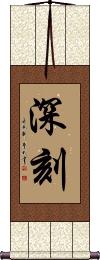
深刻 is a Chinese word that is the form of intense that describes a person who is deep, serious, and a true thinker.
If you find yourself contemplating the world and coming up with profound ideas, this might be the word for you. In some contexts (especially Korean), it can mean seriousness, gravity, or acuteness.
In Japanese, this can mean “serious problem” or can be a rare given name, Misa. You should not use this if your audience is Japanese.
Profound / Powerful Words
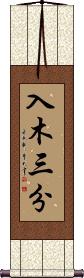
入木三分 is a four-character Chinese proverb that translates in English to a strong form of “profound” or “written with a forceful hand.”
But there is much more to the story...
The deep meaning behind this proverb comes from a man named Wan Xizhi, who lived in the third century.
He was a great writer and calligrapher whose writing style influenced generations of other writers and calligraphers.
He once wrote words on a piece of wood to be taken to an engraver.
When the engraver began to carve the characters into the wood, he found that Wang Xizhi's writing had penetrated the wood about 3/8 of an inch.
Thus people believed that his words were so powerful and profound that they caused the ink from his brush to penetrate the wood deeply.
The proverb literally means “penetrated wood three fen” (A fen is an ancient Chinese measurement of a little over 1/8 of an inch or almost 4mm).
Intense / Serious
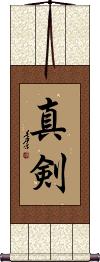
真剣 is a Japanese word that means intense, serious, or earnest. It describes a person who is deep, serious, and a true thinker or dreamer.
Literally, this means “true sword,” as compared to a sharpened wooden practice sword blank. It's real, true, and serious.
This in-stock artwork might be what you are looking for, and ships right away...
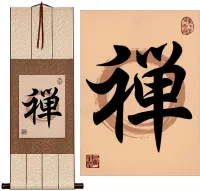
Gallery Price: $90.00
Your Price: $49.88

Gallery Price: $108.00
Your Price: $59.88
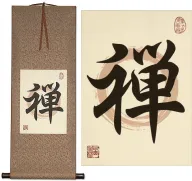
Not the results for profound that you were looking for?
Below are some entries from our dictionary that may match your profound search...
| Characters If shown, 2nd row is Simp. Chinese |
Pronunciation Romanization |
Simple Dictionary Definition |
妙 see styles |
miào miao4 miao myou / myo みょう |
More info & calligraphy: Clever / Superb / Wonderful(noun or adjectival noun) (1) strange; weird; odd; curious; (noun or adjectival noun) (2) wonder; mystery; miracle; excellence; (noun or adjectival noun) (3) cleverness; adroitness; knack; skill; (surname) Myō su, sat, mañju, sūkṣma. Wonderful, beautiful, mystic, supernatural, profound, subtle, mysterious. su means good, excellent, surpassing, beautiful, fine, easy. sat means existing, real, good. mañju means beautiful, lovely, charming. Intp. in Chinese as 不可思議 beyond thought or discussion; 絕待 special, outstanding; 無比 incomparable; 精微深遠 subtle and profound. |
禅 see styles |
yuzuru ゆずる |
More info & calligraphy: Zen / Chan / Meditation |
禪 禅 see styles |
shàn shan4 shan yuzuri ゆずり |
More info & calligraphy: Zen / Chan / Meditation(out-dated kanji) (1) (Buddhist term) dhyana (profound meditation); (2) (abbreviation) Zen (Buddhism); (surname) Yuzuri To level a place for an altar, to sacrifice to the hills and fountains; to abdicate. Adopted by Buddhists for dhyāna, 禪 or 禪那, i.e. meditation, abstraction, trance. dhyāna is 'meditation, thought, reflection, especially profound and abstract religious contemplation'. M.W. It was intp. as 'getting rid of evil', etc., later as 靜慮 quiet meditation. It is a form of 定, but that word is more closely allied with samādhi, cf. 禪定. The term also connotes Buddhism and Buddhist things in general, but has special application to the 禪宗 q.v. It is one of the six pāramitās, cf. 波. There are numerous methods and subjects of meditation. The eighteen brahmalokas are divided into four dhyāna regions 'corresponding to certain frames of mind where individuals might be reborn in strict accordance with their spiritual state'. The first three are the first dhyāna, the second three the second dhyāna, the third three the third dhyāna, and the remaining nine the fourth dhyāna. See Eitel. According to Childers' Pali Dictionary, 'The four jhānas are four stages of mystic meditation, whereby the believer's mind is purged from all earthly emotions, and detached as it were from his body, which remains plunged in a profound trance.' Seated cross-legged, the practiser 'concentrates his mind upon a single thought. Gradually his soul becomes filled with a supernatural ecstasy and serenity', his mind still reasoning: this is the first jhāna. Concentrating his mind on the same subject, he frees it from reasoning, the ecstasy and serenity remaining, which is the second jhāna. Then he divests himself of ecstasy, reaching the third stage of serenity. Lastly, in the fourth stage the mind becomes indifferent to all emotions, being exalted above them and purified. There are differences in the Mahāyāna methods, but similarity of aim. |
默 see styles |
mò mo4 mo moku |
More info & calligraphy: SilenceDark, secret, silent, profound. |
幽玄 see styles |
yōu xuán you1 xuan2 yu hsüan yuugen / yugen ゆうげん |
More info & calligraphy: Mysterioussubtle |
深刻 see styles |
shēn kè shen1 ke4 shen k`o shen ko misa みさ |
More info & calligraphy: Intense / Serious / Deep / Profound(noun or adjectival noun) serious; severe; grave; acute; (female given name) Misa |
入木三分 see styles |
rù mù sān fēn ru4 mu4 san1 fen1 ju mu san fen |
More info & calligraphy: Profound / Powerful Words |
寧靜致遠 宁静致远 see styles |
níng jìng zhì yuǎn ning2 jing4 zhi4 yuan3 ning ching chih yüan |
More info & calligraphy: Tranquility Yields Transcendence |
鏡花水月 镜花水月 see styles |
jìng huā shuǐ yuè jing4 hua1 shui3 yue4 ching hua shui yüeh kyoukasuigetsu / kyokasuigetsu きょうかすいげつ |
More info & calligraphy: Flower in the Mirror, Moon on Water(yoji) flowers reflected on a mirror and the moon reflected on the water's surface; something that is visible but having no substance; the subtle and profound beauty of poems that cannot be described in words |
冥 see styles |
míng ming2 ming mei / me めい |
dark; deep; stupid; the underworld (female given name) Mei Darkness, obscurity; deep. Hades; used chiefly in the sense of 無知 ignorance, profound, secret, invisible, e.g. as opposed to 顯 open, manifest. |
冲 see styles |
chōng chong1 ch`ung chung fukashi ふかし |
(surname) Fukashi profound |
厚 see styles |
hòu hou4 hou makoto まこと |
thick; deep or profound; kind; generous; rich or strong in flavor; to favor; to stress (suffix) thickness; (given name) Makoto thick |
宥 see styles |
yòu you4 yu yutaka ゆたか |
to forgive; to help; profound (given name) Yutaka |
微 see styles |
wēi wei1 wei honoka ほのか |
tiny; miniature; slightly; profound; abtruse; to decline; one millionth part of; micro-; Taiwan pr. [wei2] (noun or adjectival noun) (1) minuteness; (numeric) (2) one millionth; (female given name) Honoka sūkṣma. Minute, small, slight; abstruse, subtle; disguised; not; used in the sense of a molecule seven times larger than 極微 an atom; translit. vi, bi. |
沉 see styles |
chén chen2 ch`en chen jin |
to submerge; to immerse; to sink; to keep down; to lower; to drop; deep; profound; heavy sink |
沕 see styles |
wù wu4 wu |
abstruse; profound |
深 see styles |
shēn shen1 shen fukami ふかみ |
(lit. and fig.) deep (ateji / phonetic) (prefix) (1) (honorific or respectful language) august; (2) beautiful; (n,n-suf) growing late; latening; (female given name) Fukami Deep, profound, abstruse. |
淵 渊 see styles |
yuān yuan1 yüan buchi ぶち |
deep pool; deep; profound (1) deep pool; deep water; abyss; (2) depths (e.g. of despair, etc.); grip (e.g. of death); (surname) Buchi abyss |
澳 see styles |
ào ao4 ao oku おく |
deep bay; cove; harbor open sea; (personal name) Oku The south-west corner of a hall where the lares were kept; secluded, deep, profound, mysterious. |
熟 see styles |
shú shu2 shu munekazu むねかず |
ripe; mature; thoroughly cooked; done; familiar; acquainted; experienced; skilled; (of sleep etc) deep; profound; also pr. [shou2] (adj-na,adv) (kana only) (onomatopoeic or mimetic word) completely; really; thoroughly; deeply; severely; intently; (personal name) Munekazu Ripe. |
玄 see styles |
xuán xuan2 hsüan fukashi ふかし |
black; mysterious (given name) Fukashi Dark, sombre, black; abstruse, obscure, deep, profound; hence it is used to indicate Daoism, and was afterwards adopted by the Buddhists. |
窈 see styles |
yǎo yao3 yao you / yo よう |
(literary) deep; profound; dim (variant of 杳[yao3]) (female given name) Yō |
窵 窎 see styles |
diào diao4 tiao |
(literary) distant; deep; profound |
邈 see styles |
miǎo miao3 miao |
profound; remote |
三心 see styles |
sān xīn san1 xin1 san hsin sanshin さんしん |
(given name) Sanshin The three minds, or hearts; various groups are given: (1) Three assured ways of reaching the Pure Land, by (a) 至誠心 perfect sincerity; (b) 深 profound resolve for it; (c) 廻向接發願心 resolve on demitting one's merits to others. (2) (a) 根本心 The 8th or ālaya-vijñāna mind, the storehouse, or source of all seeds of good or evil; (b) 依本 the 7th or mano-vijñāna mind, the mediating cause of all taint; (c) 起事心 the ṣaḍāyatana-vijñāna mind, the immediate influence of the six senses. (3) (a) 入心 (b) 住心 (c) 出心 The mind entering into a condition, staying there, departing. (4) A pure, a single, and an undistracted mind. There are other groups. |
五智 see styles |
wǔ zhì wu3 zhi4 wu chih gochi ごち |
(place-name, surname) Gochi The five kinds of wisdom of the 眞言宗 Shingon School. Of the six elements 六大 earth, water, fire, air (or wind), ether (or space) 曇空, and consciousness (or mind 識 ), the first five form the phenomenal world, or Garbhadhātu, the womb of all things 胎藏界, the sixth is the conscious, or perceptive, or wisdom world, the Vajradhātu 金剛界, sometimes called the Diamond realm. The two realms are not originally apart, but one, and there is no consciousness without the other five elements. The sixth element, vijñāna, is further subdivided into five called the 五智 Five Wisdoms: (1) 法界體性智 dharmadhātu-prakṛti-jñāna, derived from the amala-vijñāna, or pure 識; it is the wisdom of the embodied nature of the dharmadhātu, defined as the six elements, and is associated with Vairocana 大日, in the centre, who abides in this samādhi; it also corresponds to the ether 空 element. (2) 大圓鏡智 adarśana-jñāna, the great round mirror wisdom, derived from the ālaya-vijñāna, reflecting all things; corresponds to earth, and is associated with Akṣobhya and the east. (3) 平等性智 samatā-jñāna, derived from mano-vijñāna, wisdom in regard to all things equally and universally; corresponds to fire, and is associated with Ratnasaṃbhava and the south. (4) 妙觀察智 pratyavekṣaṇa-jñāna, derived from 意識, wisdom of profound insight, or discrimination, for exposition and doubt-destruction; corresponds to water, and is associated with Amitābha and the west. (5) 成所作智 kṛtyānuṣṭhāna-jñāna, derived from the five senses, the wisdom of perfecting the double work of self-welfare and the welfare of others; corresponds to air 風 and is associated with Amoghasiddhi and the north. These five Dhyāni-Buddhas are the 五智如來. The five kinds of wisdom are the four belonging to every Buddha, of the exoteric cult, to which the esoteric cult adds the first, pure, all-refecting, universal, all-discerning, and all-perfecting. |
優奧 优奥 see styles |
yōu ào you1 ao4 yu ao uō |
excellent and profound |
冥思 see styles |
míng sī ming2 si1 ming ssu myōshi |
冥慮 The unfathomable thought or care of the buddhas and bodhisattvas, beyond the realization of men. |
冥慮 冥虑 see styles |
míng lǜ ming2 lv4 ming lü myōryo |
profound thought |
十恩 see styles |
shí ēn shi2 en1 shih en jūon |
Ten kinds of the Buddha's grace: his (1) initial resolve to universalize (his salvation); (2) self-sacrifice (in previous lives); (3) complete altruism; (4) his descent into all the six states of existence for their salvation; (5) relief of the living from distress and mortality; (6) profound pity; (7) revelation of himself in human and glorified form; (8) teaching in accordance with the capacity of his hearers, first hīnayāna, then māhayāna doctrine; (9) revealing his nirvāṇa to stimulate his disciples; (10) pitying thought for all creatures, in that dying at 80 instead of at 100 he left twenty years of his own happiness to his disciples; and also the tripiṭaka for universal salvation. |
Click here for more profound results from our dictionary
The following table may be helpful for those studying Chinese or Japanese...
| Title | Characters | Romaji (Romanized Japanese) | Various forms of Romanized Chinese | |
| Intense Serious Deep Profound | 深刻 | shinkoku / misa | shēn kè / shen1 ke4 / shen ke / shenke | shen k`o / shenko / shen ko |
| Profound Powerful Words | 入木三分 | rù mù sān fēn ru4 mu4 san1 fen1 ru mu san fen rumusanfen | ju mu san fen jumusanfen |
|
| Intense Serious | 真剣 | shin ken / shinken | ||

Successful Chinese Character and Japanese Kanji calligraphy searches within the last few hours...



