Many custom options...


And formats...



Papa in Chinese / Japanese...
Buy a Papa calligraphy wall scroll here!
Personalize your custom “Papa” project by clicking the button next to your favorite “Papa” title below...
1. Bond
9. No one knows a son better than the father
10. No man knows what he owes to his parents until he comes to have children of his own
Bond
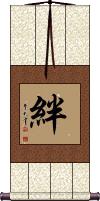
This Kanji represents a bond, as in the bond between mother and daughter, father and son, family ties, or a family bond.
絆 is the kind of character that says, no matter what happens (difficult times), we have this bond that cannot be broken.
If you go to the Japanese dictionary, the definition is the bonds (between people), (emotional) ties, relationship, connection, link, tether, or fetters.
Read this before ordering...
This Kanji is best if your audience is Japanese. While this is also a Chinese character, it has a completely different meaning in Chinese (it means to hinder or stumble in Chinese).
it’s
a very rare character in Korean Hanja but does mean bond in Korean (used in Korean words for certain kinds of glue and sticking plaster).
Father and Daughter
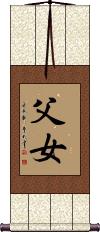
父女 is a title for “father and daughter” in Chinese.
Note: 父女 is an unusual word for a calligraphy wall scroll.
Father and Daughter
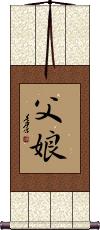
父娘 is a title for “father and daughter” in Japanese Kanji.
Daddy / Father
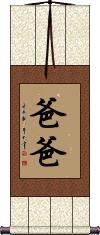
爸爸 is the colloquial way to say “Daddy” in Chinese.
Sometimes Chinese people will refer to their father with just one of these characters, “Ba,” which would be like “Dad.” With both characters, “Baba,” it's more like “Daddy.”
爸爸 is really a weird selection for a wall scroll, so consider this entry to be for educational purposes only (don't order this).
A Father’s Love
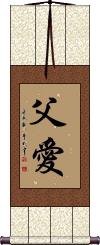
父愛 means “father's love” in Chinese.
Loving Father
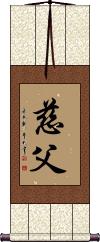
慈父 is the title of a loving father, affectionate father, or merciful father.
A great gift for your dad.
Father and Son
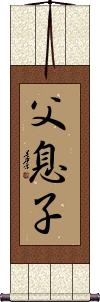
父息子 is “father and son” in Japanese.
Father and Son
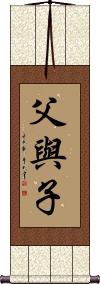
父與子 is the simple term for “Father and Son.”
However, we like some of our other tribute phrases to fathers better than this one.
A Father’s Love
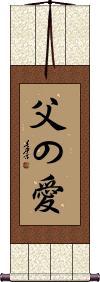
父の愛 means “father's love” in Japanese.
Love for Parents
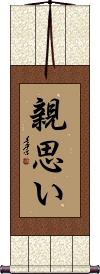
親思い is “love or affection for one's parents” in Japanese.
No one knows a son better than the father
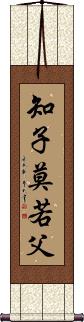
知子莫若父 can be translated as “No one knows a son better than his father.”
This idiom is based on the idea that after spending many years together, family members know everything about each other. Better than anyone else, a father knows the qualities and shortcomings of his son.
If you are looking for something about “father and son,” this is probably the best selection.
While this is the original proverb (very old), others have been composed about various combinations of mothers, sons, daughters, and fathers. Let me know if you need a custom version.
No man knows what he owes to his parents until he comes to have children of his own
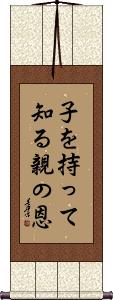
子を持って知る親の恩 literally translates as: Only after you have a baby, you would appreciate your parents (feel the way they do, etc).
This is a bit like the “walk a mile in another man's shoes” saying. Basically, it's about you cannot fully understand the plight of others until you experience it yourself. It also shows appreciation for the plight of parents.
This Japanese proverb can also be translated a few more ways:
No man knows what he owes to his parents till he comes to have children of his own.
One knows not what one owes to one's parents till one comes to have children of one's own.
Only after you have a baby, you will appreciate your parents or feel the way they do.
Only after becoming a parent yourself do you realize how much you owe [how indebted you are] to your own parents.
Note: Because this selection contains some special Japanese Hiragana characters, it should be written by a Japanese calligrapher.
The following table may be helpful for those studying Chinese or Japanese...
| Title | Characters | Romaji (Romanized Japanese) | Various forms of Romanized Chinese | |
| Bond | 絆 绊 | kizuna | bàn / ban4 / ban | pan |
| Father and Daughter | 父女 | fù nǚ / fu4 nv3 / fu nv / funv | fu nü / funü | |
| Father and Daughter | 父娘 | chichi musume chichimusume | ||
| Daddy Father | 爸爸 | bà ba / ba4 ba / ba ba / baba | pa pa / papa | |
| A Father’s Love | 父愛 父爱 | fù ài / fu4 ai4 / fu ai / fuai | ||
| Loving Father | 慈父 | jifu | cí fù / ci2 fu4 / ci fu / cifu | tz`u fu / tzufu / tzu fu |
| Father and Son | 父息子 | chichi musuko chichimusuko | ||
| Father and Son | 父與子 父与子 | fù yù zǐ fu4 yu4 zi3 fu yu zi fuyuzi | fu yü tzu fuyützu |
|
| A Father’s Love | 父の愛 | chichi no ai chichinoai | ||
| Love for Parents | 親思い | oya omoi / oyaomoi | ||
| No one knows a son better than the father | 知子莫若父 | zhī zǐ mò ruò fù zhi1 zi3 mo4 ruo4 fu4 zhi zi mo ruo fu zhizimoruofu | chih tzu mo jo fu chihtzumojofu |
|
| No man knows what he owes to his parents until he comes to have children of his own | 子を持って知る親の恩 | ko wo motte shiru oya no on kowomotteshiruoyanoon | ||
| In some entries above you will see that characters have different versions above and below a line. In these cases, the characters above the line are Traditional Chinese, while the ones below are Simplified Chinese. | ||||

Successful Chinese Character and Japanese Kanji calligraphy searches within the last few hours...



