Many custom options...


And formats...



Not what you want?
Try other similar-meaning words, fewer words, or just one word.
One With Knowledge in Chinese / Japanese...
Buy an One With Knowledge calligraphy wall scroll here!
Personalize your custom “One With Knowledge” project by clicking the button next to your favorite “One With Knowledge” title below...
1. We are not born with knowledge, how does one achieve maturity?
2. The Sea of Knowledge Has No Limits
3. Each Time You Stumble and Fall, You Gain Experience and Wisdom
4. Wisdom
5. The Nature of Enlightenment in One's Mind
6. When Three People Gather, One Becomes a Teacher
8. Sword
We are not born with knowledge, how does one achieve maturity?
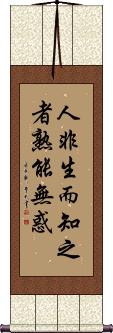
This figuratively means “Without a teacher, how can we learn/mature?”
人非生而知之者熟能無惑 is a philosophic pondering by Han Yu, a Tang Dynasty essayist, and philosopher (618-907 A.D.). This is a Chinese proverb that can be translated as “Knowledge is not innate to man, how can we overcome doubt?” or, “We are not born with knowledge, how does one achieve maturity?.”
This infers that we need the guidance of a teacher if we wish to learn, mature, and become better.
The Sea of Knowledge Has No Limits
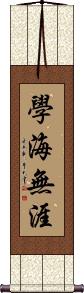
學海無涯 is a Chinese proverb that reads, “sea of learning, no horizon.”
Colloquially, it means there are no limits to what one still has left to learn.
This would be the Chinese equivalent to the quote from Hippocrates, “ars longa, vita brevis,” meaning “it takes a long time to acquire and perfect one's expertise.”
See Also: Learning is Eternal
Each Time You Stumble and Fall, You Gain Experience and Wisdom
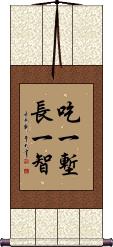
吃一塹長一智 is a Chinese proverb that means “Fall into a moat, and you will gain wisdom from the experience.”
It really suggests that the failures, troubles, frustrations, and setbacks that you encounter in your life are actually helping you to find wisdom. Some would also translate this proverb as “Learn from your mistakes” or “Learn from your experience.”
If you are studying Chinese, you will recognize the first character as “eat,” but in this case, it means to “experience” (as used in this proverb, it is suggesting that you have fallen into a moat and/or had a hard time crossing it).
Translated character by character, this whole proverb is, “Experience one moat, gain one wisdom/knowledge.”
Note: This can be pronounced in Korean, but it's not a commonly used phrase.
Wisdom
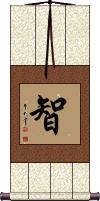
智 is the simplest way to write wisdom in Chinese, Korean Hanja, and Japanese Kanji.
Being a single character, the wisdom meaning is open to interpretation, and can also mean intellect, knowledge or reason, resourcefulness, or wit.
智 is also one of the five tenets of Confucius.
智 is sometimes included in the Bushido code but is usually not considered part of the seven key concepts of the code.
See our Wisdom in Chinese, Japanese and Korean page for more wisdom-related calligraphy.
See Also: Learn From Wisdom | Confucius
The Nature of Enlightenment in One's Mind
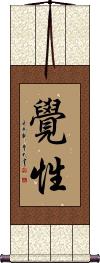
覺性 represents “The enlightened mind free from all illusion,” “The nature of enlightenment in one's mind,” or “The Buddha-nature.”
To reach this “enlightened nature,” one must form their mind into and utilize their mind as the agent of knowledge, or enlightenment.
When Three People Gather, One Becomes a Teacher
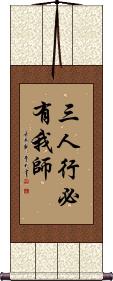
三人行必有我师 means “when three people meet, one becomes the teacher.”
This famous Chinese philosophy suggests that when people come together, they can always learn from each other.
One person must be the teacher and others learn. And in turn, the others become the teachers of the knowledge they possess.
It is important to remember that we all have something to teach, and we all have something to learn as well.
Seeking Wisdom
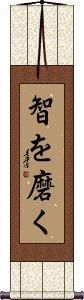
智を磨く is an old obscure Japanese phrase that means to refine, cultivate, or improve one's wisdom.
This is the mantra of one who is a seeker of wisdom. They will always want to polish, shine, refine, improve, and expand their knowledge and understanding.
Note: Because this selection contains some special Japanese Hiragana characters, it should be written by a Japanese calligrapher.
Sword
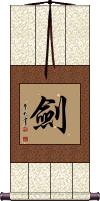
劍 is pronounced “jian” in Chinese. When you say it, imagine that you are making the sound of a sword as it clashes with a metal shield. This might get you closer to the correct pronunciation in Chinese.
I actually wonder if this word came from the metallic ringing sounds of a sword in battle - but such knowledge is lost in history.
The sword is a symbol of a warrior. The one thing that a soldier in ancient China lived and died by. A warrior with his skills and sword proves himself of great value. A warrior who losses his sword instantly becomes worthless.
劍 is an excellent scroll for someone in the military (especially officers of all services - as well as enlisted NCO Marines since they still carry swords even if mainly for ceremonial purposes). Or perhaps someone who practices variations of kung fu or tai chi that involve weapons.
Please note that while this character is understood with the sword meaning in Japanese, you might be looking for the word “katana” which also means sword in Japanese but means “knife” in Chinese.
There are other ways to write sword, and here are a few...


If you are particular about the version you receive, please let me know when you place your order (Note: Special styles are only available from one of our master calligraphers).
No Mind / Mushin
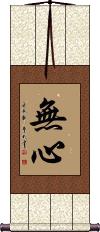
In Japanese, 無心 means innocent or without knowledge of good and evil. It literally means “without mind.”
無心 is one of the five spirits of the warrior (budo) and is often used as a Japanese martial arts tenet. Under that context, places such as the Budo Dojo define it this way: “No mind, a mind without ego. A mind like a mirror which reflects and dos not judge.” The original term was “mushin no shin,” meaning “mind of no mind.” It is a state of mind without fear, anger, or anxiety. Mushin is often described by the phrase “Mizu no Kokoro,” which means “mind like water.” The phrase is a metaphor describing the pond that clearly reflects its surroundings when calm but whose images are obscured once a pebble is dropped into its waters.
This has a good meaning in conjunction with Chan / Zen Buddhism in Japan. However, out of that context, it means mindlessness or absent-mindedness. To non-Buddhists in China, this is associated with doing something without thinking.
In Korean, this usually means indifference.
Use caution and know your audience before ordering this selection.
More info: Wikipedia: Mushin
This in-stock artwork might be what you are looking for, and ships right away...

Gallery Price: $61.00
Your Price: $33.88

Gallery Price: $61.00
Your Price: $33.88

Gallery Price: $61.00
Your Price: $33.88

Gallery Price: $61.00
Your Price: $33.88

Gallery Price: $72.00
Your Price: $39.88

Gallery Price: $61.00
Your Price: $33.88
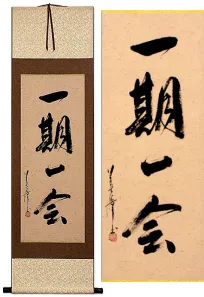
Gallery Price: $268.00
Your Price: $148.77

Gallery Price: $60.00
Your Price: $36.88
Gallery Price: $144.00
Your Price: $79.88
The following table may be helpful for those studying Chinese or Japanese...
| Title | Characters | Romaji (Romanized Japanese) | Various forms of Romanized Chinese | |
| We are not born with knowledge, how does one achieve maturity? | 人非生而知之者熟能無惑 | rén fēi shēng ér zhī zhī zhě shú néng wú huò ren2 fei1 sheng1 er2 zhi1 zhi1 zhe3 shu2 neng2 wu2 huo4 ren fei sheng er zhi zhi zhe shu neng wu huo | jen fei sheng erh chih chih che shu neng wu huo | |
| The Sea of Knowledge Has No Limits | 學海無涯 学海无涯 | xué hǎi wú yá xue2 hai3 wu2 ya2 xue hai wu ya xuehaiwuya | hsüeh hai wu ya hsüehhaiwuya |
|
| Each Time You Stumble and Fall, You Gain Experience and Wisdom | 吃一塹長一智 吃一堑长一智 | chī yí qiàn, zhǎng yí zhì chi1 yi2 qian4 zhang3 yi2 zhi4 chi yi qian zhang yi zhi chiyiqianzhangyizhi | ch`ih i ch`ien chang i chih chihichienchangichih chih i chien chang i chih |
|
| Wisdom | 智 | chi / tomo | zhì / zhi4 / zhi | chih |
| The Nature of Enlightenment in One's Mind | 覺性 觉性 | kakushou / kakusho | jué xìng / jue2 xing4 / jue xing / juexing | chüeh hsing / chüehhsing |
| When Three People Gather, One Becomes a Teacher | 三人行必有我師 三人行必有我师 | sān rén xíng bì yǒu wǒ shī san1 ren2 xing2 bi4 you3 wo3 shi1 san ren xing bi you wo shi sanrenxingbiyouwoshi | san jen hsing pi yu wo shih sanjenhsingpiyuwoshih |
|
| Seeking Wisdom | 智を磨く | chiomigaku | ||
| Sword | 劍 剑 | ken / tsurugi | jiàn / jian4 / jian | chien |
| No Mind Mushin | 無心 无心 | mu shin / mushin | wú xīn / wu2 xin1 / wu xin / wuxin | wu hsin / wuhsin |
| In some entries above you will see that characters have different versions above and below a line. In these cases, the characters above the line are Traditional Chinese, while the ones below are Simplified Chinese. | ||||

Successful Chinese Character and Japanese Kanji calligraphy searches within the last few hours...



