Many custom options...


And formats...



Not what you want?
Try other similar-meaning words, fewer words, or just one word.
Feel free to email me with your request. If it's easy, I'll translate it for free and add it to this database of calligraphy for you.
Mind in the Moment in Chinese / Japanese...
Buy a Mind in the Moment calligraphy wall scroll here!
Personalize your custom “Mind in the Moment” project by clicking the button next to your favorite “Mind in the Moment” title below...
7. Right Mindfulness / Right Memory / Perfect Mindfulness
Samyak Smriti / Samyak Smrti / Samma Sati
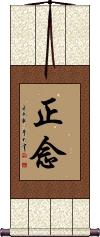
正念 is one of the Noble Eightfold Paths of Buddhism. Right Mindfulness, along with Right Effort and Right Concentration, constitute the path to Concentration or Perfect Thought.
Right Mindfulness is about remaining focused on one's body, feelings, mind, and mental qualities. It's also about being ardent, aware, and mindful, and supposes that you've already put aside worldly desire and aversion.
Monk Bhikkhu Bodhi described this as “The mind is deliberately kept at the level of bare attention, a detached observation of what is happening within us and around us in the present moment.” When practicing right mindfulness, the mind is trained to remain in the present, open, quiet, and alert, contemplating the present event.
Another definition: Ongoing mindfulness of body, feelings, thinking, and objects of thought.
This term is exclusively used by devout Buddhists. It is not a common term, and is remains an unknown concept to most Japanese and Chinese people.
See Also: Buddhism | Enlightenment | Noble Eightfold Path
Mindfulness
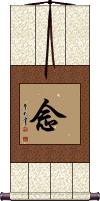
念 is the simplest way to write “mindfulness” in Chinese, Japanese Kanji, and old Korean Hanja.
念 can be defined these ways: To read; to study (a degree course); to read aloud; to miss somebody (keeping them in your mind); idea; remembrance; sense; thought; feeling; desire; concern; attention; recollection; memory; to think on/about; reflect; repeat, intone; a moment.
Obviously, the context in which the character is used determines which definition or meaning is perceived. As a single character, it's open and perhaps ambiguous. Thus, it can be read with any or all of these meanings.
念 is used in a Buddhist context (often written as 正念 or “right mindfulness”) with similar meanings of thought and contemplation.
In Japanese, this character is sometimes used as the name “Nen.”
See Also: Buddhism | Enlightenment
This in-stock artwork might be what you are looking for, and ships right away...
Gallery Price: $126.00
Your Price: $69.88
Gallery Price: $200.00
Your Price: $118.88

Gallery Price: $202.00
Your Price: $111.88

Gallery Price: $106.00
Your Price: $58.88

Gallery Price: $60.00
Your Price: $36.88

Gallery Price: $198.00
Your Price: $109.88

Gallery Price: $61.00
Your Price: $33.88


Not the results for mind in the moment that you were looking for?
Below are some entries from our dictionary that may match your mind in the moment search...
| Characters If shown, 2nd row is Simp. Chinese |
Pronunciation Romanization |
Simple Dictionary Definition |
識 识 see styles |
zhì zhi4 chih tsuguhide つぐひで |
to record; to write a footnote (1) acquaintanceship; (2) {Buddh} vijnana; consciousness; (3) (after a signature) written by ...; (personal name) Tsuguhide vijñāna, "the art of distinguishing, or perceiving, or recognizing, discerning, understanding, comprehending, distinction, intelligence, knowledge, science, learning . . . wisdom." M.W. parijñāna, "perception, thorough knowledge," etc. M.W. It is intp. by 心 the mind, mental discernment, perception, in contrast with the object discerned; also by 了別 understanding and discrimination. There are classifications of 一識 that all things are the one mind, or are metaphysical; 二識 q. v. discriminating the ālaya-vijñāna or primal undivided condition from the mano-vijñāna or that of discrimination; 三識 in the Laṅkāvatāra Sutra, fundamental, manifested and discriminate; 五識 q.v. in the 起信論, i.e. 業, 轉, 現, 知, and 相續識; 六識 the perceptions and discernings of the six organs of sense; also of 8, 9, 10, and 11 識. The most important is the eight of the 起信論, i.e. the perceptions of the six organs of sense, eye, ear, nose, tongue, body (or touch), and mind, together with manas, intp. as 意識 the consciousness of the previous moment, on which the other six depend; the eighth is the ālaya-vijñāna, v. 阿賴耶, in which is contained the seed or stock of all phenomena and which 無沒 loses none, or nothing, is indestructible; a substitute for the seventh is ādāna 'receiving' of the 唯識, which is intp. as 無解 undiscriminated, or indefinite perception; there is a difference of view between the 相 and the 性 schools in regard to the seventh and eight 識; and the latter school add a ninth called the amala, or pure vijñāna, i.e. the non-phenomenal 眞如識. The esoterics add that all phenomena are mental and all things are the one mind, hence the one mind is 無量識 unlimited mind or knowledge, every kind of knowledge, or omniscience. vijñāna is one of the twelve nidānas.; Ālaya-vijñāna and mano-vijñāna; i. e. 阿梨耶 | and 分別事 |; v. 識. |
一念 see styles |
yī niàn yi1 nian4 i nien kazune かずね |
(1) determined purpose; (2) {Buddh} an incredibly short span of time (i.e. the time occupied by a single thought); (3) {Buddh} (See 浄土宗) a single repetition of a prayer (esp. in Jodo-shu); (personal name) Kazune A kṣaṇa, or thought; a concentration of mind; a moment; the time of a thought, of which there are varying measurements from 60 kṣaṇa upwards; the Fan-yi-ming-yi makes it one kṣaṇa. A reading. A repetition (especially of Amitābha's name). The Pure-land sect identify the thought of Buddha with Amitābha's vow, hence it is an assurance of salvation. |
度忘 see styles |
dowasure どわすれ |
(irregular okurigana usage) (noun/participle) lapse of memory; forgetting for a moment something one knows well; (something) slipping one's mind |
胴忘 see styles |
douwasure / dowasure どうわすれ |
(irregular okurigana usage) (noun/participle) lapse of memory; forgetting for a moment something one knows well; (something) slipping one's mind |
ど忘れ see styles |
dowasure どわすれ |
(noun/participle) lapse of memory; forgetting for a moment something one knows well; (something) slipping one's mind |
度忘れ see styles |
dowasure どわすれ |
(noun/participle) lapse of memory; forgetting for a moment something one knows well; (something) slipping one's mind |
胴忘れ see styles |
douwasure / dowasure どうわすれ |
(noun/participle) lapse of memory; forgetting for a moment something one knows well; (something) slipping one's mind |
牟呼栗多 see styles |
móu hū lì duō mou2 hu1 li4 duo1 mou hu li to mukorita |
muhūrta, the thirtieth part of an ahorātra, a day-and-night, i. e. forty-eight minutes; a brief space of time, moment; also (wrongly) a firm mind. |
Variations: |
douwasure / dowasure どうわすれ |
(noun/participle) (See ど忘れ) lapse of memory; forgetting for a moment something one knows well; (something) slipping one's mind |
Variations: |
dowasure(do忘re, 度忘re); dowasure(do忘re) どわすれ(ど忘れ, 度忘れ); ドわすれ(ド忘れ) |
(n,vs,vt,vi) lapse of memory; (something) slipping one's mind; forgetting for a moment something one knows well |
Variations: |
douwasure / dowasure どうわすれ |
(n,vs,vt,vi) (rare) (See ど忘れ) lapse of memory; forgetting for a moment something one knows well; (something) slipping one's mind |
The following table may be helpful for those studying Chinese or Japanese...
| Title | Characters | Romaji (Romanized Japanese) | Various forms of Romanized Chinese | |
| 7. Right Mindfulness Right Memory Perfect Mindfulness | 正念 | sei nen / seinen | zhèng niàn zheng4 nian4 zheng nian zhengnian | cheng nien chengnien |
| Mindfulness | 念 | nen | niàn / nian4 / nian | nien |

Successful Chinese Character and Japanese Kanji calligraphy searches within the last few hours...



