Many custom options...


And formats...



Matter in Chinese / Japanese...
Buy a Matter calligraphy wall scroll here!
Personalize your custom “Matter” project by clicking the button next to your favorite “Matter” title below...
2. Eternal Energy / Eternal Matter
4. Enigma / Unpredictable Situation
5. Black or white cat matters not as long as it can catch mice
8. Life Goes On
9. Equality
10. Perseverance
11. Bond
12. Better to Travel 10,000 Miles than Read 10,000 Books
14. Caring
15. Walking 100 Miles: Stopping at 90 miles, is the same as stopping half-way
16. A Life of Serenity Yields Understanding
Mind Over Matter
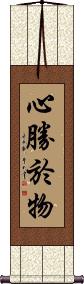
心勝於物 is how to write, “mind over matter” in Chinese.
Mind Over Matter
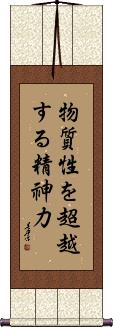
物質性を超越する精神力 means “mind over matter,” in Japanese.
If you get really technical, you get a translation like, “mental strength transcends materiality.”
Note: Because this selection contains some special Japanese Hiragana characters, it should be written by a Japanese calligrapher.
Eternal Energy / Eternal Matter
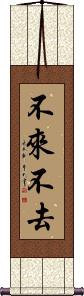
不來不去 is a Buddhist term, originally anāgamana-nirgama from Sanskrit.
This implies that things are neither coming into nor going out of existence.
This can also mean “all things are eternal,” or others will call this the Buddhist concept of the eternal conservation of energy.
This theory predates Albert Einstein and Isaac Newton.
Note: 不來不去 is not a well-known word for both Buddhists and non-Buddhists, so not all will recognize it.
Five Elements
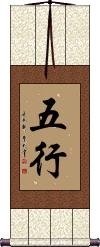
五行 is the title of the five elements: wood, fire, water, earth, and metal.
The first character means five, and the second character is simply element(s).
According to ancient Chinese science, all matter in the world is comprised of these elements. One idea presented with the five elements is that when energy is added, the matter is believed to expand. When energy is removed, matter contracts. Oddly, this concept is not far from Einstein's theories and modern science. Just a few thousand years before Einstein.
More info: Wikipedia - Five Elements (Wu Xing).
See Also: Wood | Fire | Water | Earth | Metal | Five Elements
Enigma / Unpredictable Situation
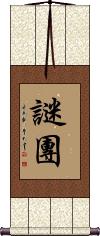
謎團 is a Chinese word that can mean riddle, enigma, unpredictable situation, or elusive matter.
Black or white cat matters not as long as it can catch mice
Ability is more important than looks
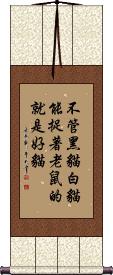
不管黑猫白猫能捉着老鼠的就是好猫 literally translates as: It doesn't matter [if a] cat [is] black [or] white, [as long as it] can catch mice, it's a good cat.
This proverb was either composed or made famous by Deng XiaoPing in 1961 when he exclaimed, “I don't care if it's a white cat or a black cat. It's a good cat so long as it catches mice” when his critics pointed out that his ideas were Capitalistic (free market). The response was meant to say, “It does not matter if it's Communist or Capitalist, as long as it works.”
This is a Chinese proverb that can be used to suggest one should disregard looks or a person's race, as long as they can do the job. It can also be used as a metaphor for many other situations.
Deng XiaoPing probably saved China from collapse (as the Soviet Union experienced). He changed China’s economy from pure Communism to a hybrid where the free market (Capitalism) is encouraged. More about Deng XiaoPing
I walk my own path
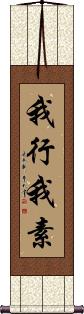
我行我素 is a way to say, “I walk my own path,” or “to continue in one's own way,” in Chinese.
This does not always have a completely positive connotation. It can mean ignoring advice or to persist in your path, no matter what others say or think.
This Too Shall Pass
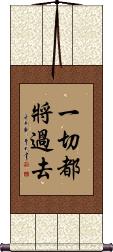
一切都將過去 is a phrase that means “this too shall pass” in Chinese.
This should be a reminder on your wall that no matter how bad things get, difficulties in life are transient and will go away in time.
This is not the only way to express this idea, as there are also 这一切都会过去 and 一切都会过去.
The version we are using here is more traditional sounding.
Life Goes On
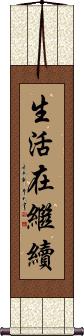
生活在繼續 means “No matter what happens, life goes on” or “For better or worse, life goes on.”
生活在繼續 is kind of modern Chinese proverb, but the meaning is generational.
生活 = to live; life; livelihood.
在 = (used before a verb to indicate an action in progress).
繼續 = to continue; to proceed with; to go on with.
Equality
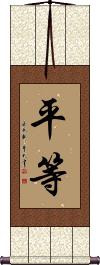
In Chinese, 平等 is the word that describes equality among all humans.
Yes, this is equality that means equality no matter of religion, whether you are rich or poor, gay or straight, black white or yellow.
In Japanese and Korean, this can be defined as equality, impartiality, and evenness (basically the same as the Chinese meaning).
Perseverance
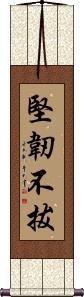
堅韌不拔 is about perseverance, being steadfast and persistent.
堅韌不拔 is a great phrase for you if you commit to your goals and overcome obstacles, no matter how long it takes.
The translation of this proverb literally means “something so persistent or steadfast, that it is not uprootable, movable, or surpassable.”
Other translations include being firm and indomitable or tenacious and unyielding.
See Also: Tenacious | Devotion | Persistence | Indomitable
Bond
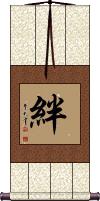
This Kanji represents a bond, as in the bond between mother and daughter, father and son, family ties, or a family bond.
絆 is the kind of character that says, no matter what happens (difficult times), we have this bond that cannot be broken.
If you go to the Japanese dictionary, the definition is the bonds (between people), (emotional) ties, relationship, connection, link, tether, or fetters.
Read this before ordering...
This Kanji is best if your audience is Japanese. While this is also a Chinese character, it has a completely different meaning in Chinese (it means to hinder or stumble in Chinese).
it’s
a very rare character in Korean Hanja but does mean bond in Korean (used in Korean words for certain kinds of glue and sticking plaster).
Better to Travel 10,000 Miles than Read 10,000 Books
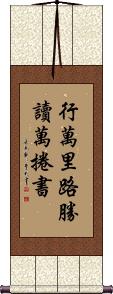
行万里路胜读万卷书 translates a few ways:
To travel ten thousand miles beats reading ten-thousand books.
Better to travel ten thousand li than to read ten thousand books. (a “li” is an ancient Chinese mile)
Traveling thousands of miles is better than reading thousands of books.
No matter how you slice it, this Chinese proverb is claiming that experience is more profound and meaningful than what you can get from a book. Go do it! Don't just read about it.
Hishiryo / Not-Thinking
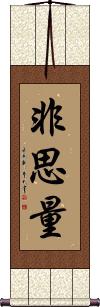
Hishiryō (非思量) literally means not-thinking.
Hishiryo can be described as a state of mind beyond thinking and non-thinking during the practice of Zazen.
Shiryō (思量) means “thinking,” and hi (非) is a prefix for negation and opposition.
Therefore, hishiryo amounts to “unthink” or “not the matter of thinking.” The word hishiryo appears in Dogen Zenji’s Fukanzazengi, Shobogenzo Zazengi, Shobogenzo Zazenshin, and Keizan Zenji’s Zazen Yojinki. It is one of the most important words used to describe zazen. Hishiryo in these writings comes from a dialogue between Yakusan Igen (745-828) and an unnamed monk, which is described in Keitoku, Dentoroku, and other Zen texts.
The above is an abridged except from School of Shodo: Hishiryo
I suggest you visit that page for a full explanation.
Caring
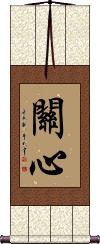
關心 means caring in Chinese.
Caring is giving love and attention to people and things that matter to you and anyone who needs help. When you care about people, you help them. You do a careful job, giving your very best effort. You treat people and things gently and respectfully. Caring makes the world a safer place.
Note: 關心 is also a word in Korean Hanja, but in Korean, it means taking interest or concern. In Korean, it's still a good word, but it doesn't quite have the “caring for a person” meaning that it does in Chinese.
See Also: Benevolence | Altruism
Walking 100 Miles: Stopping at 90 miles, is the same as stopping half-way
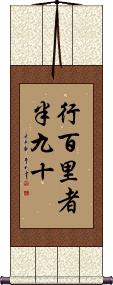
行百里者半九十 is an old Chinese proverb that speaks to the act of giving up. This phrase suggests that no matter how close you are to finishing your task or journey, giving up just before you finish is just as bad as giving up halfway.
50% finished or 90% finished, the result is the same: “You are not finished.”
You can take what you want from this proverb, but I think it suggests that you should finish what you start, and especially finish that last 10% of your journey or project so that you can honestly say “it's finished.”
Some notes: The character, 里, that I am translating as “mile” is an ancient “Chinese mile” which is actually about half a kilometer - it just doesn't sound right to say “When walking 100 half-kilometers...”
A Life of Serenity Yields Understanding
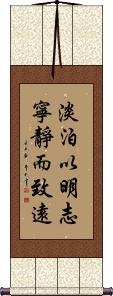
淡泊以明志寧靜而致遠 is a kind of complex ten-character proverb composed by Zhuge Liang about 1800 years ago.
淡泊以明志寧靜而致遠 is a Chinese proverb that means “Leading a simple life will yield a clear mind, and having inner peace will help you see far (into the world).”
What I have translated as “simple life” means NOT being materialistic and NOT competing in the rat race.
The last word means “far” but the deeper meaning is that you will surpass what you can currently see or understand. Perhaps even the idea of opening up vast knowledge and understanding of complex ideas.
The whole phrase has a theme that suggests that if you are NOT an aggressive, cut-throat person who fights their way to the top, no matter how many people they crush along the way, and instead seek inner peace, you will have a happier existence and be more likely to understand the meaning of life.
See Also: Serenity
Justice / Rectitude / Right Decision
Also means: honor loyalty morality righteousness
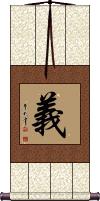
義 is about doing the right thing or making the right decision, not because it's easy but because it's ethically and morally correct.
No matter the outcome or result, one does not lose face if tempering proper justice.
義 can also be defined as righteousness, justice, morality, honor, or “right conduct.” In a more expanded definition, it can mean loyalty to friends, loyalty to the public good, or patriotism. This idea of loyalty and friendship comes from the fact that you will treat those you are loyal to with morality and justice.
義 is also one of the five tenets of Confucius's doctrine.
 There's also an alternate version of this character sometimes seen in Bushido or Korean Taekwondo tenets. It's just the addition of a radical on the left side of the character. If you want this version, click on the image to the right instead of the button above.
This is also a virtue of the Samurai Warrior
See our page with just Code of the Samurai / Bushido here
See Also: Judgment | Impartial | Confucius Tenets
Life Energy / Spiritual Energy
Chi Energy: Essence of Life / Energy Flow
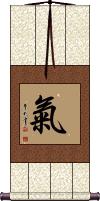
This 氣 energy flow is a fundamental concept of traditional Asian culture.
氣 is romanized as “Qi” or “Chi” in Chinese, “Gi” in Korean, and “Ki” in Japanese.
Chi is believed to be part of everything that exists, as in “life force” or “spiritual energy.” It is most often translated as “energy flow” or literally as “air” or “breath.” Some people will simply translate this as “spirit,” but you must consider the kind of spirit we're talking about. I think this is weighted more toward energy than spirit.
The character itself is a representation of steam (or breath) rising from rice. To clarify, the character for rice looks like this: 
Steam was apparently seen as visual evidence of the release of “life energy” when this concept was first developed. The Qi / Chi / Ki character is still used in compound words to mean steam or vapor.
The etymology of this character is a bit complicated. It's suggested that the first form of this character from bronze script (about 2500 years ago) looked like these samples: 

However, it was easy to confuse this with the character for the number three. So the rice radical was added by 221 B.C. (the exact time of this change is debated). This first version with the rice radical looks like this: 
The idea of Qi / Chi / Ki is really a philosophical concept. It's often used to refer to the “flow” of metaphysical energy that sustains living beings. Yet there is much debate that has continued for thousands of years as to whether Qi / Chi / Ki is pure energy or consists partially or fully of matter.
You can also see the character for Qi / Chi / Ki in common compound words such as Tai Chi / Tai Qi, Aikido, Reiki, and Qi Gong / Chi Kung.
In the modern Japanese Kanji, the rice radical has been changed into two strokes that form an X.
 The original and traditional Chinese form is still understood in Japanese, but we can also offer that modern Kanji form in our custom calligraphy. If you want this Japanese Kanji, please click on the character to the right instead of the “Select and Customize” button above.
More language notes: This is pronounced like “chee” in Mandarin Chinese, and like “key” in Japanese.
This is also the same way to write this in Korean Hanja where it is Romanized as “gi” and pronounced like “gee” but with a real G-sound, not a J-sound.
Though Vietnamese no longer use Chinese characters in their daily language, this character is still widely known in Vietnam.
See Also: Energy | Life Force | Vitality | Life | Birth | Soul
These search terms might be related to Matter:
Don't Worry, Be Happy
Freedom From Anger and Worry Yields Longevity
No Trouble / Freedom From Problems
Peaceful / Tranquil / Calm / Free From Worry
The following table may be helpful for those studying Chinese or Japanese...
| Title | Characters | Romaji (Romanized Japanese) | Various forms of Romanized Chinese | |
| Mind Over Matter | 心勝於物 心胜于物 | xīn shèng yú wù xin1 sheng4 yu2 wu4 xin sheng yu wu xinshengyuwu | hsin sheng yü wu hsinshengyüwu |
|
| Mind Over Matter | 物質性を超越する精神力 | busshitsu-sei o chouetsu suru seishin-ryoku bushitsu-sei o choetsu suru seishin-ryoku | ||
| Eternal Energy Eternal Matter | 不來不去 不来不去 | furai fuko / furaifuko | bù lái bú qù bu4 lai2 bu2 qu4 bu lai bu qu bulaibuqu | pu lai pu ch`ü pulaipuchü pu lai pu chü |
| Five Elements | 五行 | gogyou / gogyo | wǔ xíng / wu3 xing2 / wu xing / wuxing | wu hsing / wuhsing |
| Enigma Unpredictable Situation | 謎團 谜团 | mí tuán / mi2 tuan2 / mi tuan / mituan | mi t`uan / mituan / mi tuan | |
| Black or white cat matters not as long as it can catch mice | 不管黑貓白貓能捉著老鼠的就是好貓 不管黑猫白猫能捉着老鼠的就是好猫 | bù guǎn hēi māo bái māo néng zhuō zhe lǎo shǔ de jiù shì hǎo mǎo bu4 guan3 hei1 mao1 bai2 mao1 neng2 zhuo1 zhe lao3 shu3 de jiu4 shi4 hao3 mao3 bu guan hei mao bai mao neng zhuo zhe lao shu de jiu shi hao mao | pu kuan hei mao pai mao neng cho che lao shu te chiu shih hao mao | |
| I walk my own path | 我行我素 | wǒ xíng wǒ sù wo3 xing2 wo3 su4 wo xing wo su woxingwosu | wo hsing wo su wohsingwosu |
|
| This Too Shall Pass | 一切都將過去 一切都将过去 | yī qiè dōu jiāng guò qù yi1 qie4 dou1 jiang1 guo4 qu4 yi qie dou jiang guo qu yiqiedoujiangguoqu | i ch`ieh tou chiang kuo ch`ü ichiehtouchiangkuochü i chieh tou chiang kuo chü |
|
| Life Goes On | 生活在繼續 生活在继续 | shēng huó zài jì xù sheng1 huo2 zai4 ji4 xu4 sheng huo zai ji xu shenghuozaijixu | sheng huo tsai chi hsü shenghuotsaichihsü |
|
| Equality | 平等 | byou dou / byoudou / byo do | píng děng ping2 deng3 ping deng pingdeng | p`ing teng pingteng ping teng |
| Perseverance | 堅韌不拔 坚韧不拔 | jiān rèn bù bá jian1 ren4 bu4 ba2 jian ren bu ba jianrenbuba | chien jen pu pa chienjenpupa |
|
| Bond | 絆 绊 | kizuna | bàn / ban4 / ban | pan |
| Better to Travel 10,000 Miles than Read 10,000 Books | 行萬里路勝讀萬捲書 行万里路胜读万卷书 | xíng wàn lǐ lù shèng dú wàn juǎn shū xing2 wan4 li3 lu4 sheng4 du2 wan4 juan3 shu1 xing wan li lu sheng du wan juan shu | hsing wan li lu sheng tu wan chüan shu | |
| Hishiryo Not-Thinking | 非思量 | hi shi ryou hishiryou hi shi ryo | fēi sī liáng fei1 si1 liang2 fei si liang feisiliang | fei ssu liang feissuliang |
| Caring | 關心 关心 | guān xīn / guan1 xin1 / guan xin / guanxin | kuan hsin / kuanhsin | |
| Walking 100 Miles: Stopping at 90 miles, is the same as stopping half-way | 行百里者半九十 | xíng bǎi lǐ zhě bàn jiǔ shí xing2 bai3 li3 zhe3 ban4 jiu3 shi2 xing bai li zhe ban jiu shi xingbailizhebanjiushi | hsing pai li che pan chiu shih hsingpailichepanchiushih |
|
| A Life of Serenity Yields Understanding | 淡泊以明志寧靜而致遠 淡泊以明志宁静而致远 | dàn bó yǐ míng zhì, níng jìng ér zhì yuǎn dan4 bo2 yi3 ming2 zhi4, ning2 jing4 er2 zhi4 yuan3 dan bo yi ming zhi, ning jing er zhi yuan | tan po i ming chih, ning ching erh chih yüan | |
| Justice Rectitude Right Decision | 義 义 | gi | yì / yi4 / yi | i |
| Life Energy Spiritual Energy | 氣 气 / 気 | ki | qì / qi4 / qi | ch`i / chi |
| In some entries above you will see that characters have different versions above and below a line. In these cases, the characters above the line are Traditional Chinese, while the ones below are Simplified Chinese. | ||||

Successful Chinese Character and Japanese Kanji calligraphy searches within the last few hours...



