Many custom options...


And formats...



Not what you want?
Try other similar-meaning words, fewer words, or just one word.
Marine Japanese in Japanese...
Buy a Marine Japanese calligraphy wall scroll here!
Personalize your custom “Marine Japanese” project by clicking the button next to your favorite “Marine Japanese” title below...
See also: Selections of just Japanese Kanji Calligraphy
United States Marine Corps
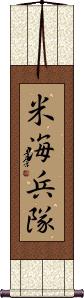
米海兵隊 is the Japanese way to write “United States Marine Corps” or simply “U.S. Marines.”
Breaking down each Kanji, this means:
“rice (American) ocean/sea soldiers/army/military corps/regiment/group.”
This title will only make sense in Japanese, it is not the same in Chinese! Make sure you know your audience before ordering a custom wall scroll.
If you are wondering about rice, America is known as “rice country” or “rice kingdom” when literally translated. The Kanji for rice is often used as an abbreviation in front of words (like a sub-adjective) to make something “American.” Americans say “rice burner” for a Japanese car and “rice rocket” for a Japanese motorcycle. If you did the same in Japanese, it would have the opposite meaning.
Note: I have not verified this but I’ve found this title used for U.S. Marines in Korean articles, so it’s most likely a normal Korean term as well (but only in Korean Hanja).
See Also: Marine Corps | Navy | Army | Art of War | Warrior | Military
Marine Corps
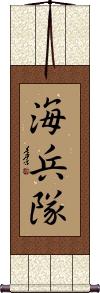
海兵隊 is the Japanese and Korean way to express “Marine Corps” or simply “Marines.” It is not specific, so this can be the Marine Corps of any country, such as the British Royal Marines to the U.S. Marines.
Breaking down each character, this means:
“ocean/sea soldiers/army corps/regiment/group.”
See Also: Military
Marine / Soldier of the Sea
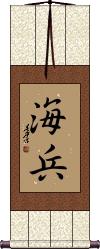
海兵 is a way to express “Marine” as in an individual “Soldier of the Sea” in Japanese Kanji and old Korean Hanja characters (not to be confused with Korean Hangul).
Breaking down each character, this means:
“ocean/sea soldier/army/warrior.”
Please note that this Japanese/Korean version kind of means “sailor” or “navy” in Chinese.
See Also: Military
Training / Drill
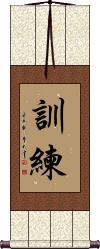
If training or drill is important to you (especially for military drill and training), 訓練 might be just the thing for a drill master to hang behind his/her desk.
This term is universal in Chinese, Japanese Kanji, and old Korean Hanja. It can also mean practice or exercise, depending on context.
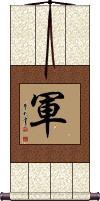
Army / Military
Pain is Weakness Leaving the Body
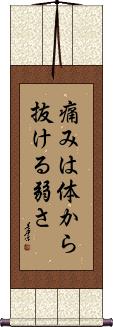
痛みは体から抜ける弱さ is how to write “pain is weakness leaving the body” in Japanese.
I remember this being shouted a lot during U.S. Marine Corps boot camp.
Note: Because this selection contains some special Japanese Hiragana characters, it should be written by a Japanese calligrapher.
Gung Ho
Working Together
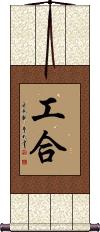
工合 is one of those Asian words that is used more in English than in the original Chinese.
Gung Ho was originally used to speak of Carlson's Raiders, a group of “Gung Ho” U.S. Marines who went on an island-hopping campaign of death during WWII.
A movie called Gung Ho came out in the mid-1940s and was later re-released in the 1950s depicting the 2nd Marine Raider Battalion, and brought this word to the mainstream.
It is still sometimes used today within the U.S. Marine Corps brotherhood to refer to a unit or group that works well together or is otherwise efficient and motivated (has good morals).
In 1986, there was a movie called Gung Ho about a Japanese company taking over an American automotive factory. They completely ignored the fact that this was a Chinese title.
It should be noted that this title actually means a condition, state, manner, or the health of something in Japanese.
Language and pronunciation notes:
Like many Asian words absorbed into common use in English, this one is drastically mispronounced. The official Romanization is “gong he” but that doesn't tell you enough. The vowel sound on the first character is like the English word “own,” now just add the g-sounds to the beginning and end. The second character is misleading, as you might think it is like the English word “he.” In reality, the vowel sound is more like the “u” in “up.”
It should also be noted that the current generation in China no longer uses or recognizes this as a common word or slogan.
Note: This can be pronounced and is a word in Japanese, though seldom used. Japanese will use a variation of "具合" instead. But still, not common.
This in-stock artwork might be what you are looking for, and ships right away...



Gallery Price: $106.00
Your Price: $58.88



Gallery Price: $200.00
Your Price: $98.88

Gallery Price: $65.00
Your Price: $39.88

Gallery Price: $36.00
Starting at: $20.00
Not the results for marine japanese that you were looking for?
Below are some entries from our dictionary that may match your marine japanese search...
| Characters If shown, 2nd row is Simp. Chinese |
Pronunciation Romanization |
Simple Dictionary Definition |
大尉 see styles |
dà wèi da4 wei4 ta wei taii(p); daii / tai(p); dai たいい(P); だいい |
captain (army rank); senior captain {mil} (だいい used by Imperial Japanese Navy) captain (Army, US Marine Corps, USAF); lieutenant (Navy); flight lieutenant (RAF, RAAF, RNZAF, etc.) |
石鼈 see styles |
hizaragai ひざらがい jiigase / jigase じいがせ |
(1) (kana only) chiton (any marine mollusk of the class Polyplacophora); sea cradle; (2) Japanese chiton (Acanthopleura japonica) |
火皿貝 see styles |
hizaragai ひざらがい |
(1) (kana only) chiton (any marine mollusk of the class Polyplacophora); sea cradle; (2) Japanese chiton (Acanthopleura japonica) |
爺が背 see styles |
jiigase / jigase じいがせ |
(1) (kana only) chiton (any marine mollusk of the class Polyplacophora); sea cradle; (2) Japanese chiton (Acanthopleura japonica) |
膝皿貝 see styles |
hizaragai ひざらがい |
(1) (kana only) chiton (any marine mollusk of the class Polyplacophora); sea cradle; (2) Japanese chiton (Acanthopleura japonica) |
ヒザラガイ see styles |
hizaragai ヒザラガイ |
(1) (kana only) chiton (any marine mollusk of the class Polyplacophora); sea cradle; (2) Japanese chiton (Acanthopleura japonica) |
Variations: |
hizaragai(膝皿貝, 火皿貝, 石鼈); jiigase(石鼈, 爺ga背); hizaragai / hizaragai(膝皿貝, 火皿貝, 石鼈); jigase(石鼈, 爺ga背); hizaragai ひざらがい(膝皿貝, 火皿貝, 石鼈); じいがせ(石鼈, 爺が背); ヒザラガイ |
(1) (kana only) chiton (any marine mollusk of the class Polyplacophora); sea cradle; (2) Japanese chiton (Acanthopleura japonica) |
The following table may be helpful for those studying Chinese or Japanese...
| Title | Characters | Romaji (Romanized Japanese) | Various forms of Romanized Chinese | |
| United States Marine Corps | 米海兵隊 | bei kai hei tai beikaiheitai | ||
| Marine Corps | 海兵隊 海兵队 | kaiheitai | ||
| Marine Soldier of the Sea | 海兵 | kai hei / kaihei | ||
| Training Drill | 訓練 训练 | kunren | xùn liàn / xun4 lian4 / xun lian / xunlian | hsün lien / hsünlien |
| Army Military | 軍 军 | gun | jūn / jun1 / jun | chün |
| Pain is Weakness Leaving the Body | 痛みは體から抜ける弱さ 痛みは体から抜ける弱さ | itami wa karada kara nukeru yowasa | ||
| Gung Ho | 工合 | guai | gōng hé / gong1 he2 / gong he / gonghe | kung ho / kungho |
| In some entries above you will see that characters have different versions above and below a line. In these cases, the characters above the line are Traditional Chinese, while the ones below are Simplified Chinese. | ||||

Successful Chinese Character and Japanese Kanji calligraphy searches within the last few hours...



