Many custom options...


And formats...



Not what you want?
Try other similar-meaning words, fewer words, or just one word.
Feel free to email me with your request. If it's easy, I'll translate it for free and add it to this database of calligraphy for you.
Lust Desire in Chinese / Japanese...
Buy a Lust Desire calligraphy wall scroll here!
Personalize your custom “Lust Desire” project by clicking the button next to your favorite “Lust Desire” title below...
Lust / Desire / Passion
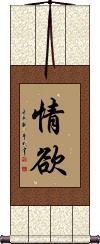
情欲 can be defined as lust, sexual desire, sensual desire, carnal desire, carnal passions, sexual desire, and passion.
The first character means feeling, emotions, passionate, sympathy, affection, love, compassion, tender feelings, and sometimes circumstances or facts.
The second character means desire, longing, appetite, wish, covetousness, greed, passion, desire, and craving.
This word is universal in Chinese, Japanese Kanji, and Korean Hanja.
Desire / Craving
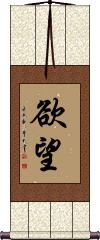
欲望 is a word that means strong desire, while some might translate it as “lust.”
The first character of this word means desire, longing, hunger, covetousness, greed, passion, desire, craving, or wish. The second character means to hope for, ambition, desire, aspire, expect, gaze (into the distance), or look for something.
Not the results for lust desire that you were looking for?
Below are some entries from our dictionary that may match your lust desire search...
| Characters If shown, 2nd row is Simp. Chinese |
Pronunciation Romanization |
Simple Dictionary Definition |
慾 欲 see styles |
yù yu4 yü yoku よく |
More info & calligraphy: Desire / Longing / Cravinggreed; craving; desire; avarice; wants Passion, inordinate desire, lust, v. 欲. |
春 see styles |
chūn chun1 ch`un chun haruji はるじ |
More info & calligraphy: Spring Season(n,adv) (1) spring; springtime; (2) New Year; (3) prime (of life); height (of one's prosperity); heyday; (4) adolescence; puberty; (5) sexuality; sexual desire; (personal name) Haruji |
欲 see styles |
yù yu4 yü yoku よく |
More info & calligraphy: Desire / Longing / Cravinggreed; craving; desire; avarice; wants; (surname) Yoku rājas, passion. Also kāma, desire, love. The Chinese word means to breathe after, aspire to, desire, and is also used as 慾 for lust, passion; it is inter alia intp. as 染愛塵 tainted with the dust (or dirt) of love, or lust. The three desires are for beauty, demeanour, and softness; the five are those of the five physical senses. |
情欲 see styles |
qíng yù qing2 yu4 ch`ing yü ching yü jōyoku じょうよく |
More info & calligraphy: Lust / Desire / PassionThe passions, desires. |
欲望 see styles |
yù wàng yu4 wang4 yü wang yokumō よくぼう |
More info & calligraphy: Desire / Cravingdesire |
三界 see styles |
sān jiè san1 jie4 san chieh mikai みかい |
(1) {Buddh} (See 欲界,色界,無色界) the three realms of existence; (2) (abbreviation) {Buddh} (See 三千大千世界) the whole universe (of a billion worlds) that Buddha enlightened; (3) {Buddh} (See 三世・さんぜ・1) past, present and future existences; (suffix) (4) far-off ...; distant ...; (surname) Mikai Trailokya or Triloka; the three realms; also 三有. It is the Buddhist metaphysical equivalent for the Brahmanic cosmological bhuvanatraya, or triple world of bhūr, bhuvaḥ, and svar, earth, atmosphere, and heaven. The Buddhist three are 欲, 色, and 無色界, i.e. world of sensuous desire, form, and formless world of pure spirit. (a) 欲界 Kāmadhātu is the realm of sensuous desire, of 婬 and 食 sex and food; it includes the six heavens of desire, the human world, and the hells. (b) 色界 Rūpadhātu is the realm of form, meaning 質礙 that which is substantial and resistant: it is above the lust-world and contains (so to speak) bodies, palaces, things, all mystic and wonderful一a semi-material conception like that in Revelation; it is represented in the 四禪天, or Brahmalokas. (c) 無色界 Arūpadhātu, or ārūpyadhātu, is the formless realm of pure spirit, where there are no bodies, places, things, at any rate none to which human terms would apply, but where the mind dwells in mystic contemplation; its extent is indefinable, but it is, conceived of in four stages, i,e. 四空處 the four "empty" regions, or regions of space in the immaterial world, which are 四無色 the four "formless" realms, or realms beyond form; being above the realm of form, their bounds cannot be defined. v. 倶舍論世間品. |
劣情 see styles |
retsujou / retsujo れつじょう |
animal passions; carnal desire; lust |
性慾 性欲 see styles |
xìng yù xing4 yu4 hsing yü seiyoku / seyoku せいよく |
sexual desire; lust (noun - becomes adjective with の) sexual desire |
情慾 情欲 see styles |
qíng yù qing2 yu4 ch`ing yü ching yü jouyoku / joyoku じょうよく |
lust; desire; sensual (noun - becomes adjective with の) passions; sexual desire; lust |
愛慾 see styles |
aiyoku あいよく |
(1) passion; sexual desire; lust; (2) (Buddhist term) attachment (esp. to one's family or a member of the opposite sex) |
愛欲 爱欲 see styles |
ài yù ai4 yu4 ai yü aiyoku あいよく |
(1) passion; sexual desire; lust; (2) (Buddhist term) attachment (esp. to one's family or a member of the opposite sex) Love and desire; love of family. |
慾望 欲望 see styles |
yù wàng yu4 wang4 yü wang yokubou / yokubo よくぼう |
desire; longing; appetite; craving (irregular kanji usage) desire; appetite; lust |
欲氣 欲气 see styles |
yù qì yu4 qi4 yü ch`i yü chi yokuke |
Desire-breath, passion-influence, the spirit or influence of desire, lust. |
欲河 see styles |
yù hé yu4 he2 yü ho yokuga |
The river of desire, or lust (which drowns). |
欲泥 see styles |
yù ní yu4 ni2 yü ni yokuni |
The mire of desire, or lust. |
欲海 see styles |
yù hǎi yu4 hai3 yü hai yokukai |
ocean of lust (Buddhist term); worldly desires The ocean of desire, so called because of its extent and depth. |
欲箭 see styles |
yù jiàn yu4 jian4 yü chien yokusen |
The arrows of desire, or lust. Also the darts of the bodhisattva 欲金剛, who hooks and draws all beings to Buddha. |
欲魔 see styles |
yù mó yu4 mo2 yü mo yokuma |
The evil demon of lust. |
淫欲 see styles |
yín yù yin2 yu4 yin yü inyoku いんよく |
lust Sexual passion. |
色慾 色欲 see styles |
sè yù se4 yu4 se yü shikiyoku しきよく |
sexual desire; lust lust; sexual appetite |
色欲 see styles |
sè yù se4 yu4 se yü shikiyoku しきよく |
lust; sexual appetite Sexual desire, or passion. |
香欲 see styles |
xiāng yù xiang1 yu4 hsiang yü |
The desire for fragrance, the lust of the nasal organ, one of the five desires. |
三善根 see styles |
sān shàn gēn san1 shan4 gen1 san shan ken sanzengon; sanzenkon さんぜんごん; さんぜんこん |
{Buddh} three wholesome roots (no coveting, no anger, no delusion) The three good "roots", the foundation of all moral development, i.e. 無貪, 無瞋, 無痴 no lust (or selfish desire), no ire, no stupidity (or unwillingness to learn). Also, 施, 慈, 慧 giving, kindness, moral wisdom; v. 三毒 the three poisons for which these are a cure. |
六十心 see styles |
liù shí xīn liu4 shi2 xin1 liu shih hsin rokujū shin |
The sixty different mental positions that may occur to the practitioner of Yoga, see 大日經, 住心品; examples of them are desire, non-desire, ire, kindness, foolishness, wisdom, decision, doubt, depression, brightness, contention, dispute, non-contention, the spirit of devas, of asuras, of nāgas, of humanity, woman (i. e. lust), mastery, commercial, and so on. |
睡眠欲 see styles |
shuì mián yù shui4 mian2 yu4 shui mien yü suimin yoku |
The lust for sleep, physical and spiritual, hence 睡眠蓋 sleep, drowsiness, or sloth as a hindrance to progress. |
十二因緣 十二因缘 see styles |
shí èr yīn yuán shi2 er4 yin1 yuan2 shih erh yin yüan jūni innen |
Dvādaśaṅga pratītyasamutpāda; the twelve nidānas; v. 尼 and 因; also 十二緣起; 因緣有支; 因緣率連; 因緣棘園; 因緣輪; 因緣重城; 因緣觀; 支佛觀. They are the twelve links in the chain of existence: (1) 無明avidyā, ignorance, or unenlightenment; (2) 行 saṃskāra, action, activity, conception, "dispositions," Keith; (3) 識 vijñāna, consciousness; (4) 名色 nāmarūpa, name and form; (5) 六入 ṣaḍāyatana, the six sense organs, i.e. eye, ear, nose, tongue, body, and mind; (6) 觸 sparśa, contact, touch; (7) 受 vedanā, sensation, feeling; (8) 愛 tṛṣṇā, thirst, desire, craving; (9) 取 upādāna, laying hold of, grasping; (10) 有 bhava, being, existing; (11) 生 jāti, birth; (12) 老死 jarāmaraṇa, old age, death. The "classical formula" reads "By reason of ignorance dispositions; by reason of dispositions consciousness", etc. A further application of the twelve nidānas is made in regard to their causaton of rebirth: (1) ignorance, as inherited passion from the beginningless past ; (2) karma, good and evil, of past lives; (3) conception as a form of perception; (4) nāmarūpa, or body and mind evolving (in the womb); (5) the six organs on the verge of birth; (6) childhood whose intelligence is limited to sparśa, contact or touch; (7) receptivity or budding intelligence and discrimination from 6 or 7 years; (8) thirst, desire, or love, age of puberty; (9) the urge of sensuous existence; (10) forming the substance, bhava, of future karma; (11) the completed karma ready for rebirth; (12) old age and death. The two first are associated with the previous life, the other ten with the present. The theory is equally applicable to all realms of reincarnation. The twelve links are also represented in a chart, at the centre of which are the serpent (anger), boar (ignorance, or stupidity), and dove (lust) representing the fundamental sins. Each catches the other by the tail, typifying the train of sins producing the wheel of life. In another circle the twelve links are represented as follows: (1) ignorance, a blind woman; (2) action, a potter at work, or man gathering fruit; (3) consciousness, a restless monkey; (4) name and form, a boat; (5) sense organs, a house; (6) contact, a man and woman sitting together; (7) sensation, a man pierced by an arrow; (8) desire, a man drinking wine; (9) craving, a couple in union; (10) existence through childbirth; (11) birth, a man carrying a corpse; (12) disease, old age, death, an old woman leaning on a stick. v. 十二因緣論 Pratītya-samutpāda śāstra. |
婆舍跋提 see styles |
pó shè bá tí po2 she4 ba2 ti2 p`o she pa t`i po she pa ti Bashabadai |
Vaśavartin, the sixth desire-heaven, the abode of Māra, the god of lust, sin, and death; its occupants avail themselves of the merits of others for their own pleasure; it is also called the abode of Śikhin (Brahma) as lord of fire; also 他化自在天 and 婆羅尼密婆舍跋提 Paranirmitavaśavartin. |
性的欲望 see styles |
seitekiyokubou / setekiyokubo せいてきよくぼう |
sexual desire; lust |
食色性也 see styles |
shí sè xìng yě shi2 se4 xing4 ye3 shih se hsing yeh |
Appetite and lust are only natural (Mencius 6A:4).; By nature we desire food and sex. |
Variations: |
jouyoku / joyoku じょうよく |
(noun - becomes adjective with の) passions; sexual desire; lust |
Click here for more lust desire results from our dictionary
The following table may be helpful for those studying Chinese or Japanese...
| Title | Characters | Romaji (Romanized Japanese) | Various forms of Romanized Chinese | |
| Lust Desire Passion | 情欲 | jouyoku / joyoku | qíng yù / qing2 yu4 / qing yu / qingyu | ch`ing yü / chingyü / ching yü |
| Desire Craving | 欲望 | yokubou / yokubo | yù wàng / yu4 wang4 / yu wang / yuwang | yü wang / yüwang |

Successful Chinese Character and Japanese Kanji calligraphy searches within the last few hours...



