Many custom options...


And formats...



Longing in Chinese / Japanese...
Buy a Longing calligraphy wall scroll here!
Personalize your custom “Longing” project by clicking the button next to your favorite “Longing” title below...
4. Desire
6. Four Noble Truths: Desire and Attachment
7. Desire
10. Four Noble Truths: Elimination of Desire or Attachment
11. Desire / Wish / Aspiration
12. I Miss You
14. Lonely
Desire / Longing / Craving
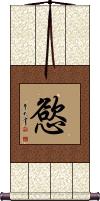
慾 means desire, longing, appetite, wish, covetousness, greed, passion, desire, avarice, and craving.
慾 is universal in Chinese, Japanese Kanji, and Korean Hanja.
The context in which this character is used determines whether the meaning is good or bad. As a single character on a wall scroll, you get to decide what the definition is to you (hopefully more toward desire than greed).
 Please note that Japanese use a simplified version of this character - it also happens to be the same simplification used in mainland China. Click on the character to the right if you want the Japanese/Simplified version of desire.
Kama - Desire Wish Longing
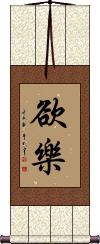
欲樂 is the Chinese and Japanese title representing the Buddhist and Jainist joys of the five desires.
Kama comes from the Pali/Sanskrit काम. The meaning is “desire, wish, longing.”
In Jainism, it can include sensual pleasure, sexual desire, and longing.
However, the Buddhist context refers more to any desire, wish, passion, longing, the pleasure of the senses, desire for, longing to and after, the aesthetic enjoyment of life, affection, or love, enjoyment of love is particularly with or without the enjoyment of sexual, sensual and erotic desire, and is often used without sexual connotations.
Longing for Lover
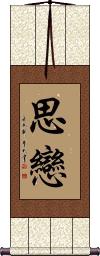
思戀 is a term used for when you miss a lover.
It suggests that you are separated (not by choice) and have longed for each other. It's a strong feeling of missing your lover.
Desire
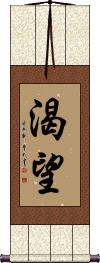
This Chinese word can mean desirous, wishful, or desire.
The first character means to thirst for [something] or to be thirsty. The second character means to hope for, to expect, to gaze (into the distance), or to look for something. The combined meaning of these two characters changes a bit, but I think it's nice to know the individual meanings to give you a better understanding of where a word comes from.
Korean definitions of this word include craving, longing, and thirst for knowledge.
Lust / Desire / Passion
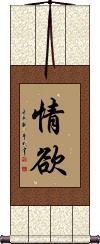
情欲 can be defined as lust, sexual desire, sensual desire, carnal desire, carnal passions, sexual desire, and passion.
The first character means feeling, emotions, passionate, sympathy, affection, love, compassion, tender feelings, and sometimes circumstances or facts.
The second character means desire, longing, appetite, wish, covetousness, greed, passion, desire, and craving.
This word is universal in Chinese, Japanese Kanji, and Korean Hanja.
Four Noble Truths: Desire and Attachment
Samudaya
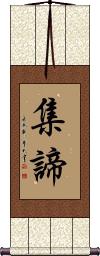
集諦 represents the idea that the core of suffering is often the concept of desire or attachment.
This can be carnal desire, monetary desire, or the attachment you have to something that you are unwilling to part with (such as a fancy car). 集諦 is a simplification of the second noble truth which is an exploration into the root causes of suffering - it's deeper than I can go in a few sentences.
This term is exclusively used by devout Buddhists. It is not a common term, and is remains an unknown concept to most Chinese, Japanese and Korean people.
See Also: Buddhism | Enlightenment
Desire
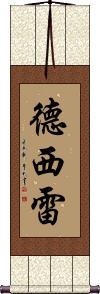
德西雷 is the transliteration to Mandarin Chinese for the Latin / Spanish name Desire.
Miss You Forever
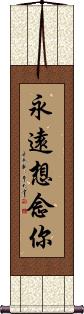
永遠想念你 is how to write “missing you forever” in Chinese.
The first two characters mean “forever” or “eternally.”
The third and fourth characters mean “missing” or “longing for.”
The last character means “you.”
This might suggest that you are missing someone whom you will never see again (depending on how you read it, or in what context it is used).
Desire / Craving
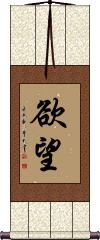
欲望 is a word that means strong desire, while some might translate it as “lust.”
The first character of this word means desire, longing, hunger, covetousness, greed, passion, desire, craving, or wish. The second character means to hope for, ambition, desire, aspire, expect, gaze (into the distance), or look for something.
Four Noble Truths: Elimination of Desire or Attachment
Nirodha
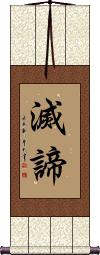
滅諦 suggests that once you eliminate desire or attachment to worldly things, only then can you achieve enlightenment.
Realize that things are impermanent. That fancy car, beautiful spouse, big house, and impressive career are things you can't take with you. These things are a flash in the pan compared to the infinite span of history, generations to come, time, and space.
This term is exclusively used by devout Buddhists. It is not a common term, and is remains an unknown concept to most Japanese, Korean, and Chinese people.
See Also: Buddhism | Enlightenment
Desire / Wish / Aspiration
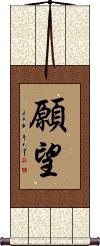
願望 means desire, wish, or aspiration in Chinese and Japanese.
I Miss You
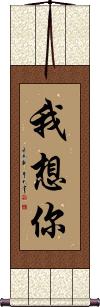
我想你 is the Chinese way to say “I miss you.”
It is said in the same word order in both English and Chinese.
Alone / A Lone Person
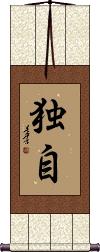
獨自 is a Japanese word that means “alone” in the context of a person by himself/herself.
This can be translated as individual, solo, on one's own, or by oneself.
See Also: I Miss You
Lonely
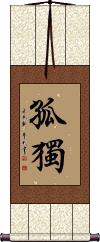
孤獨 means lonely, solitude, loneliness, and lonesome.
In some contexts, it can mean reclusive, isolated, single, or solo.
孤獨 is a Japanese word but not a good selection for a wall scroll.
In Chinese, this will relay a rather sad feeling to anyone who reads this calligraphy on your wall.
 The version shown to the left is the Traditional Chinese and ancient Japanese version. In modern Japan and China they often use a different more simplified version of the second character (as shown to the right). If you want this Japanese/Simplified version, please click on the character shown to the right instead of the button above.
One Day Seems Like 1000 Years
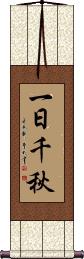
一日千秋 is a Japanese and Chinese proverb about missing someone.
一日千秋 is often used to express how hard it is to wait for someone's return or to be away from someone.
Some will translate this as “one day feels like a very long time” or “waiting for someone (something) is hard.”
You might see this romanized as a single word, Ichijitsusenshuu, or as “Ichijitsu Senshuu” from Japanese.
If you break down the characters one-by-one, we get:
一 = one/a
日 = day/sun (can also represent time or date)
千 = 1000/thousand
秋 = autumn/fall
Together, 千秋 can mean “autumn comes thousand times” (or 1000 years). It can also be read as 1000 periods of time.
However, it relays the idea of heartache as you wait for someone you miss.
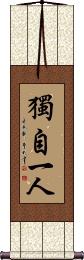
Alone / A Lone Person
Missing / Yearning
I miss you
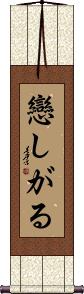
戀しがる is the most common Japanese verb for missing someone or yearning for someone (it could also be missing a place).
戀しがる is the shortest way to say, “I miss you” or “I yearn for you” in Japanese.
Breaking down the characters:
恋し (koishi) yearned for; longed for; missed (acts as an adjective in Japanese).
がる (garu) to feel, behavior (this represents emotion and turns the whole word into a verb in Japanese).
Note: Because this selection contains some special Japanese Hiragana characters, it should be written by a Japanese calligrapher.
Alone with only your shadow for company
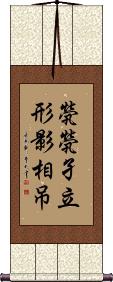
煢煢孑立形影相吊 is a Chinese proverb about the state of being as alone as you possibly can be.
It can be translated as “Alone with only your shadow for comfort/company.”
See Also: I Miss You
This in-stock artwork might be what you are looking for, and ships right away...
Gallery Price: $108.00
Your Price: $59.88

Gallery Price: $60.00
Your Price: $36.88
These search terms might be related to Longing:
Aspire / Burning Desire
Desire
Desire / Craving
Desire / Longing / Craving
Desire / Wish / Aspiration
Four Noble Truths: Desire and Attachment
Four Noble Truths: Elimination of Desire or Attachment
Give Up Desire
Kama - Desire Wish Longing
Lust / Desire / Passion
Missing / Yearning
Omoi / Desire
Worldwide Wish for Peace and Prosperity
The following table may be helpful for those studying Chinese or Japanese...
| Title | Characters | Romaji (Romanized Japanese) | Various forms of Romanized Chinese | |
| Desire Longing Craving | 慾 欲 | yoku | yù / yu4 / yu | yü |
| Kama - Desire Wish Longing | 欲樂 欲乐 | yokuraku | yù lè / yu4 le4 / yu le / yule | yü le / yüle |
| Longing for Lover | 思戀 思恋 | sī liàn / si1 lian4 / si lian / silian | ssu lien / ssulien | |
| Desire | 渴望 | kě wàng / ke3 wang4 / ke wang / kewang | k`o wang / kowang / ko wang | |
| Lust Desire Passion | 情欲 | jouyoku / joyoku | qíng yù / qing2 yu4 / qing yu / qingyu | ch`ing yü / chingyü / ching yü |
| Four Noble Truths: Desire and Attachment | 集諦 集谛 | jittai | jí dì / ji2 di4 / ji di / jidi | chi ti / chiti |
| Desire | 德西雷 | dé xī léi de2 xi1 lei2 de xi lei dexilei | te hsi lei tehsilei |
|
| Miss You Forever | 永遠想念你 永远想念你 | yǒng yuǎn xiǎng niàn nǐ yong3 yuan3 xiang3 nian4 ni3 yong yuan xiang nian ni yongyuanxiangnianni | yung yüan hsiang nien ni yungyüanhsiangnienni |
|
| Desire Craving | 欲望 | yokubou / yokubo | yù wàng / yu4 wang4 / yu wang / yuwang | yü wang / yüwang |
| Four Noble Truths: Elimination of Desire or Attachment | 滅諦 灭谛 | mettai | miè dì / mie4 di4 / mie di / miedi | mieh ti / miehti |
| Desire Wish Aspiration | 願望 愿望 | gan bou / ganbou / gan bo | yuàn wàng yuan4 wang4 yuan wang yuanwang | yüan wang yüanwang |
| I Miss You | 我想你 | wǒ xiǎng nǐ wo3 xiang3 ni3 wo xiang ni woxiangni | wo hsiang ni wohsiangni |
|
| Alone A Lone Person | 獨自 独自 | dokuji | ||
| Lonely | 孤獨 孤独 | ko doku / kodoku | gū dú / gu1 du2 / gu du / gudu | ku tu / kutu |
| One Day Seems Like 1000 Years | 一日千秋 | ichi jitsu sen shuu ichijitsusenshuu ichi jitsu sen shu | yí rì qiān qiū yi2 ri4 qian1 qiu1 yi ri qian qiu yiriqianqiu | i jih ch`ien ch`iu ijihchienchiu i jih chien chiu |
| Alone A Lone Person | 獨自一人 独自一人 | dú zì yì rén du2 zi4 yi4 ren2 du zi yi ren duziyiren | tu tzu i jen tutzuijen |
|
| Missing Yearning | 戀しがる 恋しがる | koishi garu koishigaru | ||
| Alone with only your shadow for company | 煢煢孑立形影相吊 茕茕孑立形影相吊 | qióng qióng jié lì xíng yǐng xiāng diào qiong2 qiong2 jie2 li4 xing2 ying3 xiang1 diao4 qiong qiong jie li xing ying xiang diao | ch`iung ch`iung chieh li hsing ying hsiang tiao chiung chiung chieh li hsing ying hsiang tiao |
|
| In some entries above you will see that characters have different versions above and below a line. In these cases, the characters above the line are Traditional Chinese, while the ones below are Simplified Chinese. | ||||

Successful Chinese Character and Japanese Kanji calligraphy searches within the last few hours...



