Many custom options...


And formats...



Not what you want?
Try other similar-meaning words, fewer words, or just one word.
Korean Women in old Korean Hanja...
Buy a Korean Women calligraphy wall scroll here!
Personalize your custom “Korean Women” project by clicking the button next to your favorite “Korean Women” title below...
See also: Selections of just old Korean Hanja Calligraphy
Sisterhood / Association of Women
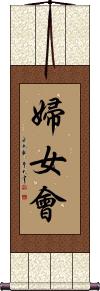
婦女會 is an expression that means “sisterhood” as in a women's association, club, or group.
The first two characters mean “women.”
The last character means to assemble, to meet, to gather, to see, union, group, or association.
Chastity
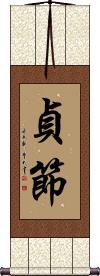
In Chinese, 貞節 would be defined as “The state of being sexually pure” or “chaste.”
Culturally, this especially applies to young women. 貞節 is not actually far off from our western view on this subject. In Japanese and Korean, this could also be used to express virtue, faithfulness, and fidelity.
See Also: Modesty
Sexy / Voluptuous
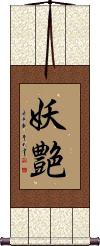
妖艶 means sexy, fascinating, voluptuous, or bewitching in Japanese Kanji. 妖艶 / 妖艷 is specifically in regards to women.
This has a dictionary meaning of flirtatious or bewitchingly pretty in Chinese. However, in practice, this would refer to a sexy but bitchy woman in modern China.
This is also a word in old Korean Hanja; however, I have not confirmed how it is perceived in Korean culture.
This may not be appropriate for a wall scroll unless your audience is Japanese only.
 Note: The second character can also be written in the alternate version shown to the right.
Flying Tigers AVG
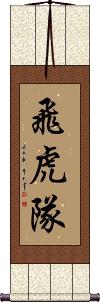
飛虎隊 is the full Chinese title of the “Flying Tigers Group.”
These were the American pilots that volunteered to go to China and fight the Japanese before the entry of the USA into World War Two. These fighter pilots were so esteemed in China that fallen American pilots could always find refuge in villages and safe passage and escape to areas of China that were not occupied by Japan at that time. Chinese villagers helped such fallen pilots with full knowledge that when the Japanese occupation forces found out, all the men, women, and children in the village would be massacred by Japanese troops (there are more than a few known cases of such massacres).
The Flying Tigers successfully kept supply lines to the Chinese resistance open and divided Japanese forces at a crucial time while America prepared to join WWII officially.
A wall scroll like this honors the men who risked or gave their lives as noble volunteers and is a reminder of the best moment in the history of Sino-American relations.
These three characters literally mean “flying tiger(s) group/team/squad.”
Note: Hanging these characters on your wall will not make you any friends with Japanese people who are aware or this history (most Japanese have no idea, as Japan’s involvement in WWII has all but been erased from school textbooks in Japan).
A Traditional Warm Welcome
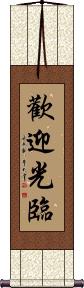
歡迎光臨 would be the ultimate Chinese “welcome mat.” Except it will be on your wall, and people will not step on it.
In a somewhat literal translation, you could say it means “I feel happy as I welcome you, as you have brought a shining light to this place with your arrival,” or more simply, “I am happy you've come as your presents brightens up the place.”
It has become common for this greeting to be announced by the staff upon the arrival of any customer into a fancy store in China. You will also see these characters on the “welcome mats” in front of 4 and 5-star hotels in China.
Having this on a wall scroll is an extra nice touch. I have seen a few horizontal scrolls with this phrase on the wall behind the reception desk of better hotels or near the front door of fine shops. At the fanciest department stores and restaurants in China, several greeters (almost always young women) will stand by the front door, all wearing sashes with this phrase embroidered. As you walk in, they will bow and say “huan ying guang lin” to welcome you to the establishment.
Note: The first two and last two characters do make words in Korean Hanja but are seldom used as a sentence like this in Korean.
This in-stock artwork might be what you are looking for, and ships right away...


Gallery Price: $60.00
Your Price: $36.88

Gallery Price: $115.00
Your Price: $63.88

Gallery Price: $200.00
Your Price: $98.88
Gallery Price: $200.00
Your Price: $111.88

Gallery Price: $40.00
Your Price: $16.88
Gallery Price: $168.00
Your Price: $92.88
Gallery Price: $106.00
Your Price: $58.88
Gallery Price: $79.00
Your Price: $43.88

Gallery Price: $40.00
Your Price: $16.88
Gallery Price: $150.00
Your Price: $82.88

Gallery Price: $103.00
Your Price: $56.88
Not the results for korean women that you were looking for?
Below are some entries from our dictionary that may match your korean women search...
| Characters If shown, 2nd row is Simp. Chinese |
Pronunciation Romanization |
Simple Dictionary Definition |
裳 see styles |
shang shang5 shang chima チマ |
used in 衣裳[yi1 shang5] (kana only) chima (kor:); long skirt traditionally worn by Korean women |
地藏 see styles |
dì zàng di4 zang4 ti tsang jizou / jizo じぞう |
Kṣitigarbha, the Bodhisattva of the Great Vow (to save all souls before accepting Bodhi); also translated Earth Treasury, Earth Womb, or Earth Store Bodhisattva (surname) Jizou Ti-tsang, J. Jizō, Kṣitigarbha, 乞叉底蘗沙; Earth-store, Earth-treasury, or Earthwomb. One of the group of eight Dhvani- Bodhisattvas. With hints of a feminine origin, he is now the guardian of the earth. Though associated with Yama as overlord, and with the dead and the hells, his role is that of saviour. Depicted with the alarum staff with its six rings, he is accredited with power over the hells and is devoted to the saving of all creatures between the nirvana of Śākyamuni and the advent of Maitreya the fifth century he has been especially considered as the deliverer from the hells. His central place in China is at Chiu-hua-shan, forty li south-west of Ch'ing-yang in Anhui. In Japan he is also the protector of travellers by land and his image accordingly appears on the roads; bereaved parents put stones by his images to seek his aid in relieving the labours of their dead in the task of piling stones on the banks of the Buddhist Styx; he also helps women in labour. He is described as holding a place between the gods and men on the one hand and the hells on the other for saving all in distress; some say he is an incarnation of Yama. At dawn he sits immobile on the earth 地 and meditates on the myriads of its beings 藏. When represented as a monk, it may be through the influence of a Korean monk who is considered to be his incarnation, and who came to China in 653 and died in 728 at the age of 99 after residing at Chiu-hua-shan for seventy-five years: his body, not decaying, is said to have been gilded over and became an object of worship. Many have confused 眞羅 part of Korea with 暹羅 Siam. There are other developments of Ti-tsang, such as the 六地藏 Six Ti-tsang, i. e. severally converting or transforming those in the hells, pretas, animals, asuras, men, and the devas; these six Ti-tsang have different images and symbols. Ti-tsang has also six messengers 六使者: Yama for transforming those in hell; the pearl-holder for pretas; the strong one or animals; the devīof mercy for asuras; the devī of the treasure for human beings; one who has charge of the heavens for the devas. There is also the 延命地藏 Yanming Ti-tsang, who controls length of days and who is approached, as also may be P'u-hsien, for that Purpose; his two assistants are the Supervisors of good and evil 掌善 and 掌惡. Under another form, as 勝軍地藏 Ti-tsang is chiefly associated with the esoteric cult. The benefits derived from his worship are many, some say ten, others say twenty-eight. His vows are contained in the 地藏菩薩本願經. There is also the 大乘大集地藏十電經 tr. by Xuanzang in 10 juan in the seventh century, which probably influenced the spread of the Ti-tsang cult. |
還鄉女 还乡女 see styles |
huán xiāng nǚ huan2 xiang1 nu:3 huan hsiang nü |
(Korean term) women who returned to Korea after being abducted during the Manchu invasions of Korea in the 17th century, only to be regarded as defiled and therefore ostracized, even by their own families |
チマチョゴリ see styles |
chimachogori チマチョゴリ |
chima jeogori (kor:); chi'ma chogori; costume traditionally worn by Korean women |
チマ・チョゴリ |
chima chogori チマ・チョゴリ |
chima jeogori (kor:); chi'ma chogori; costume traditionally worn by Korean women |
Variations: |
chimachogori; chima chogori チマチョゴリ; チマ・チョゴリ |
(See チマ,チョゴリ) chima jeogori (kor:); chi'ma chogori; costume traditionally worn by Korean women |
The following table may be helpful for those studying Chinese or Japanese...
| Title | Characters | Romaji (Romanized Japanese) | Various forms of Romanized Chinese | |
| Sisterhood Association of Women | 婦女會 妇女会 | fu jo kai / fujokai | fù nǚ huì fu4 nv3 hui4 fu nv hui funvhui | fu nü hui funühui |
| Chastity | 貞節 贞节 | teisetsu | zhēn jié / zhen1 jie2 / zhen jie / zhenjie | chen chieh / chenchieh |
| Sexy Voluptuous | 妖艶 / 妖艷 妖艳 | you en / youen / yo en | yāo yàn / yao1 yan4 / yao yan / yaoyan | yao yen / yaoyen |
| Flying Tigers AVG | 飛虎隊 飞虎队 | fēi hǔ duì fei1 hu3 dui4 fei hu dui feihudui | fei hu tui feihutui |
|
| A Traditional Warm Welcome | 歡迎光臨 欢迎光临 | huān yíng guāng lín huan1 ying2 guang1 lin2 huan ying guang lin huanyingguanglin | huan ying kuang lin huanyingkuanglin |
|
| In some entries above you will see that characters have different versions above and below a line. In these cases, the characters above the line are Traditional Chinese, while the ones below are Simplified Chinese. | ||||

Successful Chinese Character and Japanese Kanji calligraphy searches within the last few hours...



