Many custom options...


And formats...



Not what you want?
Try other similar-meaning words, fewer words, or just one word.
Korean Fish in old Korean Hanja...
Buy a Korean Fish calligraphy wall scroll here!
Personalize your custom “Korean Fish” project by clicking the button next to your favorite “Korean Fish” title below...
See also: Selections of just old Korean Hanja Calligraphy
1. Fish
2. Koi Fish
3. Kun
4. Yellow
5. Year-In Year-Out Have Abundance
6. Mermaid
8. Shark
9. Tuna
10. A Bright Future
Fish
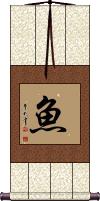
魚 is the character that means fish in Chinese, Japanese Kanji, and old Korean Hanja.
Koi Fish
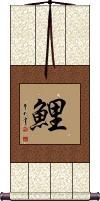
鯉 is the Japanese Kanji that created the title “koi fish.” 鯉 is pronounced “koi” in Japanese.
Here is the reality: 鯉 actually means “carp” in Chinese, Japanese Kanji, and old Korean Hanja. Koi fish really are carp (by species) and were bred to obtain colorful variations in ancient China. Some generations later, some of these colorful fish were transported to Japan, where they also became vastly popular.
Note: Please see our other entry for koi fish (Nishiki Goi) which is a more normal selection for a Japanese koi fish enthusiast to have on their wall.
Kun
Sea Creature
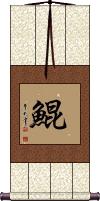
A 鲲 (Kun) is a famous sea monster, often associated or used interchangeably with a 鵬 (Peng).
鯤 is comparable to Leviathan or Jonah's whale.
In Chinese mythology, the Kun is a giant fish said to be able to turn into a bird.
鯤 and the mythological creature is also known in Japanese and Korean. However, in some contexts, this character can refer to fry (fish babies).
Yellow
Yellow Color
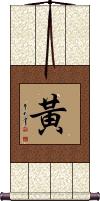
黃 is the single character for the color yellow in Chinese.
This can be a Chinese surname Huang or a Korean surname Hwang.
In China, yellow is traditionally the color of the emperor. In fact, there was a time when only the emperor could wear yellow clothing or own yellow pet fish.
Note: Goldfish were bred originally in China for the emperor. When the perfect yellow fish was bred, all but the emperor were banned from owning any. Thus a more orange-colored goldfish dominated the market.
Notes: 黃 is not a common selection for a wall scroll. In certain contexts in China, yellow can refer to pornography or vice.
 This character is written with a slight variation in Simplified Chinese and modern Japanese. Click on the image to the right if you want this alternate version.
Year-In Year-Out Have Abundance
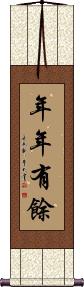
年年有餘 is a common proverb or wish of prosperity you'll hear around the time of Chinese New Year.
Directly translated character by character, it means “Year Year Have Surplus.” A more natural English translation including the deeper meaning would be “Every Year may you Have Abundance in your life.”
On a side note, this phrase often goes with a gift of something related to fish. This is because the last character, “yu” which means surplus or abundance, has exactly the same pronunciation in Mandarin as the word for “fish.”
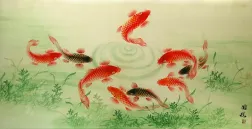
This is also one of the most common titles for traditional paintings that feature koi fish.
In China, this phrase might make an odd wall scroll - a customer asked especially for this common phrase which is why it appears here. See my other abundance-related words if you want a wall scroll that will seem more comfortable in Chinese culture.
Note: This can be pronounced in Korean, but it's not a commonly used term.
See Also: Prosperity | Good Fortune
Mermaid
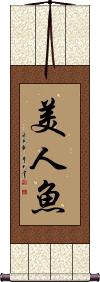
Mermaid / Merman
(Unisex)
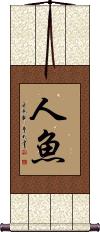
人魚 is the Japanese Kanji, Korean Hanja, and Chinese word for “merman” or “mermaid.”
It literally means “human fish.”
人魚 is a non-gender-specific or unisex word in all three languages.
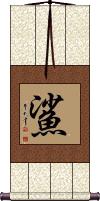
This single Chinese character means shark.
However, in Japanese, it can refer to the family of goby fish.
鯊 is good if you're looking for the word shark in Chinese and Japanese folks might misunderstand it.
Tuna
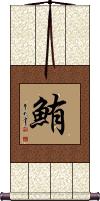
鮪 is the Chinese and Japanese character for tuna.
In Chinese, this is usually used to mean the “little tunny” (Euthynnus alletteratus), the most common tuna in the Atlantic Ocean. However, it can refer to any fish of the Thunnus genus.
In Japanese, it can refer to the Pacific bluefin tuna (Thunnus orientalis).
A Bright Future
Incredible 10,000-Mile Flight of the Peng
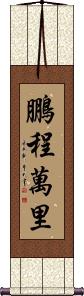
鵬程萬里 is an ancient Chinese proverb used in modern times to wish someone a long and successful career.
It's really about the 10,000 Flight of the Peng (Peng, also known as Roc is a mythical fish that can turn into a bird and take flight).
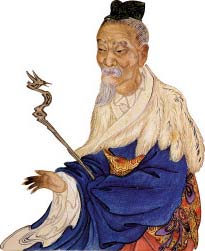
莊子
Zhuangzi or Chuang Tzu
Breaking down each character:
1. Peng or Roc (a kind of bird).
2. Journey (in this case, a flight).
3. 10,000 (Ten Thousand).
4. Li is a unit of distance often referred to as a “Chinese Mile,” though the real distance is about half a kilometer.
Direct Translation: “Peng's Journey [of] 10,000 Li.”
Literal meaning: “The 10,000-Li Flying Range Of The Roc.”
Perceived meaning: “To have a bright future” or “To go far.”
This proverb/idiom comes from the book of Zhuangzi or Chuang Tzu. It tells the tale of a huge fish that could turn into a gigantic bird. This bird was called a “peng” and was many miles long. This legendary size allowed the Peng to fly from the Northern Sea to the Southern Sea in a single bound.
Wishing someone “a Peng's Journey of 10,000 Li” will imply that they can travel far without stopping and will have great success, a long career, and a prosperous future.
This in-stock artwork might be what you are looking for, and ships right away...

Gallery Price: $200.00
Your Price: $98.88
Gallery Price: $200.00
Your Price: $111.88

Gallery Price: $40.00
Your Price: $16.88
Gallery Price: $168.00
Your Price: $92.88
Gallery Price: $106.00
Your Price: $58.88
Gallery Price: $79.00
Your Price: $43.88

Gallery Price: $40.00
Your Price: $16.88
Gallery Price: $150.00
Your Price: $82.88

Gallery Price: $103.00
Your Price: $56.88
Gallery Price: $108.00
Your Price: $59.88

The following table may be helpful for those studying Chinese or Japanese...
| Title | Characters | Romaji (Romanized Japanese) | Various forms of Romanized Chinese | |
| Fish | 魚 鱼 | sakana / gyo / uo | yú / yu2 / yu | yü |
| Koi Fish | 鯉 鲤 | koi | lǐ / li3 / li | |
| Kun | 鯤 鲲 | kon | kūn / kun1 / kun | k`un / kun |
| Yellow | 黃 黄 | hon / kou / hon / ko | huáng / huang2 / huang | |
| Year-In Year-Out Have Abundance | 年年有餘 年年有馀 | nián nián yǒu yú nian2 nian2 you3 yu2 nian nian you yu niannianyouyu | nien nien yu yü niennienyuyü |
|
| Mermaid | 美人魚 美人鱼 | měi rén yú mei3 ren2 yu2 mei ren yu meirenyu | mei jen yü meijenyü |
|
| Mermaid Merman | 人魚 人鱼 | nin gyo / ningyo | rén yú / ren2 yu2 / ren yu / renyu | jen yü / jenyü |
| Shark | 鯊 鲨 | haze | shā / sha1 / sha | |
| Tuna | 鮪 鲔 | maguro | wěi / wei3 / wei | |
| A Bright Future | 鵬程萬里 鹏程万里 | péng chéng wàn lǐ peng2 cheng2 wan4 li3 peng cheng wan li pengchengwanli | p`eng ch`eng wan li pengchengwanli peng cheng wan li |
|
| In some entries above you will see that characters have different versions above and below a line. In these cases, the characters above the line are Traditional Chinese, while the ones below are Simplified Chinese. | ||||

Successful Chinese Character and Japanese Kanji calligraphy searches within the last few hours...



