Many custom options...


And formats...



Kill in Chinese / Japanese...
Buy a Kill calligraphy wall scroll here!
Personalize your custom “Kill” project by clicking the button next to your favorite “Kill” title below...
1. Kill / Slaughter / Murder / Butcher
2. Kill / Massacre / Mass Killing
3. Assassin
Kill / Slaughter / Murder / Butcher
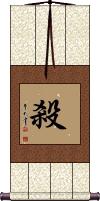
殺 is how to write “to kill” or “killing.”
殺 is an absolutely shocking word to have on a wall scroll. It will bewilder, scare, and perhaps offend any Chinese, Korean, or Japanese person who sees it. I do not in any way recommend this for a piece of calligraphy artwork. This entry is only here because our calligraphy search engine received so many requests for “kill.”
Note: In Korean Hanja, this character is not often used alone - see the other two-character entry for “kill.”
Kill / Massacre / Mass Killing
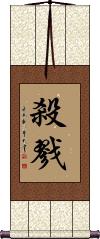
殺戮 is how to write “kill” or “massacre.”
殺戮 is an absolutely shocking word to have on a wall scroll. It will bewilder, scare, and perhaps offend any Chinese, Korean or Japanese person who sees it. I do not in any way recommend this for a piece of calligraphy artwork. This entry is only here because our calligraphy search engine received many requests for “kill” and “massacre.”
You are all a bunch of sick puppies!
Assassin
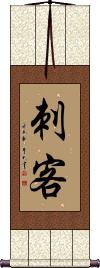
刺客 is the most sophisticated way to write “assassin” in Chinese, Korean and Japanese.
The unsophisticated way just means murderer.
Meet the Buddha, Kill the Buddha
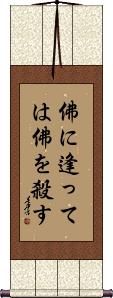
This controversial Buddhist koan means “On encountering Buddha, you should kill him.”
This is the short concise Japanese version of an original statement by ninth-century Chinese Buddhist monk Linji Yixuan, “If You Meet The Buddha On The Road, Kill Him.”
This takes some explaining... The concept here is that if you think you have seen, experienced, or achieved true enlightenment, the chances that you really have are so slim that you should kill or dismiss that idea.
Another suggestion is that one's path to becoming a Buddha is one's own, and one should not get caught up in religious fervor, and avoid “showing off” that they are a Buddhist.
Helpful references for this concept:
Lion's Roar addresses "If You Meet The Buddha On The Road, Kill Him"
Kill the Buddha
Note: Because this selection contains some special Japanese Hiragana characters, it should be written by a Japanese calligrapher.
Death Before Dishonor
You can die or kill, but never dishonor or disgrace yourself
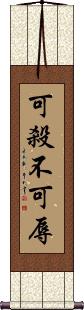
可殺不可辱 almost directly matches the idea of “Death Before Dishonor” while also being an ancient Chinese proverb.
The direct meaning is, “[you] can die/kill [but you] cannot [allow] dishonor/disgrace [upon yourself].” Chinese grammar, and especially ancient grammar, is a little different than English. Not nearly as many articles are needed, and a lot is implied.
There are many ways to express ideas similar to “Death Before Dishonor” in Chinese, and I would rate this one in the top two.
Death Before Dishonor
A soldier can die or kill, but never dishonor or disgrace himself
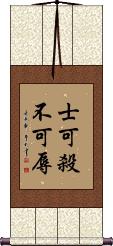
士可殺不可辱 almost directly matches the military idea of “Death Before Dishonor,” while also being an ancient Chinese proverb.
The direct meaning is, “[A] soldier/warrior can die/kill [but he/she] cannot [allow] dishonor/disgrace [upon himself/herself].” Chinese grammar, and especially ancient grammar, is a little different than English. Not nearly as many articles are needed, and a lot is implied.
There are a lot of ways to express ideas similar to “Death Before Dishonor” in Chinese, and I would rate this one in the top two.
This is the original form of this proverb with the character for “soldier/warrior” at the beginning. Most of the time, this character is dropped, becoming a five-character proverb (the soldier/warrior part is implied, even without the character being present in the proverb). We also offer a shorter version.
Drain the pond to get all the fish
Kill the goose that lays the golden eggs
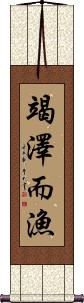
In 632 BC, Duke Wen of the Kingdom of Jin was about to lead an army against the forces of the Kingdom of Chu.
The Duke asked one of his advisers, Jiu Fan, how they could win the impending battle, as they were drastically outnumbered.
Jiu Fan said, “All is fair in war,” and suggested a plan of dishonorable tactics (cheating).
The Duke was unsure of this advice, so he asked another adviser, Yong Ji, who replied, “If you catch fish by draining the pond, you can certainly get all the fish. But there will be no fish the following year. You can cheat this one time in battle, but such tactics can only be used once, as the enemy will be wise in future encounters.”
The Duke heard the words of his wiser adviser but cheated to gain victory in the battle. However, he rewarded Yong Ji more than Jiu Fan at the victory celebration, stating that while Jiu Fan's advice gained one victory, the wise words of Yong Ji would last forever.
This Chinese idiom/proverb is still used, over 2600 years later to remind people not to burn bridges, cheat, or dishonor themselves in exchange for a short-term gain while sacrificing the future.
竭澤而漁 is very similar to the meaning of the English phrase, “Kill the goose that lays the golden eggs.”
These search terms might be related to Kill:
Kill / Slaughter / Murder / Butcher
Slay
Not the results for kill that you were looking for?
Below are some entries from our dictionary that may match your kill search...
| Characters If shown, 2nd row is Simp. Chinese |
Pronunciation Romanization |
Simple Dictionary Definition |
劉 刘 see styles |
liú liu2 liu riyou / riyo りよう |
More info & calligraphy: Lui(surname) Riyou |
殺 杀 see styles |
shā sha1 sha satsu さつ |
More info & calligraphy: Kill / Slaughter / Murder / Butcher(female given name) Satsu To kill, cut down, cut off. |
ぎる see styles |
giru ギル |
(1) kill; (2) {sports} kill (shot); smash; spike (in volleyball); (surname, given name) Gill |
十戒 see styles |
shí jiè shi2 jie4 shih chieh jukkai じゅっかい |
More info & calligraphy: Ten Commandments(1) (Buddhist term) the 10 precepts; (2) Ten Commandments; Decalogue; Decalog; (surname) Jukkai Śikṣāpada. The ten prohibitions (in Pāli form) consist of five commandments for the layman: (1) not to destroy life 不殺生 pāṇātipātāveramaṇi; (2) not to steal 不倫盜 adinnādānāver; (3) not to commit adultery 不婬慾 abrahmacaryaver.; (4) not to lie 不妄語musāvādāver.; (5) not to take intoxicating liquor 不飮酒 suramereyya-majjapamādaṭṭhānāver. Eight special commandments for laymen consist of the preceding five plus: (6) not to eat food out of regulated hours 不非時食 vikāla-bhojanāver.; (7) not to use garlands or perfumes 不著華鬘好香塗身 mālā- gandha-vilepana-dhāraṇa-maṇḍana-vibhūṣanaṭṭhānā; (8) not to sleep on high or broad beds (chastity) 不坐高廣大牀 uccāsayanā-mahāsayanā. The ten commandments for the monk are the preceding eight plus: (9) not to take part in singing, dancing, musical or theatrical performances, not to see or listen to such 不歌舞倡伎不往觀聽 nacca-gīta-vādita-visūkadassanāver.; (10) to refrain from acquiring uncoined or coined gold, or silver, or jewels 不得捉錢金銀寶物 jātarūpa-rajata-paṭīggahaṇāver. Under the Māhayāna these ten commands for the monk were changed, to accord with the new environment of the monk, to the following: not to kill, not to steal, to avoid all unchastity, not to lie, not to slander, not to insult, not to chatter, not to covet, not to give way to anger, to harbour no scepticism. |
殺人剣 see styles |
satsujinken さつじんけん |
More info & calligraphy: Sword of Death |
竭澤而漁 竭泽而渔 see styles |
jié zé ér yú jie2 ze2 er2 yu2 chieh tse erh yü |
More info & calligraphy: Drain the pond to get all the fish |
刃 see styles |
rèn ren4 jen jinji じんじ |
edge of blade (1) blade; sword; (2) (See 刃文・はもん) forged blade; wavy pattern on forged blades; (3) sharpness; (4) (rare) (See 籾) unhulled rice; (personal name) Jinji A blade, a sword; to kill. |
剝 剥 see styles |
bō bo1 po haku |
to peel; to skin; to flay; to shuck To peel, flay; kill. |
宰 see styles |
zǎi zai3 tsai tsukasa つかさ |
to slaughter; to butcher; to kill (animals etc); (coll.) to fleece; to rip off; to overcharge; (bound form) to govern; to rule; (bound form) (a title for certain government officials in ancient China) (female given name) Tsukasa rule |
幹 干 see styles |
gàn gan4 kan motoki もとき |
tree trunk; main part of something; to manage; to work; to do; capable; cadre; to kill (slang); to fuck (vulgar); (coll.) pissed off; annoyed (1) tree trunk; bole; (2) backbone; base; foundation; (given name) Motoki |
戒 see styles |
jiè jie4 chieh kai; ingoto(ok) かい; いんごと(ok) |
to guard against; to exhort; to admonish or warn; to give up or stop doing something; Buddhist monastic discipline; ring (for a finger) (1) (かい only) {Buddh} admonition; commandment; (2) sila (precept) śīla, 尸羅. Precept, command, prohibition, discipline, rule; morality. It is applied to the five, eight, ten, 250, and other commandments. The five are: (1) not to kill; (2 ) not to steal; (3) not to commit adultery; (4) not to speak falsely; (5) not to drink wine. These are the commands for lay disciples; those who observe them will be reborn in the human realm. The Sarvāstivādins did not sanction the observance of a limited selection from them as did the 成實宗 Satyasiddhi school. Each of the five precepts has five guardian spirits, in all twenty-five, 五戒二十五神. The eight for lay disciples are the above five together with Nos. 7, 8, and 9 of the following; the ten commands for the ordained, monks and nuns, are the above five with the following: (6) not to use adornments of flowers, nor perfumes; (7) not to perform as an actor, juggler, acrobat, or go to watch and hear them; (8) not to sit on elevated, broad, and large divans (or beds); (9) not to eat except in regulation hours; (10) not to possess money, gold or silver, or precious things. The 具足戒full commands for a monk number 250, those for a nun are 348, commonly called 500. Śīla is also the first of the 五分法身, i.e. a condition above all moral error. The Sutra of Brahma's Net has the following after the first five: (6) not to speak of the sins of those in orders; (7) not to vaunt self and depreciate others; (8) not to be avaricious; (9) not to be angry; (10) not to slander the triratna. |
戕 see styles |
qiāng qiang1 ch`iang chiang |
to kill; to injure; Taiwan pr. [qiang2] |
戡 see styles |
kān kan1 k`an kan |
kill; suppress |
戮 see styles |
lù lu4 lu |
(bound form) to kill; variant of 勠[lu4] |
掛 挂 see styles |
guà gua4 kua kake かけ |
to hang; to suspend (from a hook etc); to hang up (the phone); (of a line) to be dead; to be worried; to be concerned; (dialect) to make a phone call; to register (at a hospital); to make an appointment (with a doctor); (slang) to kill; to die; to be finished; to fail (an exam); classifier for sets or clusters of objects (suf,adj-no) (1) -clad; (2) (kana only) in the midst of; (3) tenths (e.g. wholesale price, as tenths of retail price); (4) times (i.e. multiplied by); (5) able-to-seat (of a chair, etc.); (suffix) charge; duty; person in charge; official; clerk; (1) (abbreviation) credit; (2) money owed on an account; bill; (3) (abbreviation) (kana only) hot noodles in broth; (n,n-suf) (4) proportion (of wholesale price, as tenths of list price); (suffix) (5) in the midst of; (6) rest; rack; hanger; (surname) Kake To hang, suspend. |
杸 see styles |
shū shu1 shu |
to kill; a spear |
殊 see styles |
shū shu1 shu shu こと |
(literary) to kill; to behead; to sever; to separate; to surpass; (bound form) different; (bound form) special; remarkable; (literary) very; extremely (n,adj-na,n-pref) (1) (archaism) difference (from one another); different thing; other; (adjectival noun) (2) unusual; extraordinary; (adjectival noun) unusual; extraordinary To kill, exterminate; different; very. |
煞 see styles |
shà sha4 sha setsu |
fiend; demon; very; (Tw) SARS (loanword) to kill |
仆す see styles |
taosu たおす |
(transitive verb) to kill; to defeat; to beat |
仇殺 仇杀 see styles |
chóu shā chou2 sha1 ch`ou sha chou sha |
to kill in revenge |
倒す see styles |
taosu たおす kokasu こかす |
(transitive verb) (1) to throw down; to bring down; to blow down; to fell; to knock down; to set (something) down on its side; to turn (something) on its side; (2) to kill; to defeat; to beat; (3) to overthrow; to trip up; to ruin; (4) to leave unpaid; to cheat; (v4s,vt) (archaism) to knock down; to knock over |
做掉 see styles |
zuò diào zuo4 diao4 tso tiao |
to kill; to get rid of; (sports) to defeat; to eliminate |
八戒 see styles |
bā jiè ba1 jie4 pa chieh hakkai; hachikai はっかい; はちかい |
the eight precepts (Buddhism) {Buddh} (See 五戒) the eight precepts (the five precepts with the addition of prohibitions against lying in a luxurious bed, self-decoration, song and dance, and eating after noon) (八戒齋) The first eight of the ten commandments, see 戒; not to kill; not to take things not given; no ignoble (i.e. sexual) conduct; not to speak falsely; not to drink wine; not to indulge in cosmetics, personal adornments, dancing, or music; not to sleep on fine beds, but on a mat on the ground; and not to eat out of regulation hours, i.e. after noon. Another group divides the sixth into two―against cosmetics and adornments and against dancing and music; the first eight are then called the eight prohibitory commands and the last the 齋 or fasting commandment. Also 八齋戒; 八關齋 (八支齋) ; cf. 八種勝法. |
劫殺 劫杀 see styles |
jié shā jie2 sha1 chieh sha |
to rob and kill |
十道 see styles |
shí dào shi2 dao4 shih tao jū no michi |
The ten (good) ways for deliverance from mortality- not to kill, steal, act wrongly, lie, be double-tongued, be of evil speech, slander, covet, be angry, look wrongly (or wrong views). |
哈喇 see styles |
hā la ha1 la5 ha la |
rancid; to kill; to slaughter |
宰了 see styles |
zǎi le zai3 le5 tsai le |
(coll.) (typically used hyperbolically) to kill (sb) |
害す see styles |
gaisu がいす |
(v5s,vs-c,vt) (1) (See 害する) to injure; to damage; to harm; to hurt; (v5s,vs-c,vt) (2) to kill; (v5s,vs-c,vt) (3) to hinder; to obstruct |
害命 see styles |
hài mìng hai4 ming4 hai ming |
to kill sb; to murder |
害意 see styles |
hài yì hai4 yi4 hai i gaii / gai がいい |
malice; malicious intent; intent to kill malevolent intentions |
Click here for more kill results from our dictionary
The following table may be helpful for those studying Chinese or Japanese...
| Title | Characters | Romaji (Romanized Japanese) | Various forms of Romanized Chinese | |
| Kill Slaughter Murder Butcher | 殺 杀 | satsu | shā / sha1 / sha | |
| Kill Massacre Mass Killing | 殺戮 杀戮 | satsuriku | shā lù / sha1 lu4 / sha lu / shalu | |
| Assassin | 刺客 | shikaku / shikyaku | cì kè / ci4 ke4 / ci ke / cike | tz`u k`o / tzuko / tzu ko |
| Meet the Buddha, Kill the Buddha | 佛に逢っては佛を殺す | butsu ni atte wa butsu o korosu | ||
| Death Before Dishonor | 可殺不可辱 可杀不可辱 | kě shā bù kě rǔ ke3 sha1 bu4 ke3 ru3 ke sha bu ke ru keshabukeru | k`o sha pu k`o ju koshapukoju ko sha pu ko ju |
|
| Death Before Dishonor | 士可殺不可辱 士可杀不可辱 | shì kě shā bù kě rǔ shi4 ke3 sha1 bu4 ke3 ru3 shi ke sha bu ke ru shikeshabukeru | shih k`o sha pu k`o ju shihkoshapukoju shih ko sha pu ko ju |
|
| Drain the pond to get all the fish | 竭澤而漁 竭泽而渔 | jié zé ér yú jie2 ze2 er2 yu2 jie ze er yu jiezeeryu | chieh tse erh yü chiehtseerhyü |
|
| In some entries above you will see that characters have different versions above and below a line. In these cases, the characters above the line are Traditional Chinese, while the ones below are Simplified Chinese. | ||||

Successful Chinese Character and Japanese Kanji calligraphy searches within the last few hours...



