Many custom options...


And formats...



Not what you want?
Try other similar-meaning words, fewer words, or just one word.
I Want to Believe in Chinese / Japanese...
Buy an I Want to Believe calligraphy wall scroll here!
Personalize your custom “I Want to Believe” project by clicking the button next to your favorite “I Want to Believe” title below...
Commitment
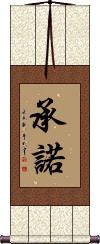
承諾 embodies the idea of commitment but also means to make a big effort or to undertake a great task.
Commitment is caring deeply about something or someone. It is deciding carefully what you want to do and then giving it 100%, holding nothing back. You give your all to a friendship, a task, or something you believe in. You finish what you start. You keep your promises.
In Chinese, this word directly means to undertake something or to make a promise to do something.
Outside of the commitment idea, this particular word can also mean approval, acceptance, consent, assent, acquiescence, or agreement, depending on context (especially in Japanese and Korean). Therefore, this word is probably best if your audience is Chinese.
See Also: Partnership | Hard Work | Dedication
Fate / Opportunity / Chance
The Buddhist idea of Fate
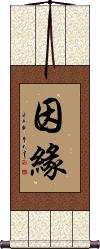
因緣 is the Buddhist concept of a chance meeting or an opportunity that presents itself by fate.
Sometimes this is used to describe a cosmic chain of events or cause and effect.
It also is used to describe predestined relationships between people - and sometimes married couples (although if you want one about marriage, try this: Fate / Destiny of Lovers.
因緣 can also be translated as origin, karma, destiny, affinity, connection, and relation. This all depends on context - seen alone on a wall scroll, this will be read with a “fate/chance” meaning by a Chinese person or a Korean person who can read Hanja.
The more complex definition of this word would be, “Direct causes and indirect conditions, which underlie the actions of all things.”
This concept is known as nidana in the original Sanskrit. Also sometimes presented as hetupratyaya (or “hetu and prataya”), which I believe is Pali.
Note: Japanese will tend to use this version of the second Kanji: 
If you order this from the Japanese master calligrapher, expect that you’ll get this version. However, this word often carries a negative connotation in Japanese (bad things happen), as it is used that way in a certain Japanese idiom. Therefore, this may not be the best choice if Japanese is your target language.
See Also: Buddhism | Opportunity
Turtle
...also means tortoise
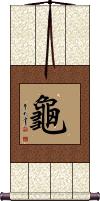
龜 is the generic term for turtle in Chinese and old Korean Hanja. It's like saying “turtle” (or “tortoise”) without being specific about the species of turtle.
Please note that there are many special characters in Chinese and a few in Japanese that denote specific species of turtle and do not include this character. We can't possibly cover all of these species, but if you want a certain one, such as “loggerhead” or a “leatherback,” just contact me, and I'll do my best to research your special species.
If you noticed, I said species names that do not include this character. This is because, in much the same way we can do it in English by just saying, “loggerhead” instead of “loggerhead turtle,” the same can be done in Chinese and Japanese.
 This may be hard to believe, but the image shown to the right is an alternate version of this character, which is currently used in Japan. This was originally an alternate form in ancient China for turtle - but it's so obscure now that most Chinese people would just think this is the Japanese version of turtle (I did a lot of research on this). The version shown in the upper left is traditional Chinese (also used in Korea 100+ years ago). It will generally not be recognized by the new generation of Japanese people. If your audience is Japanese, please click on the Kanji image shown to the right to have the calligrapher write that version (instead of clicking the button above).
Note: In Japanese, this Kanji is also a representation of long life. This is related to the fact that a tortoise can live for hundreds of years.
This in-stock artwork might be what you are looking for, and ships right away...
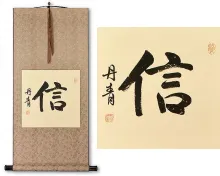
Gallery Price: $65.00
Your Price: $39.88
Not the results for i want to believe that you were looking for?
Below are some entries from our dictionary that may match your i want to believe search...
| Characters If shown, 2nd row is Simp. Chinese |
Pronunciation Romanization |
Simple Dictionary Definition |
想 see styles |
xiǎng xiang3 hsiang nozomu のぞむ |
to think (about); to think of; to devise; to think (that); to believe (that); to desire; to want (to); to miss (feel wistful about the absence of) (1) conception; idea; thought; (2) {Buddh} (See 五蘊) samjna (perception); (given name) Nozomu To think, meditate, reflect, expect; a function of mind. |
念う see styles |
omou / omo おもう |
(transitive verb) (1) to think; to consider; to believe; (2) to think (of doing); to plan (to do); (3) to judge; to assess; to regard; (4) to imagine; to suppose; to dream; (5) to expect; to look forward to; (6) to feel; to desire; to want; (7) to recall; to remember |
思う see styles |
omou / omo おもう |
(transitive verb) (1) to think; to consider; to believe; (2) to think (of doing); to plan (to do); (3) to judge; to assess; to regard; (4) to imagine; to suppose; to dream; (5) to expect; to look forward to; (6) to feel; to desire; to want; (7) to recall; to remember |
惟う see styles |
omou / omo おもう |
(transitive verb) (1) to think; to consider; to believe; (2) to think (of doing); to plan (to do); (3) to judge; to assess; to regard; (4) to imagine; to suppose; to dream; (5) to expect; to look forward to; (6) to feel; to desire; to want; (7) to recall; to remember |
想う see styles |
omou / omo おもう |
(transitive verb) (1) to think; to consider; to believe; (2) to think (of doing); to plan (to do); (3) to judge; to assess; to regard; (4) to imagine; to suppose; to dream; (5) to expect; to look forward to; (6) to feel; to desire; to want; (7) to recall; to remember |
憶う see styles |
omou / omo おもう |
(transitive verb) (1) to think; to consider; to believe; (2) to think (of doing); to plan (to do); (3) to judge; to assess; to regard; (4) to imagine; to suppose; to dream; (5) to expect; to look forward to; (6) to feel; to desire; to want; (7) to recall; to remember |
懐う see styles |
omou / omo おもう |
(transitive verb) (1) to think; to consider; to believe; (2) to think (of doing); to plan (to do); (3) to judge; to assess; to regard; (4) to imagine; to suppose; to dream; (5) to expect; to look forward to; (6) to feel; to desire; to want; (7) to recall; to remember |
Variations: |
omou / omo おもう |
(transitive verb) (1) (想う has connotations of heart-felt) to think; to consider; to believe; to reckon; (transitive verb) (2) to think (of doing); to plan (to do); (transitive verb) (3) to judge; to assess; to regard; (transitive verb) (4) to imagine; to suppose; to dream; (transitive verb) (5) to expect; to look forward to; (transitive verb) (6) to feel; to be (in a state of mind); to desire; to want; (transitive verb) (7) to recall; to remember |
Variations: |
omou / omo おもう |
(transitive verb) (1) (想う has connotations of heart-felt) to think; to consider; to believe; to reckon; (transitive verb) (2) to think (of doing); to plan (to do); (transitive verb) (3) to judge; to assess; to regard; (transitive verb) (4) to imagine; to suppose; to dream; (transitive verb) (5) to expect; to look forward to; (transitive verb) (6) to feel; to be (in a state of mind); to desire; to want; (transitive verb) (7) to care (deeply) for; to yearn for; to worry about; to love; (transitive verb) (8) to recall; to remember |
The following table may be helpful for those studying Chinese or Japanese...
| Title | Characters | Romaji (Romanized Japanese) | Various forms of Romanized Chinese | |
| Commitment | 承諾 承诺 | shoudaku / shodaku | chéng nuò cheng2 nuo4 cheng nuo chengnuo | ch`eng no chengno cheng no |
| Fate Opportunity Chance | 因緣 因缘 / 因縁 | in nen / innen | yīn yuán / yin1 yuan2 / yin yuan / yinyuan | yin yüan / yinyüan |
| Turtle | 龜 龟 / 亀 | kame | guī / gui1 / gui | kuei |
| In some entries above you will see that characters have different versions above and below a line. In these cases, the characters above the line are Traditional Chinese, while the ones below are Simplified Chinese. | ||||

Successful Chinese Character and Japanese Kanji calligraphy searches within the last few hours...



