Many custom options...


And formats...



Not what you want?
Try other similar-meaning words, fewer words, or just one word.
I Care for You in Chinese / Japanese...
Buy an I Care for You calligraphy wall scroll here!
Personalize your custom “I Care for You” project by clicking the button next to your favorite “I Care for You” title below...
God Bless You
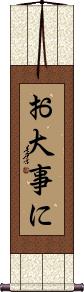
お大事に means “God bless you” in Japanese.
It can also mean “take care of yourself,” or “get well soon.” It's not always associated with religious meaning.
Note: Because this selection contains some special Japanese Hiragana characters, it should be written by a Japanese calligrapher.
Caring
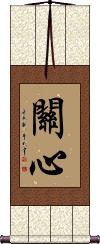
關心 means caring in Chinese.
Caring is giving love and attention to people and things that matter to you and anyone who needs help. When you care about people, you help them. You do a careful job, giving your very best effort. You treat people and things gently and respectfully. Caring makes the world a safer place.
Note: 關心 is also a word in Korean Hanja, but in Korean, it means taking interest or concern. In Korean, it's still a good word, but it doesn't quite have the “caring for a person” meaning that it does in Chinese.
See Also: Benevolence | Altruism
Diligence
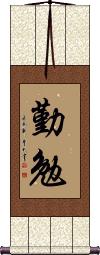
勤勉 can be translated as diligence, industrious, assiduity, assiduous, diligent, or sedulity.
Diligence is working hard and doing your absolute best. You take special care by doing things step by step. Diligence helps you to get things done with excellence and enthusiasm. Diligence leads to success.
See Also: Hard Work | Tenacity | Commitment | Passion for a Cause
Kindness / Caring
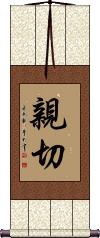
親切 is a Chinese/Japanese/Korean word that can also mean affectionate, cordial, warm, or close (emotionally).
Kindness shows you care and are doing some good to make life better for others. Be thoughtful about people's needs. Show love and compassion to someone who is sad or needs your help. When you are tempted to be cruel, to criticize or tease, decide to be kind instead.
See Also: Love | Caring | Benevolence
Divine Protection
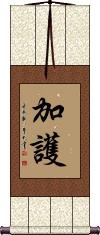
加護 is Japanese for “divine protection” or “the saving grace of God.”
Please consider this blessing to be Japanese only. This can have the same meaning in the context of Buddhism in Chinese, but it's also a nickname for “intensive care” at Chinese hospitals.
Note: My Japanese translator says this is not commonly used in Japanese. I added this because a customer asked for it. There is no better Japanese phrase to express this idea - so this is it if you want it.
Appreciation and Love for Your Parents
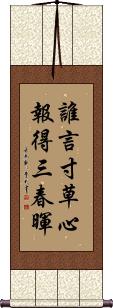
誰言寸草心報得三春暉 is the last line of a famous poem. It is perceived as a tribute or ode to your parents or mother from a child or children that have left home.
The poem was written by Meng Jiao during the Tang Dynasty (about 1200 years ago). The Chinese title is “You Zi Yin” which means “The Traveler's Recite.”
The last line as shown here speaks of the generous and warm spring sunlight which gives the grass far beyond what the little grass can could ever give back (except perhaps by showing its lovely green leaves and flourishing). The metaphor is that the sun is your mother or parents, and you are the grass. Your parents raise you and give you all the love and care you need to prepare you for the world. A debt that you can never repay, nor is repayment expected.
The first part of the poem (not written in the characters to the left) suggests that the thread in a loving mother's hands is the shirt of her traveling offspring. Vigorously sewing while wishing them to come back sooner than they left.
...This part is really hard to translate into English that makes any sense but maybe you get the idea. We are talking about a poem that is so old that many Chinese people would have trouble reading it (as if it was the King James Version of Chinese).
Brotherly and Sisterly Love
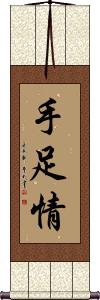
手足情 is the love between siblings.
When you love, protect, care for, and have a deep bond that only brothers or sisters can.
The actual translation is “Hand and Foot,” but the relationship between brothers or sisters is like that of hands and feet. They belong together and complete the body. Even though this says “hand and foot,” it will always be read with the brotherly and sisterly love meaning in Chinese.
Note: During the past 20 years, the “One child policy” in China is slowly making this term obsolete.
Self-Love / Love Yourself / Love Oneself
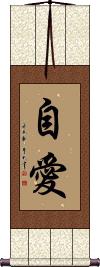
自愛 means self-love, self-regard, regard for oneself, cherishing one's good name, taking care of oneself, or love myself.
In the Buddhist context, this is the cause of all pursuit or seeking, which in turn causes all suffering. All Buddhas discharge themselves from self-love and all pursuits of personal gratification. Such elimination of self-love is a step towards nirvāṇa.
This title can be taken as positive or negative, depending on how you read it. Some will see it as arrogant, and others will read it as a token of self-respect. Because of this ambiguity, I do not recommend this title for a wall scroll.
This in-stock artwork might be what you are looking for, and ships right away...

Gallery Price: $61.00
Your Price: $33.88
Gallery Price: $108.00
Your Price: $59.88

Gallery Price: $61.00
Your Price: $33.88


Gallery Price: $61.00
Your Price: $33.88
Gallery Price: $108.00
Your Price: $59.88


Gallery Price: $60.00
Your Price: $36.88

Gallery Price: $60.00
Your Price: $36.88

Gallery Price: $120.00
Your Price: $49.88
Gallery Price: $304.00
Your Price: $168.88
Gallery Price: $90.00
Your Price: $49.88
The following table may be helpful for those studying Chinese or Japanese...
| Title | Characters | Romaji (Romanized Japanese) | Various forms of Romanized Chinese | |
| God Bless You | お大事に | odaijini | ||
| Caring | 關心 关心 | guān xīn / guan1 xin1 / guan xin / guanxin | kuan hsin / kuanhsin | |
| Diligence | 勤勉 | kinben | qín miǎn / qin2 mian3 / qin mian / qinmian | ch`in mien / chinmien / chin mien |
| Kindness Caring | 親切 亲切 | shin setsu / shinsetsu | qīn qiè / qin1 qie4 / qin qie / qinqie | ch`in ch`ieh / chinchieh / chin chieh |
| Divine Protection | 加護 加护 | ka go / kago | jiā hù / jia1 hu4 / jia hu / jiahu | chia hu / chiahu |
| Appreciation and Love for Your Parents | 誰言寸草心報得三春暉 谁言寸草心报得三春晖 | shuí yán cùn cǎo xīn bào dé sān chūn huī shui2 yan2 cun4 cao3 xin1 bao4 de2 san1 chun1 hui1 shui yan cun cao xin bao de san chun hui | shui yen ts`un ts`ao hsin pao te san ch`un hui shui yen tsun tsao hsin pao te san chun hui |
|
| Brotherly and Sisterly Love | 手足情 | shǒu zú qíng shou3 zu2 qing2 shou zu qing shouzuqing | shou tsu ch`ing shoutsuching shou tsu ching |
|
| Self-Love Love Yourself Love Oneself | 自愛 自爱 | ji ai / jiai | zì ài / zi4 ai4 / zi ai / ziai | tzu ai / tzuai |
| In some entries above you will see that characters have different versions above and below a line. In these cases, the characters above the line are Traditional Chinese, while the ones below are Simplified Chinese. | ||||

Successful Chinese Character and Japanese Kanji calligraphy searches within the last few hours...



