Many custom options...


And formats...



Not what you want?
Try other similar-meaning words, fewer words, or just one word.
High Mountain in Chinese / Japanese...
Buy a High Mountain calligraphy wall scroll here!
Personalize your custom “High Mountain” project by clicking the button next to your favorite “High Mountain” title below...
High Mountain Long River
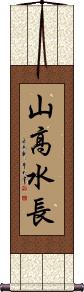
山高水長 is a Chinese idiom that means “high as the mountain and long as the river.”
It figuratively means “noble and far-reaching.”
Not sure this is valid or commonly used in Korean. It probably was borrowed into Korean a few hundred years ago but is obscure now.
When the sun rises it first shines on the highest mountain
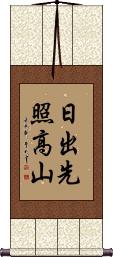
This old Buddhist phrase means, “When the sun rises it always shines first on the highest mountain,” or “When the sun appears, it first casts its light upon the highest mountain.”
This comes from the Avatamsaka Sutra and has been used as the name or portion of the name for temples in Japan and sites in China.
The Buddha's first round of teaching (Avatamsaka period) is likened to the time when the sun rises from the east horizon. When the sun first rises it illuminates the high mountains. In this analogy, the high mountains represent the great Bodhisattvas and/or those most ready to receive enlightenment and liberation.
This can be romanized from Japanese as “Nichi shutsu sen shō kō san,” “Nisshutsu saki teru takayama,” or “Hide temazu kōzan wo terasu yama.” The last one is probably the most common. Ask three Japanese people what they think the pronunciation is, and you will get three different opinions.
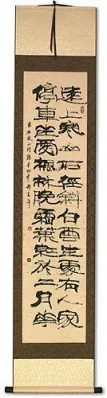
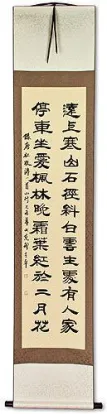
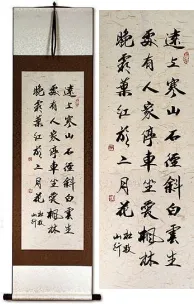
Mountain Travels Poem by Dumu

This poem was written almost 1200 years ago during the Tang dynasty.
It depicts traveling up a place known as Cold Mountain, where some hearty people have built their homes. The traveler is overwhelmed by the beauty of the turning leaves of the maple forest that surrounds him just as night overtakes the day, and darkness prevails. His heart implores him to stop, and take in all of the beauty around him.
First, before you get to the full translation, I must tell you that Chinese poetry is a lot different than what we have in the west. Chinese words simply don't rhyme in the same way that English or other western languages do. Chinese poetry depends on rhythm and a certain beat of repeated numbers of characters.
I have done my best to translate this poem keeping a certain feel of the original poet. But some of the original beauty of the poem in its original Chinese will be lost in translation.
Far away on Cold Mountain, a stone path leads upwards.
Among white clouds, people's homes reside.
Stopping my carriage I must, as to admire the maple forest at nights fall.
In awe of autumn leaves showing more red than even flowers of early spring.
Hopefully, this poem will remind you to stop, and “take it all in” as you travel through life.
The poet's name is “Du Mu” in Chinese that is: 
 .
.
The title of the poem, “Mountain Travels” is: 

You can have the title, poet's name, and even “Tang Dynasty” written as an inscription on your custom wall scroll if you like.
More about the poet:
Dumu lived from 803-852 AD and was a leading Chinese poet during the later part of the Tang dynasty.
He was born in Chang'an, a city in central China and the former capital of the ancient Chinese empire in 221-206 BC. In present-day China, his birthplace is currently known as Xi'an, the home of the Terracotta Soldiers.
He was awarded his Jinshi degree (an exam administered by the emperor's court which leads to becoming an official of the court) at the age of 25 and went on to hold many official positions over the years. However, he never achieved a high rank, apparently because of some disputes between various factions, and his family's criticism of the government. His last post in the court was his appointment to the office of Secretariat Drafter.
During his life, he wrote scores of narrative poems, as well as a commentary on the Art of War and many letters of advice to high officials.
His poems were often very realistic and often depicted everyday life. He wrote poems about everything, from drinking beer in a tavern to weepy poems about lost love.
The thing that strikes you most is the fact even after 1200 years, not much has changed about the beauty of nature, toils, and troubles of love and beer drinking.
Choi
Surname
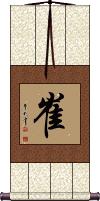
崔 is both a word and surname in Chinese and Korean.
In Korean, this romanizes as Choi. Occasionally, some have romanized it as Choe.
In Chinese, this is romanized as Cui in the mainland and Tsui in Taiwan.
The meaning of this characters is high mountain or precipitous.
崔 is also a rarely used Japanese surname or given name. From Japanese, this has the following possible romanizations: Chiyoi; Chioe; Chiejiyon; Chiei; Chie; Che; Takashi; Sun; Sa.
This in-stock artwork might be what you are looking for, and ships right away...


Gallery Price: $72.00
Your Price: $39.88
Gallery Price: $60.00
Your Price: $39.88
Gallery Price: $200.00
Your Price: $79.88
Gallery Price: $200.00
Your Price: $79.88
Gallery Price: $60.00
Your Price: $39.88

Gallery Price: $60.00
Your Price: $39.88
Gallery Price: $160.00
Your Price: $88.77
Gallery Price: $83.00
Your Price: $45.88
Gallery Price: $72.00
Your Price: $39.88
Gallery Price: $72.00
Your Price: $39.88
Gallery Price: $60.00
Your Price: $39.88
Not the results for high mountain that you were looking for?
Below are some entries from our dictionary that may match your high mountain search...
| Characters If shown, 2nd row is Simp. Chinese |
Pronunciation Romanization |
Simple Dictionary Definition |
山 see styles |
shān shan1 shan yamamura やまむら |
More info & calligraphy: Mountain(n,ctr) (1) mountain; hill; (n,ctr) (2) mine; (n,ctr) (3) (mountain) forest; (n,ctr) (4) heap; pile; stack; mountain; (5) protruding or high part of an object; crown (of a hat); thread (of a screw); tread (of a tire); (6) climax; peak; critical point; (7) guess; speculation; gamble; (8) (slang) (kana only) (police and crime reporter jargon; usu. written as ヤマ) (criminal) case; crime; (9) mountain climbing; mountaineering; (10) (See 山鉾) festival float (esp. one mounted with a decorative halberd); (11) {cards} (See 山札・1) deck (from which players draw cards); draw pile; stock; (12) {mahj} wall; wall tile; (prefix noun) (13) (before the name of a plant or animal) wild; (personal name) Yamamura A hill, mountain; a monastery. |
道士 see styles |
dào shì dao4 shi4 tao shih michishi みちし |
More info & calligraphy: Taoist / Daoist(1) Taoist; (2) person of high morals; (3) Buddhist monk; (4) immortal mountain wizard; Taoist immortal; (personal name) Michishi A Taoist (hermit), also applied to Buddhists, and to Śākyamuni. |
山高水長 山高水长 see styles |
shān gāo shuǐ cháng shan1 gao1 shui3 chang2 shan kao shui ch`ang shan kao shui chang |
More info & calligraphy: High Mountain Long River |
屴 see styles |
lì li4 li |
high mountain range |
峨 see styles |
é e2 o ga |
lofty; name of a mountain High, commanding. |
峰 see styles |
fēng feng1 feng minezaki みねざき |
(of a mountain) high and tapered peak or summit; mountain-like in appearance; highest level; classifier for camels (1) peak; summit; ridge; top; (2) back of a blade; (surname) Minezaki peak |
嶽 岳 see styles |
yuè yue4 yüeh dake だけ |
high mountain; highest peak of a mountain ridge (n,suf) (1) peak; (2) mountain; (place-name, surname) Dake crag |
巋 岿 see styles |
kuī kui1 k`uei kuei |
high and mighty (of mountain); hilly |
磪 see styles |
cuī cui1 ts`ui tsui |
a high mountain; precipitous |
天梯 see styles |
tiān tī tian1 ti1 t`ien t`i tien ti |
stairway to heaven; high mountain road; tall ladder on a building or other large structure; space elevator |
尭々 see styles |
gyougyou / gyogyo ぎょうぎょう |
(adj-t,adv-to) high (as of a mountain) |
尭尭 see styles |
gyougyou / gyogyo ぎょうぎょう |
(adj-t,adv-to) high (as of a mountain) |
峻峰 see styles |
shunpou / shunpo しゅんぽう |
(See 峻嶺) steep peak; steep ridge; high rugged mountain; (given name) Shunpou |
峻嶺 峻岭 see styles |
jun lǐng jun4 ling3 chün ling shunrei / shunre しゅんれい |
lofty mountain range steep peak; steep ridge; high rugged mountain; (given name) Shunrei |
御岳 see styles |
mitake みたけ |
(obscure) large, high mountain; (Okinawa) sacred site; sacred grove; (place-name, surname) Mitake |
御嶽 see styles |
mitake みたけ |
(obscure) large, high mountain; (Okinawa) sacred site; sacred grove; (place-name, surname) Mitake |
慢山 see styles |
màn shān man4 shan1 man shan mansen |
Pride as high as a mountain. |
来光 see styles |
raikou / raiko らいこう |
(See 御来光) sunrise viewed from the top of a high mountain; (surname) Raikou |
高寒 see styles |
gāo hán gao1 han2 kao han |
high and cold (mountain area) |
高山 see styles |
gāo shān gao1 shan1 kao shan takayama たかやま |
high mountain; alpine mountain (noun - becomes adjective with の) high mountain; alpine mountain; (place-name, surname) Takayama Meru |
高峰 see styles |
gāo fēng gao1 feng1 kao feng takamine たかみね |
peak; summit; height high mountain; lofty peak; (place-name, surname) Takamine Gobong |
高嶽 see styles |
gāo yuè gao1 yue4 kao yüeh takatake たかたけ |
(surname) Takatake high mountain |
ご来光 see styles |
goraikou / goraiko ごらいこう |
sunrise viewed from the top of a high mountain; the rising sun |
地致婆 see styles |
dì zhì pó di4 zhi4 po2 ti chih p`o ti chih po jichiba |
tiṭibha, titi.lambha, 'a particular high mountain, ' M. W. 1,000 quadrillions; a 大地致婆 is said to be 10,000 quadrillions. |
妙高山 see styles |
miào gāo shān miao4 gao1 shan1 miao kao shan myoukouzan / myokozan みょうこうざん |
(personal name) Myōkouzan (妙高山王) The wonderful high mountain, Sumeru; the king of mountains. |
御来光 see styles |
goraikou / goraiko ごらいこう |
sunrise viewed from the top of a high mountain; the rising sun |
山高海深 see styles |
shān gāo hǎi shēn shan1 gao1 hai3 shen1 shan kao hai shen |
high as the mountain and deep as the sea (idiom); fig. infinite bounty |
道山學海 道山学海 see styles |
dào shān xué hǎi dao4 shan1 xue2 hai3 tao shan hsüeh hai |
mountain of Dao, sea of learning (idiom); learning is as high as the mountains, as wide as the seas; ars longa, vita brevis |
Variations: |
gyougyou / gyogyo ぎょうぎょう |
(adj-t,adv-to) high (as of a mountain) |
Variations: |
mitake みたけ |
(rare) large, high mountain |
Click here for more high mountain results from our dictionary
The following table may be helpful for those studying Chinese or Japanese...
| Title | Characters | Romaji (Romanized Japanese) | Various forms of Romanized Chinese | |
| High Mountain Long River | 山高水長 山高水长 | shān gāo shuǐ cháng shan1 gao1 shui3 chang2 shan gao shui chang shangaoshuichang | shan kao shui ch`ang shankaoshuichang shan kao shui chang |
|
| When the sun rises it first shines on the highest mountain | 日出先照高山 | hiide temazu kousan wo terasu yama hide temazu kosan wo terasu yama | rì chū xiān zhào gāo shān ri4 chu1 xian1 zhao4 gao1 shan1 ri chu xian zhao gao shan richuxianzhaogaoshan | jih ch`u hsien chao kao shan jihchuhsienchaokaoshan jih chu hsien chao kao shan |
| Mountain Travels Poem by Dumu | 遠上寒山石徑斜白雲生處有人家停車坐愛楓林晚霜葉紅於二月花 远上寒山石径斜白云生处有人家停车坐爱枫林晚霜叶红于二月花 | yuǎn shàng hán shān shí jìng xiá bái yún shēng chù yǒu rén jiā tíng chē zuò ài fēng lín wǎn shuàng yè hóng yú èr yuè huā yuan3 shang4 han2 shan1 shi2 jing4 xia2 bai2 yun2 sheng1 chu4 you3 ren2 jia1 ting2 che1 zuo4 ai4 feng1 lin2 wan3 shuang4 ye4 hong2 yu2 er4 yue4 hua1 yuan shang han shan shi jing xia bai yun sheng chu you ren jia ting che zuo ai feng lin wan shuang ye hong yu er yue hua | yüan shang han shan shih ching hsia pai yün sheng ch`u yu jen chia t`ing ch`e tso ai feng lin wan shuang yeh hung yü erh yüeh hua yüan shang han shan shih ching hsia pai yün sheng chu yu jen chia ting che tso ai feng lin wan shuang yeh hung yü erh yüeh hua |
|
| Choi | 崔 | cuī / cui1 / cui | ts`ui / tsui | |
| In some entries above you will see that characters have different versions above and below a line. In these cases, the characters above the line are Traditional Chinese, while the ones below are Simplified Chinese. | ||||

Successful Chinese Character and Japanese Kanji calligraphy searches within the last few hours...



