Many custom options...


And formats...



The Great Wall of China in Chinese / Japanese...
Buy a The Great Wall of China calligraphy wall scroll here!
Personalize your custom “The Great Wall of China” project by clicking the button next to your favorite “The Great Wall of China” title below...
2. China
4. Great Aspirations / Ambition
5. China
6. Flowers / Blooming / Splendid / China
7. Wall
9. Great Peace
10. Great Sea
11. Great Endeavor / To Strive
13. Great Britain
14. Great Ambitions
17. Great Wisdom
18. Great Power
19. Grand Master / Great Teacher
20. Great Wisdom
21. Great Illumination of Wisdom
22. Heroic Spirit / Great Ambition
The Great Wall of China
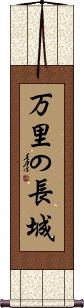
万里の長城 is the Japanese name for the Great Wall of China.
The Great Wall of China
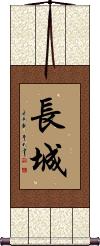
長城 is the Chinese name for the Great Wall.
Built at the northern border of China to protect from Mongol attack.
Notes:
In Japanese, this can be a surname Nagaki. Japanese often use a longer title for the Great Wall of China.
In Korean, this refers to Changsŏng (a city in Changsŏng-kun county, Chŏllanam-to province).
China
I Climbed the Great Wall

登长城 means to ascend or to climb the Great Wall of China.
登長城 is the poetic and native way to express this feat.
登 means “to ascend” and is a classical verb used in inscriptions, poems, and calligraphy.
长城 is the title of the Great Wall.
This three-character phrase is concise and implies achievement rather than casual travel.
Great Aspirations / Ambition
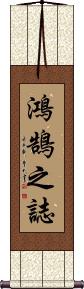
鴻鵠之誌 is a Chinese proverb that implies that having grand ambitions also means that others will not understand your great expectations and ideas.
Though the actual words come from a longer saying of Confucius, which goes, “The little swallows living under the eaves wouldn't understand the lofty ambitions of a swan (who flies far and wide).”
This Confucius quote has led to this idiomatic expression in China that means “think big.” What you'd be saying is “The lofty ambitions of a swan.”
Note that Chinese people sometimes refer to the little swallow as one who does not “think big” but is, instead, stuck in a rut or just leading a mundane life. Therefore, it's a compliment to be called a swan but not a good thing to be called a swallow.
Great Aspirations / Ambition
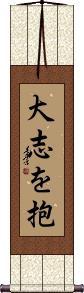
大志を抱 is a single Japanese word that kind of reads like a short proverb.
It suggests that you should have “high aims,” “ambitions,” or “aspirations” in your life.
China
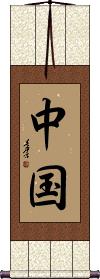
This is the country of China written in Japanese.
Flowers / Blooming / Splendid / China
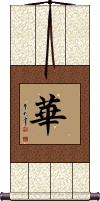
華 means blooming flowers or splendid China.
華 is really open to interpretation. 華 meant flowers or blooming in ancient China. It still has that meaning in Japanese, and Buddhist contexts.
In modern China, this means glorious, beautiful, splendid, magnificent, or the best part of something. It can also refer to the country of China or something Chinese (such as people - overseas Chinese are often called “hua ren”). 華 is also a surname in China.
In Japanese, this can be the female given name “Ririka.” It's also the short name for a certain kind of playing cards in Japan.
In Korean, This can be the surname “Hwa.” While it also means splendid, flowery, or the country of China in Korean.
Wall

沃爾 is the name Wall in Chinese (Mandarin).
Wall

ウォール is the name Wall in Japanese Katakana.
Note: Because this title is entirely Japanese Katakana, it should be written by a Japanese calligrapher.
Facing the Wall Nine Years
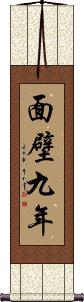
面壁九年 is a Buddhist term that means “facing a wall for nine years.”
This refers to the Bodhidharma who stared at a wall in meditation at the Shaolin Temple (or in a cave) for nine years until reaching full enlightenment.
Great Peace
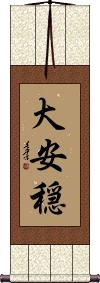
大安穏 means great peace, great repose, nirvanic peace, or great tranquility.
Great Sea
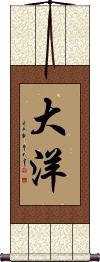
This is a rarely-used word for ocean in Japanese, Chinese, and Korean. This is here mostly for reference - please order a different ocean for your custom calligraphy wall scroll.
The first character means “big” or “great.”
The second means “ocean” or “body of water” (it can sometimes mean “foreign” but not in this case).
The first character designates that you are talking about a great or huge body of water (certainly a major ocean and not a smaller sea).
Great Endeavor / To Strive
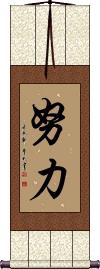
努力 means great effort; to strive; to try hard; great effort; great exertion; great endeavor (endeavour); great effort; to strive.
This “striving endeavor” word is valid in Chinese, Japanese Kanji, and old Korean Hanja.
Door of Great Wisdom
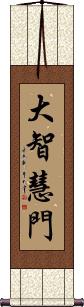
大智慧門 is the title for “The Great Wisdom Door,” or “The Gate to Great Wisdom.”
This refers to a portal to all wisdom and knowledge in Buddhism.
Great Britain
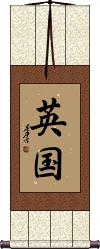
This is Great Britain written in Japanese.
Great Britain
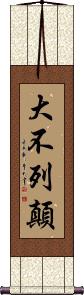
This is the Chinese name for Great Britain.
See Also: England | United Kingdom | Scotland | Ireland | Europe
Great Ambitions
Brave the wind and the waves
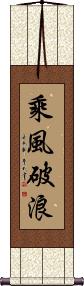
乘風破浪 is a Chinese proverb that represents having great ambitions.
The British might say “to plough through.” Another way to understand it is “surmount all difficulties and forge ahead courageously.”
This can also be translated as “braving the wind and waves,” “to brave the wind and the billows,” “to ride the wind and crest the waves,” or “to be ambitious and unafraid.”
Literally, it reads: “ride (like a chariot) [the] wind [and] break/cleave/cut [the] waves,” or “ride [the] wind [and] slash [through the] waves.”
乘風破浪 is a great proverb to encourage yourself or someone else not to be afraid of problems or troubles, and when you have a dream, just go for it.
There is an alternate version, 長風破浪, but 乘風破浪 is far more common.
Daimyo / Great Name
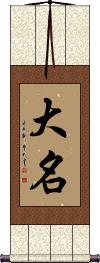
大名 is the title Daimyō in Japanese, which means “lord” or “great name.”
This has the same meaning in Chinese as “great name,” or “your distinguished name.” In ancient Japan, this referred to a feudal lord.
Also sometimes romanized from Japanese as Daimio, Daimyou, Oomiyou, or Oomyou.
Great Responsibility
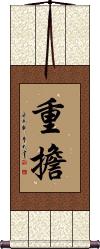
重擔 means heavy burden, difficult task, heavy load, or great responsibility.
Great Wisdom
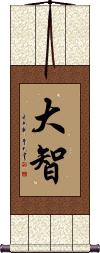
大智 is a Zen Buddhist title that means supreme wisdom, great wisdom, Buddha-wisdom, omniscience, or transcendental wisdom.
Great Power
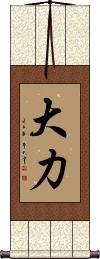
大力 can mean immense physical strength or great power.
This can also act as an adjective for expressing how energetically or vigorously something is.
This can also be a given name, Dairiki, in Japanese.
Grand Master / Great Teacher
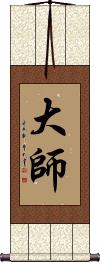
大師 is a way to title a great master, grand master, or great teacher.
This can be used in the context of martial arts or a Buddhist teacher. Thus, it can be used to title a living Buddha, Bodhisattva, or high-ranking monk.
Great Wisdom
Prajñā
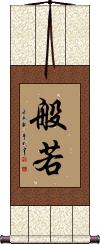
般若 means great wisdom or wondrous knowledge.
In the Buddhist context, this is prajna or prajñā, to know, to understand, to have the wisdom required to attain enlightenment.
Since this is a wisdom that transcends the realm of logic, the pure, absolute wisdom beyond the reach of words and concepts, it is not obtained through learning but is realized for the first time through a religious experience.
Great Illumination of Wisdom
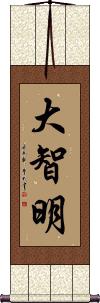
大智明 is a Zen Buddhist title that means the great illumination of wisdom.
This refers to wisdom so bright that it shines through obviously to all in its presence.
Heroic Spirit / Great Ambition
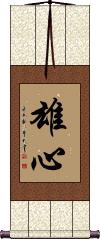
雄心 are the Chinese characters and Japanese Kanji for great ambition, lofty aspiration, or heroic spirit.
Great Lord / Tycoon
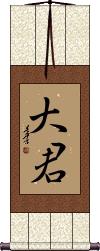
大君 is the Japanese word Taikun. It's defined directly as liege, lord, or an alternate title for a shogunate.
The sound of this Japanese word entered the English lexicon by the 1800s but took the spelling of “tycoon.” Even President Lincoln was referred to as a Tycoon in the 1860s.
In Japan, this is still understood as “Great Lord” or “Big Boss.” In America, it means “Bill Gates” and “Warren Buffet.”
The Great Path has No Gate
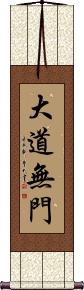
大道無門 is a Buddhist proverb that means “The Great Way has no entrance,” “The Great Way is gateless,” or “The Great Path lacks a gate.”
This can be translated in many other ways.
This concept was authored within a long sacred text by 無門慧開 (known as Wúmén Huìkāi in Chinese or Mumon Ekai in Japanese). He was a Chinese Chan Master (in Japanese, a Zen Master) who lived between 1183 and 1260 AD. His most famous work was a 48-koan collection titled “The Gateless Barrier” or “The Gateless Gate” (無門關 Wú Mén Guān in Chinese, or 無門関 Mu Mon Kan in Japanese). This calligraphy title is a notable line from this collection.
I like this reference to the source of this proverb: The Gateless Gate 無門關
Big Dream / Great Hope
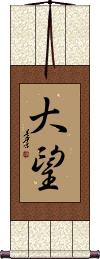
大望 is one of a few ways to write “dream big” in Japanese.
This is a good title if you want that to inspire ambition or high aspirations. 大望 is also a way to say “great expectations.”
Great Expectations
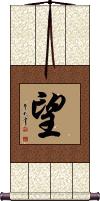
望 holds the ideas of ambition, hope, desire, aspiring to, expectations, looking towards, to gaze (into the distance), and in some contexts, full moon rising.
望 is one of those single characters that is vague but in that vagueness, it also means many things.
望 is a whole word in Chinese and old Korean but is seldom seen alone in Japanese. Still, it holds the meanings noted above in all three languages.
Great Lotus Wisdom - Samadhi Wisdom
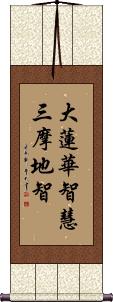
大蓮華智慧三摩地智 is the title for “The wisdom of the great lotus, samādhi-wisdom.”
This is also the penetrating wisdom of Amitābha.
The following table may be helpful for those studying Chinese or Japanese...
| Title | Characters | Romaji (Romanized Japanese) | Various forms of Romanized Chinese | |
| The Great Wall of China | 万里の長城 | ban ri no chou jou banrinochoujou ban ri no cho jo | ||
| The Great Wall of China | 長城 长城 | chou jou / choujou / cho jo | cháng chéng chang2 cheng2 chang cheng changcheng | ch`ang ch`eng changcheng chang cheng |
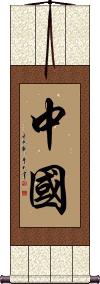
| China | 中國 中国 | chū goku / chūgoku | zhōng guó zhong1 guo2 zhong guo zhongguo | chung kuo chungkuo |
| I Climbed the Great Wall | 登長城 登长城 | dēng cháng chéng deng1 chang2 cheng2 deng chang cheng dengchangcheng | teng ch`ang ch`eng tengchangcheng teng chang cheng |
|
| Great Aspirations Ambition | 鴻鵠之誌 鸿鹄之志 | hóng hú zhī zhì hong2 hu2 zhi1 zhi4 hong hu zhi zhi honghuzhizhi | hung hu chih chih hunghuchihchih |
|
| Great Aspirations Ambition | 大志を抱 | tai shi wo idaku taishiwoidaku | ||
| China | 中國 中国 | chuu goku / chuugoku / chu goku | ||
| Flowers Blooming Splendid China | 華 华 | ririka | huá / hua2 / hua | |
| Wall | 沃爾 沃尔 | wò ěr / wo4 er3 / wo er / woer | wo erh / woerh | |
| Wall | ウォール | wooru / woru | ||
| Facing the Wall Nine Years | 面壁九年 | menpeki kyunen menpekikyunen | miàn bì jiǔ nián mian4 bi4 jiu3 nian2 mian bi jiu nian mianbijiunian | mien pi chiu nien mienpichiunien |
| Great Peace | 大安穏 | daiannon | ||
| Great Sea | 大洋 | tai you / taiyou / tai yo | dà yáng / da4 yang2 / da yang / dayang | ta yang / tayang |
| Great Endeavor To Strive | 努力 | doryoku / doryoku | nǔ lì / nu3 li4 / nu li / nuli | |
| Door of Great Wisdom | 大智慧門 大智慧门 | dai chi e mon daichiemon | dà zhì huì mén da4 zhi4 hui4 men2 da zhi hui men dazhihuimen | ta chih hui men tachihhuimen |
| Great Britain | 英國 英国 | ei koku / eikoku | ||
| Great Britain | 大不列顛 大不列颠 | dà bù liè diān da4 bu4 lie4 dian1 da bu lie dian dabuliedian | ta pu lieh tien tapuliehtien |
|
| Great Ambitions | 乘風破浪 乘风破浪 | chéng fēng pò làng cheng2 feng1 po4 lang4 cheng feng po lang chengfengpolang | ch`eng feng p`o lang chengfengpolang cheng feng po lang |
|
| Daimyo Great Name | 大名 | dai myou / daimyou / dai myo | dà míng / da4 ming2 / da ming / daming | ta ming / taming |
| Great Responsibility | 重擔 重担 | juu tan / juutan / ju tan | zhòng dàn zhong4 dan4 zhong dan zhongdan | chung tan chungtan |
| Great Wisdom | 大智 | daichi | dà zhì / da4 zhi4 / da zhi / dazhi | ta chih / tachih |
| Great Power | 大力 | dai riki / dairiki | dà lì / da4 li4 / da li / dali | ta li / tali |
| Grand Master Great Teacher | 大師 大师 | daishi | dà shī / da4 shi1 / da shi / dashi | ta shih / tashih |
| Great Wisdom | 般若 | hannya | bō rě / bo1 re3 / bo re / bore | po je / poje |
| Great Illumination of Wisdom | 大智明 | dai chi myou daichimyou dai chi myo | dà zhì míng da4 zhi4 ming2 da zhi ming dazhiming | ta chih ming tachihming |
| Heroic Spirit Great Ambition | 雄心 | yuushin / yushin | xióng xīn xiong2 xin1 xiong xin xiongxin | hsiung hsin hsiunghsin |
| Great Lord Tycoon | 大君 | tai kun / taikun | ||
| The Great Path has No Gate | 大道無門 大道无门 | dai dou mu mon daidoumumon dai do mu mon | dà dào wú mén da4 dao4 wu2 men2 da dao wu men dadaowumen | ta tao wu men tataowumen |
| Big Dream Great Hope | 大望 | tai mou / taimou / tai mo | ||
| Great Expectations | 望 | bou / nozomi bo / nozomi | wàng / wang4 / wang | |
| Great Lotus Wisdom - Samadhi Wisdom | 大蓮華智慧三摩地智 大莲华智慧三摩地智 | dai renge chie sanmajichi dairengechiesanmajichi | dà lián huá zhì huì sān mó dì zhì da4 lian2 hua2 zhi4 hui4 san1 mo2 di4 zhi4 da lian hua zhi hui san mo di zhi | ta lien hua chih hui san mo ti chih |
| In some entries above you will see that characters have different versions above and below a line. In these cases, the characters above the line are Traditional Chinese, while the ones below are Simplified Chinese. | ||||

Successful Chinese Character and Japanese Kanji calligraphy searches within the last few hours...



