Many custom options...


And formats...



Not what you want?
Try other similar-meaning words, fewer words, or just one word.
Friendship-Both in Chinese / Japanese...
Buy a Friendship-Both calligraphy wall scroll here!
Personalize your custom “Friendship-Both” project by clicking the button next to your favorite “Friendship-Both” title below...
1. Friendship
5. Eternal Friendship / Friends Forever
6. Soul Mates
8. Best Friends
9. Friendliness
11. Best Friends / Closest Friend
12. Most Sincere Friend / Honest Friend / Real Friend / Best Friend
13. Friend
14. Yushinkai
16. Commitment
17. Generosity
Friendship
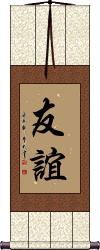
友誼 can be defined as companionship or fellowship.
This word is common in Chinese and Korean Hanja but is seldom used in Japanese anymore.
See Also: Partnership | Friendliness
Friendship
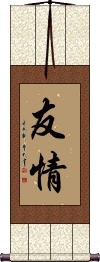
友情 can be translated as “camaraderie” or “fellowship.”
But this character combination is only used commonly in Japanese Kanji and Korean Hanja.
Friend / Friendship
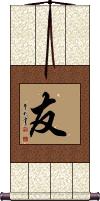
友 is the simplest way to express the idea of friends or friendship in Chinese.
It can mean friend, companion, or pal in Japanese. In Korean, it can mean friend, companion, or associate.
This single character is open to interpretation, so it can mean different things to different people (not necessarily a bad thing, as you can decide what it means to you). If you want a more concisely-defined word, you should probably pick one of our multi-character friendship-related words.
See Also: Best Friends | Friendly | Friendship
Friendship Dojo

友愛道場 can be translated as “Friendship Dojo.”
友愛 = Friendship or fraternity.
道場 = Training hall.
Friend / Friendship
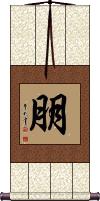
朋 is a simple way to say friend, companion, comrade, or pal in Chinese, Japanese Kanji, or old Korean Hanja.
朋 is a very short form, so a longer two-character word for friendship might be better.
Note: In Japanese, this can also be the female given name, Yukari.
Eternal Friendship / Friends Forever
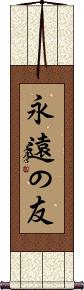
永遠の友 is a Japanese phrase about eternal friendship.
The first two characters mean eternal, eternity, perpetuity, forever, immortality, and permanence.
The third character is a possessive article which sort of makes this selection mean “Love, of the eternal kind.”
The last character is “friend” or “Friendship.”
See Also: Best Friends
Eternal Friendship / Friends Forever
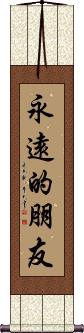
永遠的朋友 means friends that are eternal or a friendship that will last forever - you will remain the best of friends as long as you live.
The first two characters mean forever, eternal, eternity, perpetuity, immortality, and/or permanence.
The middle character links the words (it's a possessive article).
The last two characters represent friendship, or simply “friends.”
Soul Mates
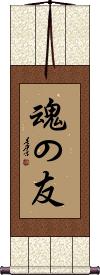
魂の友 is one of a few ways to write “Soul Mates” in Japanese.
The first Kanji means soul, spirit, ghost, immortal soul, the mind, or conscious mind. From Sanskrit, it's Vijñāna.
The middle character is a Japanese Hiragana connecting or possessive article that links the two ideas together.
The last Kanji means friends or friendship.
Love and Honor
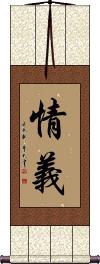
情義 means to love and honor in Chinese. 情義 is more or less the kind of thing you'd find in marriage vows.
The first character suggests emotions, passion, heart, humanity, sympathy, and feelings.
In this context, the second character means to honor your lover's wishes and treat them justly and righteously (fairly). That second character can also be translated as “obligation,” as in the obligation a husband and wife have to love each other even through difficult times.
In the context outside of a couple's relationship, this word can mean “comradeship.”
Japanese may see this more as “humanity and justice” than “love and honor.” It's probably best if your target is Chinese.
This is the short and sweet form, there is also a longer poetic form (you can find it here: Love and Honor if it’s not on the page you are currently viewing).
See Also: Love and Honor
Best Friends
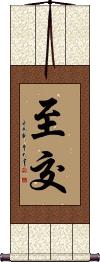
至交 is an alternate way to say best friend in Chinese.
The first character can mean “most,” “extreme” or “best.” The second character means “making friends” or “building friendship.” There's sort of a suggestion with the second character that fate caused you to intersect in life and become friends (that character can mean intersection in some context).
This can also mean “most intimate friend,” “very good friend of long-standing,” or “closest friend.”
See Also: Friendship | Soulmates
Friendliness
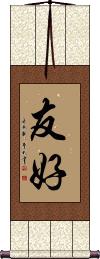
友好 is a Japanese, Chinese, and old Korean word that means friendliness.
This word can also be defined as “amity,” “friendly,” and “outgoing.”
This can be a Japanese given name Yuukou or Yuko. It can also be a Japanese surname that romanizes as Tomoyoshi.
See Also: Friendship
Partnership: Marriage
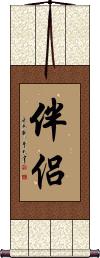
伴侶 is a Chinese, Japanese, and old Korean word that expresses the kind of partnership in which a good marriage is founded.
伴侶 could also be translated as mates or companionship or as a noun to refer to a partner or companion.
This does not have to include marriage but at least refers to a partnership with a deep relationship or bond.
Note that this is not the same as a business partner. Different words are used for various types business partnerships.
See Also: Friendship
Best Friends / Closest Friend
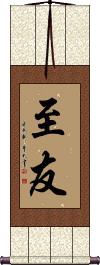
至友 is one way to say best friend in Chinese.
The first character can mean “most,” “extreme,” or “best.”
The second character means “friend” or “friends” (plural forms work differently in China).
Can also be translated as “close friend” or “most intimate friend.”
See Also: Friendship | Soulmates
Most Sincere Friend / Honest Friend / Real Friend / Best Friend
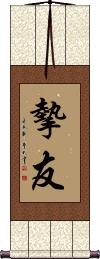
摯友 is one way to say best friend in Chinese.
The first character can mean “honest” or “most sincere.” The second character means “friend” or “friends” (plural forms work differently in Chinese).
See Also: Friendship | Soulmates
Friend
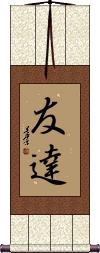
友達 is the most common way to say “friend” in Japanese.
See Also: Best Friends | Friendly | Friendship
Yushinkai

友心会 is the martial arts title Yushinkai in Japanese Kanji.
This can translate as “Friendship Club” or “Friends Heart Club.”
Other possible titles that are romanized as Yushinkai are 有心会 and 結心会. These have a meaning that is more like Heartfelt Club or Heart-to-Heart Club. Be sure to check carefully to see what your school title is before you order. Let me know if you need one of these alternate versions.
Five Codes of Tang Soo Do
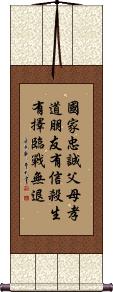
国家忠诚父母孝道朋友有信杀生有择临战无退 are the five codes of Tang Soo Do.
I suggest you have this arranged in five columns when you get to the options page for your custom calligraphy wall scroll.
Here are my translations of each of the five codes:
國家忠誠 Be loyal to your country.
父母孝道 In regards to parents, behave in a filial way.
朋友有信 Be faithful in friendship.
殺生有擇 When fighting for life and death, make noble choices.
臨戰無退 No retreat in battle.
Note: “Tang Soo Do” is a romanization of 唐手道. It's 당수도 in Korean Hangul. It can also be romanized as “Tangsudo” or “Dangsudo.”
Commitment
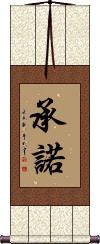
承諾 embodies the idea of commitment but also means to make a big effort or to undertake a great task.
Commitment is caring deeply about something or someone. It is deciding carefully what you want to do and then giving it 100%, holding nothing back. You give your all to a friendship, a task, or something you believe in. You finish what you start. You keep your promises.
In Chinese, this word directly means to undertake something or to make a promise to do something.
Outside of the commitment idea, this particular word can also mean approval, acceptance, consent, assent, acquiescence, or agreement, depending on context (especially in Japanese and Korean). Therefore, this word is probably best if your audience is Chinese.
See Also: Partnership | Hard Work | Dedication
Generosity
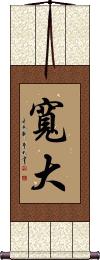
寬大 is a Chinese, Japanese, and Korean word that means Generosity.
Generosity is giving and sharing. You share freely, not with the idea of receiving something in return. You find ways to give others happiness and give just for the joy of giving. Generosity is one of the best ways to show love and friendship.
寬大 can also be translated as charitable, magnanimity, liberality, or in some contexts, broad-mindedness.
Note: There is a tiny deviation in the first character when written in Japanese. If you choose our Japanese master calligrapher, the little dot on the lower right of the first character will be omitted. With or without the dot, this can be read in Chinese, Japanese Kanji, and old Korean Hanja.
See Also: Benevolence | Altruism | Charity
Justice / Rectitude / Right Decision
Also means: honor loyalty morality righteousness
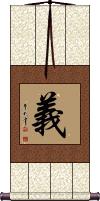
義 is about doing the right thing or making the right decision, not because it's easy but because it's ethically and morally correct.
No matter the outcome or result, one does not lose face if tempering proper justice.
義 can also be defined as righteousness, justice, morality, honor, or “right conduct.” In a more expanded definition, it can mean loyalty to friends, loyalty to the public good, or patriotism. This idea of loyalty and friendship comes from the fact that you will treat those you are loyal to with morality and justice.
義 is also one of the five tenets of Confucius's doctrine.
 There's also an alternate version of this character sometimes seen in Bushido or Korean Taekwondo tenets. It's just the addition of a radical on the left side of the character. If you want this version, click on the image to the right instead of the button above.
This is also a virtue of the Samurai Warrior
See our page with just Code of the Samurai / Bushido here
See Also: Judgment | Impartial | Confucius Tenets
Unselfish: Perfectly Impartial
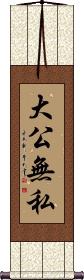
大公無私 is a Chinese proverb that comes from an old story from some time before 476 BC. About a man named Qi Huangyang, who was commissioned by the king to select the best person for a certain job in the Imperial Court.
Qi Huangyang selected his enemy for the job. The king was very confused by the selection, but Qi Huangyang explained that he was asked to find the best person for the job, not necessarily someone that he liked or had a friendship with.
Later, Confucius commented on how unselfish and impartial Qi Huangyang was by saying, “Da Gong Wu Si” which, if you look it up in a Chinese dictionary, is generally translated as “Unselfish” or “Just and Fair.”
If you translate each character, you'd have something like
“Big/Deep Justice Without Self.”
Direct translations like this leave out a lot of what the Chinese characters really say. Use your imagination, and suddenly you realize that “without self” means “without thinking about yourself in the decision” - together, these two words mean “unselfish.” The first two characters serve to drive the point home that we are talking about a concept that is similar to “blind justice.”
One of my Chinese-English dictionaries translates this simply as “just and fair.” So that is the short and simple version.
Note: This can be pronounced in Korean, but it's not a commonly used term.
See Also: Selflessness | Work Unselfishly for the Common Good | Altruism
This in-stock artwork might be what you are looking for, and ships right away...

Gallery Price: $61.00
Your Price: $33.88

Gallery Price: $61.00
Your Price: $33.88

Gallery Price: $61.00
Your Price: $33.88

Gallery Price: $61.00
Your Price: $33.88
Gallery Price: $304.00
Your Price: $168.88
The following table may be helpful for those studying Chinese or Japanese...
| Title | Characters | Romaji (Romanized Japanese) | Various forms of Romanized Chinese | |
| Friendship | 友誼 友谊 | yuugi / yugi | yǒu yì / you3 yi4 / you yi / youyi | yu i / yui |
| Friendship | 友情 | yuujou / yujo | yǒu qíng / you3 qing2 / you qing / youqing | yu ch`ing / yuching / yu ching |
| Friend Friendship | 友 | tomo | yǒu / you3 / you | yu |
| Friendship Dojo | 友愛道場 | yū ai dō jō yūaidōjō | yǒu ài dào chǎng you3 ai4 dao4 chang3 you ai dao chang youaidaochang | yu ai tao ch`ang yuaitaochang yu ai tao chang |
| Friend Friendship | 朋 | tomo | péng / peng2 / peng | p`eng / peng |
| Eternal Friendship Friends Forever | 永遠の友 | ei en no yuu eiennoyuu ei en no yu | ||
| Eternal Friendship Friends Forever | 永遠的朋友 永远的朋友 | yǒng yuǎn de péng yǒu yong3 yuan3 de peng2 you3 yong yuan de peng you yongyuandepengyou | yung yüan te p`eng yu yungyüantepengyu yung yüan te peng yu |
|
| Soul Mates | 魂の友 | tamashii no tomo tamashiinotomo tamashi no tomo | ||
| Love and Honor | 情義 情义 | qíng yì / qing2 yi4 / qing yi / qingyi | ch`ing i / chingi / ching i | |
| Best Friends | 至交 | zhì jiāo / zhi4 jiao1 / zhi jiao / zhijiao | chih chiao / chihchiao | |
| Friendliness | 友好 | yuukou / yuko | yǒu hǎo / you3 hao3 / you hao / youhao | yu hao / yuhao |
| Partnership: Marriage | 伴侶 伴侣 | hanryo | bàn lǚ / ban4 lv3 / ban lv / banlv | pan lü / panlü |
| Best Friends Closest Friend | 至友 | zhì yǒu / zhi4 you3 / zhi you / zhiyou | chih yu / chihyu | |
| Most Sincere Friend Honest Friend Real Friend Best Friend | 摯友 挚友 | zhì yǒu / zhi4 you3 / zhi you / zhiyou | chih yu / chihyu | |
| Friend | 友達 友达 | tomo dachi / tomodachi | ||
| Yushinkai | 友心會 友心会 | yuu shin kai yuushinkai yu shin kai | ||
| Five Codes of Tang Soo Do | 國家忠誠父母孝道朋友有信殺生有擇臨戰無退 国家忠诚父母孝道朋友有信杀生有择临战无退 | guó jiā zhōng chéng fù mǔ xiào dào péng yǒu yǒu xìn shā shēng yǒu zé lín zhàn wú tuì guo2 jia1 zhong1 cheng2 fu4 mu3 xiao4 dao4 peng2 you3 you3 xin4 sha1 sheng1 you3 ze2 lin2 zhan4 wu2 tui4 guo jia zhong cheng fu mu xiao dao peng you you xin sha sheng you ze lin zhan wu tui | kuo chia chung ch`eng fu mu hsiao tao p`eng yu yu hsin sha sheng yu tse lin chan wu t`ui kuo chia chung cheng fu mu hsiao tao peng yu yu hsin sha sheng yu tse lin chan wu tui |
|
| Commitment | 承諾 承诺 | shoudaku / shodaku | chéng nuò cheng2 nuo4 cheng nuo chengnuo | ch`eng no chengno cheng no |
| Generosity | 寬大 宽大 | kandai | kuān dà / kuan1 da4 / kuan da / kuanda | k`uan ta / kuanta / kuan ta |
| Justice Rectitude Right Decision | 義 义 | gi | yì / yi4 / yi | i |
| Unselfish: Perfectly Impartial | 大公無私 大公无私 | dà gōng wú sī da4 gong1 wu2 si1 da gong wu si dagongwusi | ta kung wu ssu takungwussu |
|
| In some entries above you will see that characters have different versions above and below a line. In these cases, the characters above the line are Traditional Chinese, while the ones below are Simplified Chinese. | ||||

Successful Chinese Character and Japanese Kanji calligraphy searches within the last few hours...



