Didn't find what you want?
Try these methods:
1. Make your search more specific.
2. Use other similar-meaning words.
3. Use less words or just one word.
4. Post your request on our forum so that we can translate/create what you want.
We'll build you a handmade custom "Aikido" calligraphy wall scroll if you wish!
Quick links to words on this page...
Check out all the Custom Calligraphy Options
Click on a![]()
to select your calligraphy and start customizing your artwork project...


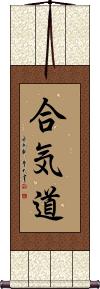
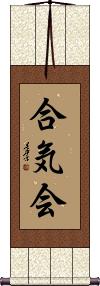
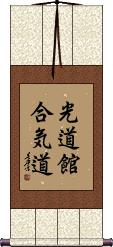
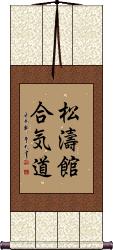
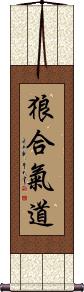
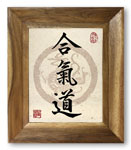
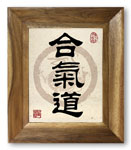
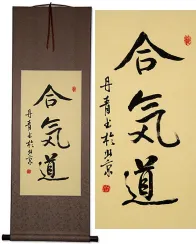
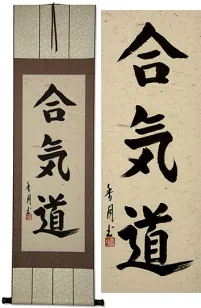
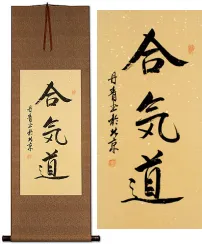
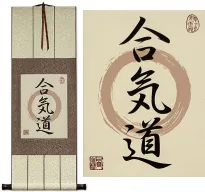
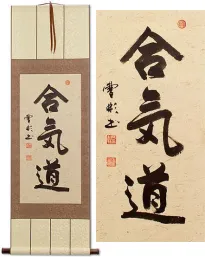
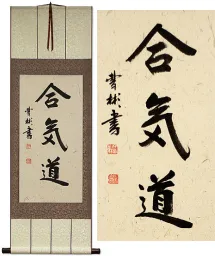
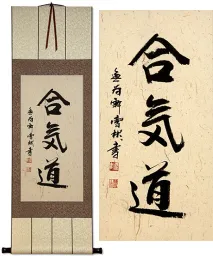
Aikido is often referred to as the defensive martial art. While aikido was born in Japan, it has become a somewhat famous form of defensive tactics taught to soldiers and Marines, as well as some law enforcement officers in the west.
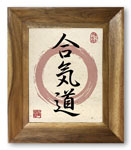
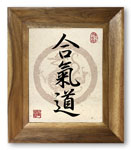
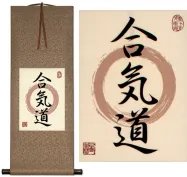
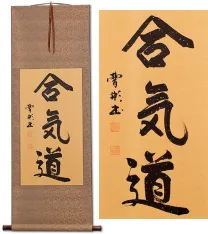
Looking at the characters, the first means "union" or "harmony".
The second character means "universal energy" or "spirit".
The third means "way" or "method".
Please note that while these Japanese Kanji characters can be pronounced in Chinese, this word is not well-known in China and is not considered part of the Chinese lexicon.
Note: It is somewhat accepted that this is the origin of Hapkido in Korea. And other than a modern simplification to the middle Kanji of this 3-Kanji word, it is written the same in Korean Hanja.
More aikido info.
See Also... Martial Arts | Hapkido
Score: 100/100


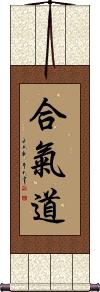
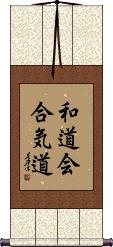
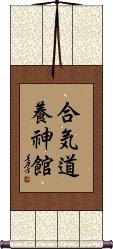
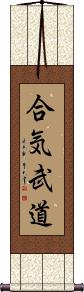
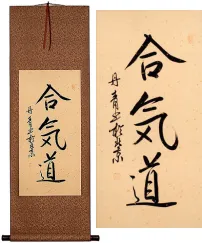
Hapkido is a mostly-defensive martial art of Korea. It has some connection to Aikido of Japan. In fact, they are written with the same characters in both languages. However, it should be noted that the Korean Hanja characters shown here are the original and traditional Chinese form - but in modern Japan, the middle character was slightly simplified. The connection between Japanese Aikido and Korean Hapkido is a bit muddled in history. This is probably due to the relationship between the two countries - especially during WWII when many Koreans became virtual slaves for the Japanese (many Koreans are still bitter about that, so many things were disassociated from having any Japanese origin).
Looking at the characters, the first means "union" or "harmony."
The second character means "universal energy" or "spirit".
The third means "way" or "method".
One way to translate this into English is "Harmonizing Energy Method". This makes since, as Hapkido has more to do with redirecting energy, rather that fighting with strength against strength.
More Hapkido info
More notes:
1. Sometimes Hapkido is Romanized as "hap ki do", "hapki-do" "hab gi do" or "hapgido".
2. Korean Hanja characters are actually Chinese characters that usually hold the same meaning in both languages. There was a time when these characters were the standard and only written form of Korean. The development of modern Korean Hangul characters is a somewhat recent event in the greater scope of history. There was a time when Chinese characters were the written form of many languages in places known in modern times as North Korea, South Korea, Japan, Vietnam, Singapore, Hong Kong, Taiwan, Mainland China, and a significant portion of Malaysia. Even today, more people in the world can read Chinese characters than can read English.
3. While these Korean Hanja characters can be pronounced in Chinese, this word is not well-known in China and is not considered part of the Chinese lexicon.
Score: 100/100


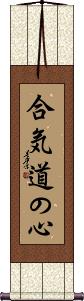
This is the title Heijoshin, as associated with Kendo and Aikido schools of Japanese martial arts.
This is also a word in Japanese which can be translated as "one's self-possession" or "presence of mind".
In Chinese and Korean, this means "simplicity heart". In Chinese and Korean, this implies that you enjoy what you have, keep your heart in balance, and have no over-blown ambitions.
Score: 16/100


If you've taken even a single karate class in your life, you know this term. This is sensei, which is associated in the west with a master or instructor of karate, aikido, judo, and other Japanese martial arts.
In reality, this is a term of respect for almost any professional or skilled person (doctor, lawyer, teacher, etc). In some cases, it is used for musicians and artists who have achieved a certain level of fame, skill, or accomplishment.
It should be noted that this is also a courtesy title in Chinese, but more like calling someone "mister" or "gentleman". It doesn't really have the "master" or "teacher" meaning in Chinese - see our Chinese "Master / Sifu / Shi Fu" entry if your audience is Chinese.
In Korean Hanja, this means teacher, instructor, schoolmaster, or schoolmistress.
This entry is more for educational purposes. This is kind of a strange thing to put on a wall scroll. It's a title that is used more orally to show respect, rather than something written in calligraphy. If you feel that it is appropriate in your circumstances, we are very willing to create a piece of sensei Japanese calligraphy artwork for you.
Score: 16/100


This form of martial arts can be translated in several ways. Some will call it "fist principles" or "the way of the fist", or even "law of the fist". The first character literally means fist. The second can mean law, method, way, principle or Buddhist teaching.
Kempo is really a pot luck of martial arts. Often a combination of Chinese martial arts such as Shaolin Kung Fu with Japanese martial arts such as Karate, Jujutsu (Jujitsu), Aikido, and others. You may see the term "Kempo Karate" which basically means Karate with other disciplines added. In this way, Kempo becomes an adjective rather than a title or school of martial arts.
These facts will long be argued by various masters and students of Kempo. Even the argument as to whether it should be spelled "kenpo" or "Kempo" ensues at dojos around the world (the correct Romaji should actually be "kenpou" if you precisely follow the rules).
The benefit of Kempo is that the techniques are easier to learn and master compared to pure Kung Fu (wu shu). Students are often taught basic Karate moves, kicks, and punches before augmenting the basic skills with complex Kung Fu techniques. This allows students of Kempo achieve a level where they can defend themselves or fight in a relatively short amount of time (a few years rather than a decade or more).
Because the definition of this word is so fluid, I should make some notes here:
1. Purists in Okinawa will claim that "Okinawa Kenpo" or "Ryukyu Hon Kenpo" is the original and true version of this martial art from the old kingdom. There is actually little or no connection between Okinawa Kenpo and the way the word is used elsewhere.
2. In Chinese, where these characters are pronounced "quan fa" (sometimes Romanized as "chuan fa" because the Chinese-pinyin "q" actually sounds like an English "ch" sound), these characters do not hold the connotation of being a mixed martial art. It is simply defined as "the law of the fist".
3. In my Japanese dictionary, it oddly defines Kenpo as "Chinese art of self-defense". I personally don't feel this is the most common way that people perceive the word, but just something you should know.
Score: 16/100

Qi which is also Romanized as Chi in Chinese or Ki in Japanese, is a fundamental concept of traditional Asian culture. Qi is believed to be part of everything that exists, as in “life force” or “spiritual energy”. It is most often translated as “energy flow,” or literally as “air” or “breath”.
The character itself is a representation of steam (or breath) rising from rice.
This was apparently seen as the release of energy from the rice when this concept was first developed. To clarify, the character for rice is shown to the right. The Qi / Chi / Ki character is still used in compound words to mean steam or vapor.
The idea of Qi / Chi / Ki is really a philosophical concept. It's often used to refer to the “flow” of metaphysical energy that sustains living beings. Yet there is much debate that has continued for thousands of years as to whether Qi / Chi / Ki is pure energy, or consists partially, or fully of matter.
You can also see the character for Qi / Chi / Ki in common compound words such as Tai Chi / Tai Qi, Aikido, Reiki and Qi Gong / Chi Kung.
In the modern Japanese Kanji, the rice radical has been changed into two strokes that form an X.
The original and traditional Chinese form is still understood in Japanese, but we can also offer that modern Kanji form in our custom calligraphy. If you want this Japanese Kanji, please click on the character to the right, instead of the “Select and Customize” button above.
More language notes: This is pronounced like “chee” in Mandarin Chinese, and like “key” in Japanese.
This is also the same way to write this in Korean Hanja where it is Romanized as “gi” and pronounced like “gee”, but with a real G-sound, not a J-sound.
Though Vietnamese no longer use Chinese characters in their daily language, this character is still widely known in Vietnam.
See Also... Life Force | Vitality | Life | Birth | Soul
Score: 16/100


This is the title of the Kyuki-Do form of Korean martial arts.
In Korean Hangul, it's 격기도.
While "Kyuki-Do" is the most common romanized form of this title, the official Korean romanization is actually "Gyeog Gi Do" or "Gyeoggi-Do".
The first character means to hit, strike, attack, rout, or break.
The second means "life energy" or "atmosphere".
The last means "the way" or "method".
FYI: The last two characters are the same as the last two in the titles Hapkido and Aikido.
I have included Mandarin Chinese pronunciation above, however, this term would only be known by Chinese people familiar with this style of martial arts. Consider this to be a Korean-only title.
Score: 16/100
Wall scroll artwork shown on this page is priced as follows:
1 character $29.88 each
2-3 characters $39.88 each
After you select your calligraphy, our website will take you through the process of customizing your artwork.
Options for other mounting such as portraits are available for $13 less.
We also offer the services of a famous master calligrapher for a $40 fee on any scroll if you are looking for investment-quality calligraphy.
If you chose our famous master-calligrapher, you also get more choices for silk and paper colors and the option for larger artwork.
All of our calligraphy is completely done by hand in the ancient way.
When the calligrapher finishes creating your artwork, it is taken to our art mounting workshop in Beijing where a wall scroll is made by hand from a combination of silk, rice paper, and wood.
After we create your wall scroll, it takes at least two weeks for air mail delivery from Beijing to you.
Therefore, allow at least 3 weeks for delivery from the time you place your order.
When you select your calligraphy, you'll be taken to another page where you can choose various custom options.
More AIKIDO Asian artwork can be found here.
The scroll that I am holding in this picture is a "regular size"
4-character wall scroll.
As you can see, it is a great size to hang on your wall.
(We also offer custom wall scrolls in larger sizes)
Professional calligraphers are getting to be hard to find these days.
Instead of drawing characters by hand, the new generation in China merely type roman letters into their computer keyboards and pick the character that they want from a list that pops up.
There is some fear that true Chinese calligraphy may become a lost art in the coming years. Many art institutes in China are now promoting calligraphy programs in hopes of keeping this unique form
of art alive.
Even with the teachings of a top-ranked calligrapher in China, my calligraphy will never be good enough to sell. I will leave that to the experts.
The same calligrapher who gave me those lessons also attracted a crowd of thousands and a TV crew as he created characters over 6-feet high. He happens to be ranked as one of the top 100 calligraphers in all of China. He is also one of very few that would actually attempt such a feat.
The following table is only helpful for those studying Chinese (or Japanese), and perhaps helps search engines to find this page when someone enters Romanized Chinese or Japanese
| Title | Characters Simplified Traditional |
Japanese Romaji (Romanized Japanese) | Various forms of Hanyu-Pinyin (Romanized Chinese) | |||
| Aikido (Japanese) | 合気道 (Modern Japanese) 合氣道 (Old Japanese/Chinese) | ai ki dou aikidou ai ki do | hé qì dào he qi dao | he2 qi4 dao4 heqidao | ||
| Hapkido | 合气道 合氣道 | aikido | hé qì dào he qi dao | he2 qi4 dao4 heqidao | ||
| Heijoshin | 平常心 平常心 | hei jou shin heijoushin hei jo shin | píng cháng xīn ping chang xin | ping2 chang2 xin1 pingchangxin | ||
| Sensei / Master / Teacher / Mister | 先生 先生 | sensei | xiān shēng xian sheng | xian1 sheng1 xiansheng | ||
| Kenpo / Kempo / Quan Fa / Chuan Fa | 拳法 拳法 | kenpou kenpo | quán fǎ quan fa | quan2 fa3 quanfa | ||
| Life Energy / Spiritual Energy | 气 / 気 氣 | ki | qì qi | qi4 qi | ||
| Kyuki-Do | 击气道 擊氣道 | n/a | jī qì dào ji qi dao | ji1 qi4 dao4 jiqidao | ||
| If you have not set up your computer to display Chinese, the characters in this table probably look like empty boxes or random text garbage.
This is why we spent hundreds of hours making images so that you could view the characters in the "aikido" listings above. If you want your Windows computer to be able to display Chinese characters you can either head to your Regional and Language options in your Win XP control panel, select the [Languages] tab and click on [Install files for East Asian Languages]. This task will ask for your Win XP CD to complete in most cases. If you don't have your Windows XP CD, or are running Windows 98, you can also download/run the simplified Chinese font package installer from Microsoft which works independently with Win 98, ME, 2000, and XP. It's a 2.5MB download, so if you are on dial up, start the download and go make a sandwich. | ||||||
Some people may refer to this entry as Aikido Kanji, Aikido Characters, Aikido in Chinese Writing, Aikido in Japanese Writing, Aikido in Asian Writing, Aikido Ideograms, Chinese Aikido symbols, Aikido Hieroglyphics, Aikido Glyphs, Aikido in Chinese Letters, Aikido Hanzi, Aikido in Japanese Kanji, Aikido Pictograms, Aikido in the Chinese Written-Language, or Aikido in the Japanese Written-Language.
All custom calligraphy items are made-to-order in our little Beijing artwork-mounting workshop.
Normal delivery isjust over 3 weeksfor these handmade items.
Copyright Oriental Outpost 2002-2009 - All Rights Reserved
Image Use Policy | Privacy Policy
This page of aikido Chinese calligraphy dictionary search results was generated in 0.536264181137seconds.