Many custom options...


And formats...



The name Ability in Chinese / Japanese...
Buy an Ability calligraphy wall scroll here!
Personalize your custom “Ability” project by clicking the button next to your favorite “Ability” title below...
Ability to Adapt
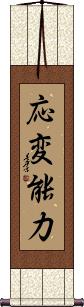
応変能力 is “the ability to take proper steps to meet the situation,” “the ability to adapt oneself to the requirement of the moment,” “the ability to adapt to circumstances,” or “adapt and overcome,” in Japanese Kanji.
Black or white cat matters not as long as it can catch mice
Ability is more important than looks
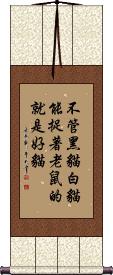
不管黑猫白猫能捉着老鼠的就是好猫 literally translates as: It doesn't matter [if a] cat [is] black [or] white, [as long as it] can catch mice, it's a good cat.
This proverb was either composed or made famous by Deng XiaoPing in 1961 when he exclaimed, “I don't care if it's a white cat or a black cat. It's a good cat so long as it catches mice” when his critics pointed out that his ideas were Capitalistic (free market). The response was meant to say, “It does not matter if it's Communist or Capitalist, as long as it works.”
This is a Chinese proverb that can be used to suggest one should disregard looks or a person's race, as long as they can do the job. It can also be used as a metaphor for many other situations.
Deng XiaoPing probably saved China from collapse (as the Soviet Union experienced). He changed China’s economy from pure Communism to a hybrid where the free market (Capitalism) is encouraged. More about Deng XiaoPing
Hidden Dragon Crouching Tiger
Undiscovered persons of exceptional ability
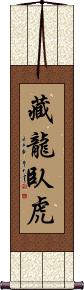
The meaning of 藏龍臥虎 is that both the tiger and dragon have amazing talents, but if they are out of view, you may not have discovered them.
This old Chinese idiom/proverb is appropriate for someone with an amazing ability that keeps that ability hidden.
You might think this title is in reverse, but actually, this is the original Chinese proverb.
The movie Crouching Tiger, Hidden Dragon, popularized this alternate version.
Leadership / Ability to Lead
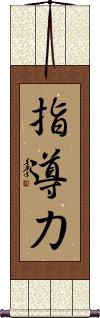
指導力 is the Japanese word for “Leadership.”
This refers to the ability to lead (or, with certain adjectives added, the lack of ability to lead).
Strength / Ability
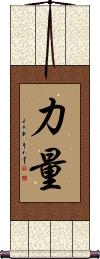
力量 is a general strength term.
It can refer to mental or physical strength (depending on context). 力量 can also be used to describe strength in terms of capability, capacity, ability, and even tact. Some may translate this as power or force.
These search terms might be related to Ability:
Control of Power
Determination to Achieve / Will-Power
Energy / Capability
Geisha of Unequaled Talent
Girl Power / Woman Power
Great Power
Juggernaut / Absolute Power
Perseverance / Will-Power
Power / Strength
Power of Oneself / Self-Sufficient
Power of Understanding and Wisdom
Psychic Power
Self-Discipline / Will-Power
Skill Acquired Through Hard Training
The Spirit of the Dragon Horse and Power of a Tiger
Will-Power / Self-Control
Not the results for ability that you were looking for?
Below are some entries from our dictionary that may match your ability search...
| Characters If shown, 2nd row is Simp. Chinese |
Pronunciation Romanization |
Simple Dictionary Definition |
力 see styles |
lì li4 li ryoku りょく |
More info & calligraphy: Power / Strength(suffix) strength; power; proficiency; ability; (given name) Riki bala; power, strength, of which there are several categories: 二力 power of choice and of practice; 三力 the power of Buddha; of meditation (samādhi) and of practice. 五力 pañcabala, the five powers of faith, zeal, memory (or remembering), meditation, and wisdom. 六力 A child's power is in crying; a woman's in resentment; a king's in domineering; an arhat's in zeal (or progress); a Buddha's in mercy; and a bhikṣu's in endurance (of despite) . 十力 q.v. The ten powers of Buddhas and bodhisattvas. |
能 see styles |
néng neng2 neng nou / no のう |
More info & calligraphy: Neng(1) talent; gift; function; (2) noh (theatre); (surname) Nozaki śak. Able to, can; capability, power. |
力量 see styles |
lì liang li4 liang5 li liang rikiryou / rikiryo りきりょう |
More info & calligraphy: Strength / Ability(1) ability; capacity; capability; talent; (2) physical strength |
才智 see styles |
cái zhì cai2 zhi4 ts`ai chih tsai chih saitomo さいとも |
ability and wisdom wit and intelligence; (surname) Saitomo exceptional ability and intelligence |
蛟龍 蛟龙 see styles |
jiāo lóng jiao1 long2 chiao lung kouryuu / koryu こうりゅう |
More info & calligraphy: Water Dragon / Rain Dragon(1) mizuchi; mythical dragon-like beast, believed to ascend to the heavens through rain; (2) unfulfilled genius; dormant talent; (given name) Kōryū |
ハーク see styles |
paaku / paku パーク |
{vidg} perk; special ability; (personal name) Park; Parke; Perk |
指導力 see styles |
shidouryoku / shidoryoku しどうりょく |
More info & calligraphy: Leadership / Ability to Lead |
超能力 see styles |
chāo néng lì chao1 neng2 li4 ch`ao neng li chao neng li chounouryoku / chonoryoku ちょうのうりょく |
More info & calligraphy: Supernatural Energy(1) extra-sensory perception; ESP; psi; psychic ability; (2) psychokinesis; PK |
千慮一得 千虑一得 see styles |
qiān lǜ yī dé qian1 lu:4 yi1 de2 ch`ien lü i te chien lü i te senryoittoku; senryonoittoku せんりょいっとく; せんりょのいっとく |
More info & calligraphy: Even a fool may sometimes come up with a good idea(expression) (yoji) even a fool may sometimes come up with a good idea |
応変能力 see styles |
ouhennouryoku / ohennoryoku おうへんのうりょく |
More info & calligraphy: Ability to Adapt |
具 see styles |
jù ju4 chü gu ぐ |
tool; device; utensil; equipment; instrument; talent; ability; to possess; to have; to provide; to furnish; to state; classifier for devices, coffins, dead bodies (1) tool; means; (2) ingredients (added to soup, rice, etc.); (counter) (3) counter for sets of armor, utensils, furniture, etc.; (female given name) Tomo All; complete; to present; implements; translit. gh. |
器 see styles |
qì qi4 ch`i chi ki き |
device; tool; utensil; CL:臺|台[tai2] (n,n-suf) (1) device; instrument; (n,n-suf) (2) vessel; container; (3) ability; capacity; calibre; caliber; (given name) Utsuwa A vessel, utensil, tool. |
手 see styles |
shǒu shou3 shou te て |
hand; (formal) to hold; person engaged in certain types of work; person skilled in certain types of work; personal(ly); convenient; classifier for skill; CL:雙|双[shuang1],隻|只[zhi1] (1) (occ. pronounced た when a prefix) (See お手・おて・1) hand; arm; (2) (colloquialism) (See お手・おて・3) forepaw; foreleg; (3) handle; (4) hand; worker; help; (5) trouble; care; effort; (6) means; way; trick; move; technique; workmanship; (7) hand; handwriting; (8) kind; type; sort; (9) (See 手に入る) one's hands; one's possession; (10) (See 手に余る) ability to cope; (11) hand (of cards); (12) (See 山の手・1) direction; (n,n-suf,ctr) (13) move (in go, shogi, etc.); (surname) Tezaki pāṇī; hasta; kara; hand, arm. |
才 see styles |
cái cai2 ts`ai tsai sai さい |
ability; talent; sb of a certain type; a capable individual; then and only then; just now; (before an expression of quantity) only (1) ability; gift; talent; aptitude; genius; (2) sai; traditional unit of volume, approx. 1.8 ml; (given name) Mitsu ability |
投 see styles |
tóu tou2 t`ou tou tou / to とう |
to throw (something in a specific direction: ball, javelin, grenade etc); to cast (a ballot); to cast (a glance, a shadow etc); to put in (money for investment, a coin to operate a slot machine); to send (a letter, a manuscript etc); to throw oneself into (a river, a well etc to commit suicide); to go to; to seek refuge; to place oneself into the hands of; (coll.) to rinse (clothes) in water (1) {baseb} pitching ability; (counter) (2) {sports} counter for throws (of a javelin, bowling ball, etc.); (counter) (3) {fish} counter for casts (of a line) To cast, throw into, surrender, tender. |
材 see styles |
cái cai2 ts`ai tsai zai ざい |
material; timber; ability; aptitude; a capable individual; coffin (old) (n,n-suf) (1) wood; lumber; timber; (2) (raw) material; stuff; (3) talent; ability; capable person; (personal name) Motoki |
精 see styles |
jīng jing1 ching sei / se せい |
essence; extract; vitality; energy; semen; sperm; mythical goblin spirit; highly perfected; elite; the pick of something; proficient (refined ability); extremely (fine); selected rice (archaic) (1) spirit; sprite; nymph; (2) energy; vigor (vigour); strength; (3) fine details; (4) (See 精液) semen; (given name) Makoto Cleaned rice, freed from the husk, pure; essential, essence, germinating principle, spirit; fine, best, finest. |
腕 see styles |
wàn wan4 wan ude うで |
wrist; (squid, starfish etc) arm (1) arm; (2) skill; efforts; ability; (place-name) Ude [upper] arm |
蛟 see styles |
jiāo jiao1 chiao mitsuchi みつち mizuchi みずち |
a legendary dragon with the ability to control rain and floods; see also 蛟龍|蛟龙[jiao1 long2] mizuchi; mythical dragon-like beast |
諝 谞 see styles |
xū xu1 hsü |
(literary) ability and wisdom; scheme; stratagem |
跣 see styles |
xiǎn xian3 hsien sen せん |
barefooted (noun - becomes adjective with の) (1) barefoot; (suffix noun) (2) superior to (a professional, etc. in ability or achievement); (given name) Sen |
輇 辁 see styles |
quán quan2 ch`üan chüan |
limited (of talent or ability); (archaic) solid wheel (without spokes) |
量 see styles |
liàng liang4 liang ryou / ryo りょう |
capacity; quantity; amount; to estimate; abbr. for 量詞|量词[liang4 ci2], classifier (in Chinese grammar); measure word (n,n-suf) (1) quantity; amount; volume; capacity; portion (of food); (2) (See 度量・1) generosity; magnanimity; tolerance; (3) pramana (means by which one gains accurate and valid knowledge; in Indian philosophy); (surname, female given name) Ryō pramāṇa. Measure, capacity, length, ability; to measure, deliberate; a syllogism in logic, v. 比量. A syllogism, consisting of 宗 pratijñā, proposition; 因 hetu, reason; 喩 udāharaṇa, example; but the syllogism varies in the number of its avayava, or members. There are other divisions from 2 to 6, e.g. 現量 and 比量 direct or sense inferences, and comparative or logical inferences; to these are added 聖教量 arguments based on authority; 譬喩量 analogy; 義准 postulation, or general assent; and 無體 negation, or non-existence. |
三細 三细 see styles |
sān xì san1 xi4 san hsi sansai |
The three refined, or subtle conceptions, in contrast with the 六麤 cruder or common concepts, in the Awakening of Faith 起信論. The three are 無明業相 "ignorance", or the unenlightened condition, considered as in primal action, the stirring of the perceptive faculty; 能見相 ability to perceive phenomena; perceptive faculties; 境界相 the object perceived, or the empirical world. The first is associated with the 體corpus or substance, the second and third with function, but both must have co-existence, e.g. water and waves. v. 六麤. |
上達 上达 see styles |
shàng dá shang4 da2 shang ta joutatsu / jotatsu じょうたつ |
to reach the higher authorities (n,vs,vi) (1) improvement (e.g. in skill, ability); advance; progress; (n,vs,vt,vi) (2) (See 上通) (ant: 下達) communication of opinions of the general populace to those of high rank; (given name) Jōtatsu excellent |
二根 see styles |
èr gēn er4 gen1 erh ken nikon |
The two "roots" or natural powers. (1) (a) 利根 keen, able (in the religion); (b) 鈍根 dull. (2) (a) 正根; 勝義根The power or ability which uses the sense organs to discern the truth; (b) 扶根; 扶 (or浮) 塵根the sense organs 五根 as aids. (3) The male and female sexual organs. |
伎倆 伎俩 see styles |
jì liǎng ji4 liang3 chi liang giryou / giryo ぎりょう |
trick; scheme; ploy; skill ability; competency; talent; skill; capacity |
伎能 see styles |
ginou / gino ぎのう |
(irregular kanji usage) technical skill; ability; capacity |
信行 see styles |
xìn xíng xin4 xing2 hsin hsing nobuyuki のぶゆき |
(surname, given name) Nobuyuki Believing action; faith and practice. Action resulting from faith in another's teaching, in contrast with 法行 action resulting from direct apprehension of the doctrine; the former is found among the 鈍根, i.e. those of inferior ability, the latter among the 利根, i.e. the mentally acute. |
働き see styles |
hataraki はたらき |
(1) work; labor; labour; (2) achievement; performance; ability; talent; (3) salary; income; earnings; (4) action; activity; workings; function; operation; movement; motion; (5) {ling} (also written as 活) conjugation; inflection |
Click here for more ability results from our dictionary
The following table may be helpful for those studying Chinese or Japanese...
| Title | Characters | Romaji (Romanized Japanese) | Various forms of Romanized Chinese | |
| Ability to Adapt | 応変能力 | ouhen nouryoku ouhennouryoku ohen noryoku | ||
| Black or white cat matters not as long as it can catch mice | 不管黑貓白貓能捉著老鼠的就是好貓 不管黑猫白猫能捉着老鼠的就是好猫 | bù guǎn hēi māo bái māo néng zhuō zhe lǎo shǔ de jiù shì hǎo mǎo bu4 guan3 hei1 mao1 bai2 mao1 neng2 zhuo1 zhe lao3 shu3 de jiu4 shi4 hao3 mao3 bu guan hei mao bai mao neng zhuo zhe lao shu de jiu shi hao mao | pu kuan hei mao pai mao neng cho che lao shu te chiu shih hao mao | |
| Hidden Dragon Crouching Tiger | 藏龍臥虎 藏龙卧虎 | cáng lóng wò hǔ cang2 long2 wo4 hu3 cang long wo hu canglongwohu | ts`ang lung wo hu tsanglungwohu tsang lung wo hu |
|
| Leadership Ability to Lead | 指導力 指导力 | shidouryoku shidoryoku | ||
| Strength Ability | 力量 | riki ryou / rikiryou / riki ryo | lì liàng / li4 liang4 / li liang / liliang | |
| In some entries above you will see that characters have different versions above and below a line. In these cases, the characters above the line are Traditional Chinese, while the ones below are Simplified Chinese. | ||||

Successful Chinese Character and Japanese Kanji calligraphy searches within the last few hours...



