Many custom options...


And formats...



Tiger in Chinese / Japanese...
Buy a Tiger calligraphy wall scroll here!
Personalize your custom “Tiger” project by clicking the button next to your favorite “Tiger” title below...
2. Crouching Tiger Hidden Dragon
3. The Spirit of the Dragon Horse and Power of a Tiger
5. The Spirit of Dragon and Tiger
6. Fierce Tiger
7. Fire Tiger
8. Hidden Dragon Crouching Tiger
9. How can you catch tiger cubs without entering the lair of the tiger?
10. Tiger Heart
11. Tiger Rumor
12. Water Tiger
13. White Tiger
14. Tiger
Black Tiger Fist
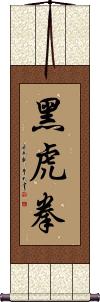
黑虎拳 is Hei Hu Quan or “Black Tiger Fist” - a school of Chinese Martial Arts.
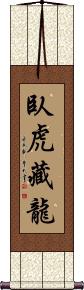
臥虎藏龍 is the movie title of the Kung Fu epic that was very popular in the west a few years back.
This is a re-ordering of an ancient Chinese proverb that refers to undiscovered talents.
The movie was one of the most popular Chinese foreign films to ever debut in the USA but received a lukewarm reception in China.
Note: This can be pronounced in Korean, but it's not a commonly used term.
The Spirit of the Dragon Horse and Power of a Tiger
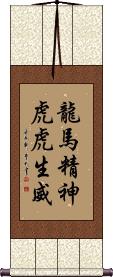
龍馬精神虎虎生威 is an old proverb that is used to wish someone great health and success combined as a great compliment.
The meaning is “The vigor and spirit of the legendary dragon-horse and the power and prestige of the tiger.”
By giving a wall scroll like this to someone, you were either wishing or telling them that they have these qualities. There is also a suggestion of good health - at least anyone with the vigor of a dragon horse would seem to also be in good health.
The Five Animals
Dragon Snake Tiger Leopard Crane
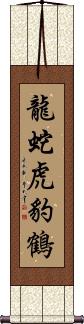
龍蛇虎豹鶴 is a list of the Chinese characters for the five animals of Shaolin Kung Fu in a comfortable order (meaning that they are in the proper order and will “feel right” to a Chinese person who views this arrangement).
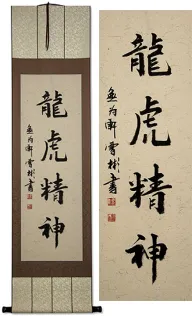
The Spirit of Dragon and Tiger
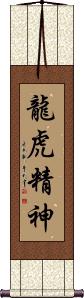
龍虎精神 means the spirit of the dragon and tiger.
It speaks to the vitality and vigor that is the nature of these two creatures.
Beyond “spirit,” the last two characters can also mean mind, soul, or heart. Therefore, you can also say this means “Heart of the Dragon and Tiger,” etc.
龍虎精神 is often titled “Ryukoseishin” in many Japanese martial arts.
Fierce Tiger
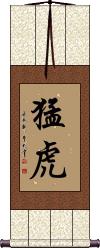
猛虎 means “fierce tiger” or “ferocious tiger” in Chinese, Japanese Kanji, and old Korean Hanja.
Fire Tiger
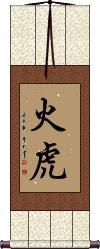
火虎 is the Chinese and Japanese title for “fire tiger.”
If you were born between 9 Feb 1986 and 28 Jan 1987, or between 13 Feb 1926 and 1 Feb 1927, you are a fire tiger according to the Chinese Zodiac.
There are 12 animals and 5 elements in the cycle. Therefore, the fire tiger comes around once every 60 years. The next will be in 2046.
The branch of the zodiac for tiger is written 寅 when dating ancient documents and artwork, but 虎 is the way to write the character for an actual tiger.
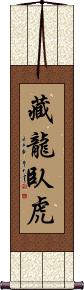
The meaning of 藏龍臥虎 is that both the tiger and dragon have amazing talents, but if they are out of view, you may not have discovered them.
This old Chinese idiom/proverb is appropriate for someone with an amazing ability that keeps that ability hidden.
You might think this title is in reverse, but actually, this is the original Chinese proverb.
The movie Crouching Tiger, Hidden Dragon, popularized this alternate version.
How can you catch tiger cubs without entering the lair of the tiger?
Nothing ventured, nothing gained
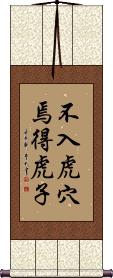
While perhaps no longer politically correct, this Chinese proverb is a reminder that you must take risks if you want rewards.
不入虎穴焉得虎子 is similar to the English proverb, “Nothing ventured, nothing gained.”
The literal word order of the Chinese is, “If (you) don't enter the tiger's lair/cave, how can (you) get/obtain tiger cubs?.”
How can you catch tiger cubs without entering the lair of the tiger?
Nothing ventured, nothing gained
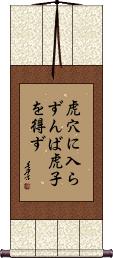
虎穴に入らずんば虎子を得ず is the Japanese version of an ancient Chinese proverb. 虎穴に入らずんば虎子を得ず is a reminder that you must take risks if you want the reward.
虎穴に入らずんば虎子を得ず is similar to the English proverb, “Nothing ventured, nothing gained.”
Note: Because this selection contains some special Japanese Hiragana characters, it should be written by a Japanese calligrapher.
Tiger Heart
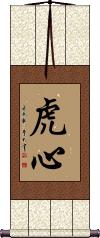
虎心 is “Tiger Heart” in Chinese and Japanese.
This can be a name and is also a rare and exotic gourmet dish served on occasion in southern China.
Tiger Rumor
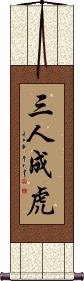
These four characters together relay the meaning that can be expressed in English as “When three people say there's a tiger running in the street, you believe it.”
Of course, there is an ancient story behind this idiom...
三人成虎 is actually a proverb that resulted from a conversation that occurred around 300 B.C.
The conversation was between the king of the Wei kingdom and one of the king's ministers named Pang Cong.
It was near the end of one of many wars, this time with the Zhao kingdom. Pang Cong was to be sent by the king to the Zhao kingdom with the king's son, who was to be held hostage. It was common at the time for a king to make his son a hostage to secure stable peace between warring kingdoms.
Before minister Pang Cong departed, he asked his king, “If one person told you a tiger was running in the street, would you believe it?.”
“No,” the king said.
The minister continued, “What if two people told you?”
The king replied, “Well, I would have my doubts but I might believe it.”
The minister continued, “So, what if three people told you that a tiger is running in the streets?”
The king replied, “Yes, I would believe it. It must be true if three people say it.”
The minister then reminded the king, “Your son and I are now traveling far away to live in the distant Zhao kingdom - much farther from your palace than the street. Rumors may fly about me in my absence, so I hope your majesty will weight such rumors appropriately.”
The king replied, “I have every trust in you, do not worry”
While the minister was gone, the king's enemies gossiped about minister Pang Cong on many occasions. At first, the king thought nothing of these comments and rumors. But slowly, as the rumors mounted, the king began to suspect ill of his minister.
Sometime later, when peace was well-established, the minister and prince were freed and returned to the kingdom of Wei. The king received his son BUT DID NOT EVEN SUMMON MINISTER PANG CONG TO THE PALACE!
Hopefully, this story will help you see how dangerous words can be when used to promote rumors or create ill will. And perhaps will inspire you not to believe everything you hear.
There is also a secondary suggestion in this idiom that gossip is as ferocious as a tiger. Some Chinese people who don't know the ancient story above may believe that this scroll means that rumors are as vicious as three tigers.
Note: This proverb appears in my Korean dictionary but is not well-known in Korea.
Water Tiger
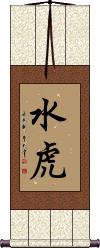
水虎 means “water tiger” in Chinese and Japanese.
White Tiger
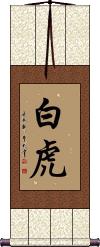
白虎 is the title “White Tiger” in Chinese, Japanese, and old Korean Hanja.
In Chinese folklore, the White Tiger rules or represents the seven mansions (constellations) of the western sky. However, in modern Chinese, a “white tiger” is also slang for hairless female genitalia (be careful about this, as Chinese men might secretly laugh or snicker when they see your white tiger wall scroll).
In Japanese folklore, the White Tiger is a god said to rule over the western heavens. They also know of the Chinese seven mansions of the western heavens. In Japanese, this can also be the given name Byakko.
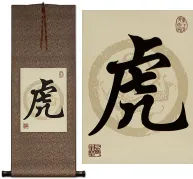
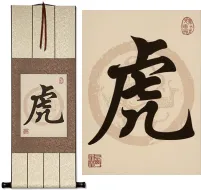
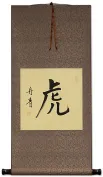
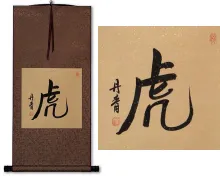
Tiger
Year of the Tiger / Zodiac Sign
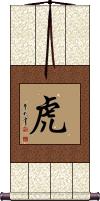
虎 is the character for tiger in Chinese, old Korean Hanja, and Japanese Kanji.
Since you already know what a tiger is, here's some trivia: If you look at the Japanese pronunciation, you might remember a movie called “Tora Tora Tora” which was the code word used to initiate the attack on Pearl Harbor. It simply means “Tiger Tiger Tiger.”
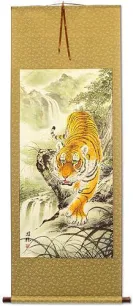
In Chinese culture, the tiger is considered to be the king of all animals (in much the way we see the lion in western culture).
From the Chinese Zodiac, if you were born in the year of the tiger, you . . .
Have a strong personality.
Are full of self-confidence.
Love adventure
Don't like to obey others.
See also our Chinese Zodiac or Tiger Calligraphy pages.
Dragon Crane Tiger
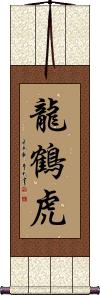
龍鶴虎 is Dragon Crane Tiger in Chinese.
This in-stock artwork might be what you are looking for, and ships right away...

Gallery Price: $65.00
Your Price: $39.88
Gallery Price: $65.00
Your Price: $39.88
Gallery Price: $200.00
Your Price: $99.88
The following table may be helpful for those studying Chinese or Japanese...
| Title | Characters | Romaji (Romanized Japanese) | Various forms of Romanized Chinese | |
| Black Tiger Fist | 黑虎拳 | hēi hǔ quán hei1 hu3 quan2 hei hu quan heihuquan | hei hu ch`üan heihuchüan hei hu chüan |
|
| Crouching Tiger Hidden Dragon | 臥虎藏龍 卧虎藏龙 | wò hǔ cáng lóng wo4 hu3 cang2 long2 wo hu cang long wohucanglong | wo hu ts`ang lung wohutsanglung wo hu tsang lung |
|
| The Spirit of the Dragon Horse and Power of a Tiger | 龍馬精神虎虎生威 龙马精神虎虎生威 | lóng mǎ jīng shén hǔ hǔ shēng wēi long2 ma3 jing1 shen2 hu3 hu3 sheng1 wei1 long ma jing shen hu hu sheng wei | lung ma ching shen hu hu sheng wei | |
| The Five Animals | 龍蛇虎豹鶴 龙蛇虎豹鹤 | ryuu hebi tora hyou tsuru ryuuhebitorahyoutsuru ryu hebi tora hyo tsuru | lóng shé hǔ bào hè long2 she2 hu3 bao4 he4 long she hu bao he longshehubaohe | lung she hu pao ho lungshehupaoho |
| The Spirit of Dragon and Tiger | 龍虎精神 龙虎精神 | ryu ko sei shin ryukoseishin | lóng hǔ jīng shén long2 hu3 jing1 shen2 long hu jing shen longhujingshen | lung hu ching shen lunghuchingshen |
| Fierce Tiger | 猛虎 | mou ko / mouko / mo ko | měng hǔ / meng3 hu3 / meng hu / menghu | |
| Fire Tiger | 火虎 | hi tora / hitora | huǒ hǔ / huo3 hu3 / huo hu / huohu | |
| Hidden Dragon Crouching Tiger | 藏龍臥虎 藏龙卧虎 | cáng lóng wò hǔ cang2 long2 wo4 hu3 cang long wo hu canglongwohu | ts`ang lung wo hu tsanglungwohu tsang lung wo hu |
|
| How can you catch tiger cubs without entering the lair of the tiger? | 不入虎穴焉得虎子 | bú rù hǔ xué yān dé hǔ zǐ bu2 ru4 hu3 xue2 yan1 de2 hu3 zi3 bu ru hu xue yan de hu zi buruhuxueyandehuzi | pu ju hu hsüeh yen te hu tzu pujuhuhsüehyentehutzu |
|
| How can you catch tiger cubs without entering the lair of the tiger? | 虎穴に入らずんば虎子を得ず | koketsu ni haira zun ba tora ko o e zu | ||
| Tiger Heart | 虎心 | tora kokoro torakokoro | hǔ xīn / hu3 xin1 / hu xin / huxin | hu hsin / huhsin |
| Tiger Rumor | 三人成虎 | sān rén chéng hǔ san1 ren2 cheng2 hu3 san ren cheng hu sanrenchenghu | san jen ch`eng hu sanjenchenghu san jen cheng hu |
|
| Water Tiger | 水虎 | sui ko / suiko | shuǐ hǔ / shui3 hu3 / shui hu / shuihu | |
| White Tiger | 白虎 | byakko / hakko byako / hako | bái hǔ / bai2 hu3 / bai hu / baihu | pai hu / paihu |
| Tiger | 虎 | tora | hǔ / hu3 / hu | |
| Dragon Crane Tiger | 龍鶴虎 龙鹤虎 | lóng hè hǔ long2 he4 hu3 long he hu longhehu | lung ho hu lunghohu |
|
| In some entries above you will see that characters have different versions above and below a line. In these cases, the characters above the line are Traditional Chinese, while the ones below are Simplified Chinese. | ||||

Successful Chinese Character and Japanese Kanji calligraphy searches within the last few hours...



