Many custom options...


And formats...



Not what you want?
Try other similar-meaning words, fewer words, or just one word.
The Number Ten in Chinese / Japanese...
Buy a The Number Ten calligraphy wall scroll here!
Personalize your custom “The Number Ten” project by clicking the button next to your favorite “The Number Ten” title below...
Ten
The number ten
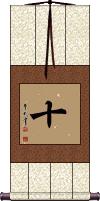
十 is the number ten in Chinese, Japanese Kanji, and old Korean Hanja.
This is a strange selection for a wall scroll, so it's here mostly for reference. I guess it's OK if the number ten is important to you.
 Because this character is rather simple (just two strokes), there is an anti-fraud way to write ten on bank documents. This variant is shown to the right.
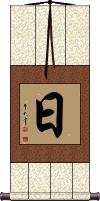
This is how to write “day” in Chinese, Japanese, and Korean Hanja.
This can also mean “Sun,” the star in the middle of the Solar system in which we live. In Japanese, it can also mean “sunshine” or even “Sunday.”
When writing the date in modern Chinese and Japanese, putting a number in front of this character indicates the day of the month. Of course, you need to indicate the month too... The month is expressed with a number followed by the character for the moon. So “three moons ten suns” would be “March 10th” or “3/10.”
Note: This is also the first character for the proper name of Japan. Remember that Japan is “The land of the rising sun”? Well, the first character for Japan means “sun” and the second means “origin” so you get the real meaning now. Sometimes, in China, this sun character can be a short name for Japan or a suffix for something of or from Japan.
Moon
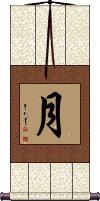
月 is how to write the title for “moon” in Chinese, Korean Hanja, and Japanese Kanji.
月 is also used to refer to the month. This is because China traditionally uses a lunar calendar, so saying “next moon” is the same as saying “next month” etc.
In modern Chinese and Japanese and old Korean, the character for a number is put in front of this moon character to represent western months. So “one moon” is January “two moons” is February etc.
If you are wondering, in the east Asian way to write dates, the character for “sun” or “day” is used with a number in front of it to express the day of the month. So “ten moons, one sun” becomes “October 1st” or “10/1” (this date happens to be Chinese National Day - The equivalent of Independence Day in the USA, Canada Day, or the Queen's Birthday).
In Japanese, 月 can be a surname that romanizes as Tsuki, Tsukizaki, or Takagetsu.
This in-stock artwork might be what you are looking for, and ships right away...

Gallery Price: $108.00
Your Price: $59.88
Not the results for The number Ten that you were looking for?
Below are some entries from our dictionary that may match your The number Ten search...
| Characters If shown, 2nd row is Simp. Chinese |
Pronunciation Romanization |
Simple Dictionary Definition |
京 see styles |
jīng jing1 ching miyako みやこ |
capital city of a country; big; algebraic term for a large number (old); artificial mound (old) (1) (きょう only) imperial capital (esp. Kyoto); (2) (きょう only) (See 伊呂波歌) final word of an iroha poem; (numeric) (3) (usu. けい) 10^16; 10,000,000,000,000,000; ten quadrillion; (surname, female given name) Miyako capital |
戒 see styles |
jiè jie4 chieh kai; ingoto(ok) かい; いんごと(ok) |
to guard against; to exhort; to admonish or warn; to give up or stop doing something; Buddhist monastic discipline; ring (for a finger) (1) (かい only) {Buddh} admonition; commandment; (2) sila (precept) śīla, 尸羅. Precept, command, prohibition, discipline, rule; morality. It is applied to the five, eight, ten, 250, and other commandments. The five are: (1) not to kill; (2 ) not to steal; (3) not to commit adultery; (4) not to speak falsely; (5) not to drink wine. These are the commands for lay disciples; those who observe them will be reborn in the human realm. The Sarvāstivādins did not sanction the observance of a limited selection from them as did the 成實宗 Satyasiddhi school. Each of the five precepts has five guardian spirits, in all twenty-five, 五戒二十五神. The eight for lay disciples are the above five together with Nos. 7, 8, and 9 of the following; the ten commands for the ordained, monks and nuns, are the above five with the following: (6) not to use adornments of flowers, nor perfumes; (7) not to perform as an actor, juggler, acrobat, or go to watch and hear them; (8) not to sit on elevated, broad, and large divans (or beds); (9) not to eat except in regulation hours; (10) not to possess money, gold or silver, or precious things. The 具足戒full commands for a monk number 250, those for a nun are 348, commonly called 500. Śīla is also the first of the 五分法身, i.e. a condition above all moral error. The Sutra of Brahma's Net has the following after the first five: (6) not to speak of the sins of those in orders; (7) not to vaunt self and depreciate others; (8) not to be avaricious; (9) not to be angry; (10) not to slander the triratna. |
萬 万 see styles |
wàn wan4 wan yorozu よろづ |
ten thousand; a great number (counter) {mahj} counter for character tiles (chi: wàn); (surname) Yorozu Myriad, 10,000; all. |
點 点 see styles |
diǎn dian3 tien ten |
to touch briefly; to tap; to mark with a dot; to check off (on a list); to order (food etc); to select; to mention; to bring up (a topic or person); to hint at; to imply; to administer (eye medicine etc) in drops; to light (a fire, a lamp etc); to ignite; to nod (one's head) in agreement; to beckon by moving (one's hand) up and down; point; dot; spot; speck; dot stroke in Chinese characters; (math.) decimal point; point in time or space; (after a number) o'clock; a small amount; a bit; (after a verb or adjective) a bit more; classifier for small amounts To dot, touch, punctuate, light, nod; the stroke of a clock; to check off; a speck, dot, drop, etc. |
両手 see styles |
ryoute / ryote りょうて |
(1) both hands; both arms; (2) (from the number of fingers on both hands; used as secret jargon) ten |
五桁 see styles |
goketa ごけた |
five-digit number; "ten thousands" column |
十六 see styles |
shí liù shi2 liu4 shih liu tomu とむ |
sixteen; 16 16; sixteen; (given name) Tomu ṣoḍaśa Sixteen is the esoteric (Shingon) perfect number, just as ten is the perfect number in the Huayan sūtra and generally, see 大日經疏 5. |
十干 see styles |
shí gān shi2 gan1 shih kan jikkan じっかん |
same as 天干; the 10 heavenly stems 甲, 乙, 丙, 丁, 戊, 己, 庚, 辛, 壬, 癸 (used cyclically in the calendar and as ordinal number like Roman I, II, III) ten celestial stems (two types each of wood, fire, earth, metal, water); ten heavenly stems |
定員 定员 see styles |
dìng yuán ding4 yuan2 ting yüan teiin / ten ていいん |
fixed complement (of crew, passengers etc) (1) fixed number (of people); prescribed number (of regular personnel, students, etc.); quota; numerical limit; complement; (2) capacity (of a bus, boat, theatre, etc.); seating capacity |
第十 see styles |
dì shí di4 shi2 ti shih daijuu / daiju だいじゅう |
(surname) Daijuu number ten |
十天干 see styles |
shí tiān gān shi2 tian1 gan1 shih t`ien kan shih tien kan |
the ten Heavenly Stems 甲[jia3], 乙[yi3], 丙[bing3], 丁[ding1], 戊[wu4], 己[ji3], 庚[geng1], 辛[xin1], 壬[ren2], 癸[gui3] (used cyclically in the calendar and as ordinal number like Roman I, II, III) |
忉利天 see styles |
dāo lì tiān dao1 li4 tian1 tao li t`ien tao li tien Tōri Ten |
trāyastriṃśas, 怛唎耶怛唎奢; 多羅夜登陵舍; the heavens of the thirty-three devas, 三十三天, the second of the desire-heavens, the heaven of Indra; it is the Svarga of Hindu mythology, situated on Meru with thirty-two deva-cities, eight on each side; a central city is 善見城 Sudarśana, or Amarāvatī, where Indra, with 1, 000 heads and eyes and four arms, lives in his palace called 禪延; 毘闍延 (or 毘禪延) ? Vaijayanta, and 'revels in numberless sensual pleasures together with his wife' Śacī and with 119, 000 concubines. 'There he receives the monthly reports of the' four Mahārājas as to the good and evil in the world. 'The whole myth may have an astronomical' or meteorological background, e. g. the number thirty-three indicating the 'eight Vasus, eleven Rudras, twelve Ādityas, and two Aśvins of Vedic mythology. ' Eitel. Cf. 因陀羅. |
贍部洲 赡部洲 see styles |
shàn bù zhōu shan4 bu4 zhou1 shan pu chou senbushū |
Jambudvīpa. Name of the southern of the four great continents, said to be of triangular shape, and to be called after the shape of the leaf of an immense Jambu-tree on Mount Meru, or after fine gold that is found below the tree. It is divided into four parts: south of the Himālayas by the lord of elephants, because of their number; north by the lord of horses; west by the lord of jewels; east by the lord of men. This seems to imply a region larger than India, and Eitel includes in Jambudvīpa the following countries around the Anavatapta lake and the Himālayas. North: Huns, Uigurs, Turks. East: China, Corea, Japan, and some islands. South: Northern India with twenty-seven kingdoms, Eastern India ten kingdoms, Southern India fifteen kingdoms, Central India thirty kingdoms. West: Thirty-four kingdoms. |
那由他 see styles |
nà yóu tā na4 you2 ta1 na yu t`a na yu ta nayuta なゆた |
(1) (Buddhist term) an extremely great number (often said to be 100 million) (san: nayuta); (numeric) (2) 10^60 (or 10^72); (female given name) Nayuta nayuta, 那庾多 (or 那由多); 那術 (or 那述) a numeral, 100,000, or one million, or ten million. |
金剛天 金刚天 see styles |
jīn gāng tiān jin1 gang1 tian1 chin kang t`ien chin kang tien kongō ten |
The vajradevas twenty in number in the vajradhātu group. |
五十二位 see styles |
wǔ shí èr wèi wu3 shi2 er4 wei4 wu shih erh wei gojūni i |
The fifty-two stages in the process of becoming a Buddha; of these fifty-one are to bodhisattvahood, the fifty-second to Buddhahood. They are: Ten 十信 or stages of faith; thirty of the 三賢 or three grades of virtue i. e. ten 十住, ten 十行, and ten 十廻向; and twelve of the three grades of 聖 holiness, or sainthood, i. e. ten 地, plus 等覺 and 妙覺. These are the Tiantai stages; there are others, and the number and character of the stages vary in different schools. |
十指に余る see styles |
jisshiniamaru じっしにあまる |
(exp,v5r) to number more than ten; to be numerous |
Variations: |
tenkii; ten kii / tenki; ten ki テンキー; テン・キー |
(1) numeric keypad (wasei: ten key); number pad; numpad; (2) numeric key |
The following table may be helpful for those studying Chinese or Japanese...
| Title | Characters | Romaji (Romanized Japanese) | Various forms of Romanized Chinese | |
| Ten | 十 / 拾 十 | juu / ju | shí / shi2 / shi | shih |
| Day | 日 | hi / nichi | rì / ri4 / ri | jih |
| Moon | 月 | tsuki | yuè / yue4 / yue | yüeh |
| In some entries above you will see that characters have different versions above and below a line. In these cases, the characters above the line are Traditional Chinese, while the ones below are Simplified Chinese. | ||||

Successful Chinese Character and Japanese Kanji calligraphy searches within the last few hours...



