» Japanese Art

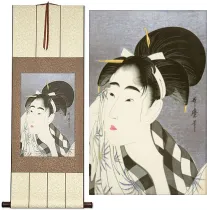
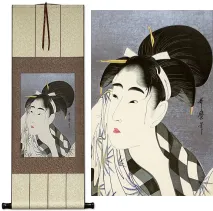
Pretty Face
Japanese Oil Painting
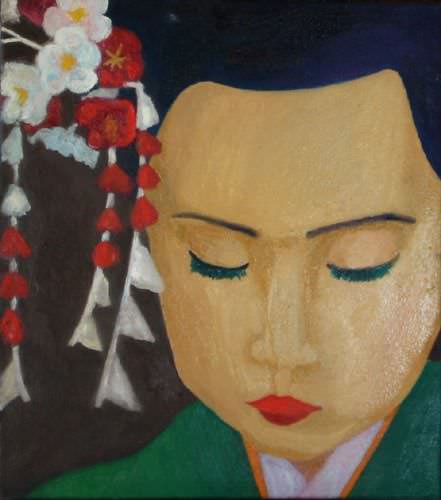
Pretty Face - Japanese Oil Painting line
arrow
18"
(45.5cm)
arrow
line
arrow 16"
(40.6cm)
arrow


Typical Gallery Price: $880.00

Your Price:
US$395.00U.S. Dollars

GBP £239.73British Pounds
Euro €266.62Euro
Canadian $423.29Canadian Dollars
Australian $434.57Australian Dollars


See how "Pretty Face - Japanese Oil Painting" would look after being professionally framed

Want to see what this painting might look like after you frame it?
Frame View

Is your computer monitor too small?
Click below for a smaller framed view
Zoom to 75% | Zoom to 50%

Approximate Measurements:
16" x 18"   (40.6cm x 45.5cm)


Pretty Face - Japanese Lady

This painting features a pretty Japanese girl with flowers in her hair. This is actually the artist's sister.


About the art:

This is done on canvas with oil paints. The canvas is mounted to 1½" (39mm) thick museum style stretcher bars. This means the artwork is ready-to-hang. However, you could also frame it if you wish.
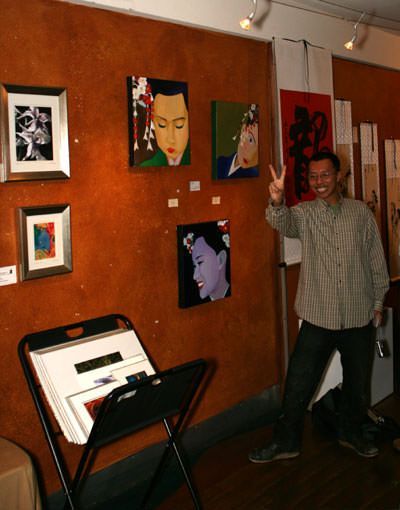
Tomo Uesugi, Asian artist from Japan.

Tomo Uesugi, a contemporary artist from Japan.


About the artist:

Uesugi Tomotsugu (or Tomo as his friends call him) was born in Kyoto, Japan in 1979. After growing up in Osaka, he left in search of adventure and something different in other parts of the world. His interest in other cultures led him to places like Italy and Ireland before deciding to spend some time in America.

While he sees these adventures in other countries as an exciting and unforgettable chapter in his life, he didn't realize that it would also present great opportunities for his art. During the past few years, Tomo has created a buzz about his unique artwork at several exhibitions in Southern California. In fact, I personally invited Tomo to feature his newest pieces at our Asian art exhibition in December 2006.

Tomo's artwork comes from his experiences. Some of his paintings have a very Japanese theme, from his memories of growing up in Osaka. Others are reflections of people that he's met along the way in his travels around the world. He never uses models, pictures in magazines, or other media for inspiration. It all comes from his memory, which makes the artwork more personal and emotional.

Since we, as westerners may not notice their own environment, it may surprise you to hear that Tomo thinks of California as an exotic land full of diverse people from many different cultures. He doesn't think of Japan as being that exotic, because "all the faces are similar, and the culture is so unified". He feels that in California, the faces are all different, as if the people are like colors of paint and the city is the canvas. This has allowed Tomo to live his philosophy that all races can co-existence. This is the philosophy he often expresses in his art.

The more faces Tomo sees, the more he realizes how similar we all are. He's met a friend from Iran that reminds him of a friend in Japan. And when in Japan, the people he meets often remind him of his friends in America. Through his art, he hopes that in some small way, he can show others how close or similar all of mankind is, and spawn a desire to create a less violent society where people of varying backgrounds can develop positive relationships.


« Previous Artwork | Next Artwork »

Typical Gallery Price: $880.00

Your Price:
US$395.00U.S. Dollars

GBP £239.73British Pounds
Euro €266.62Euro
Canadian $423.29Canadian Dollars
Australian $434.57Australian Dollars


All orders billed in U.S. Dollars.
Other currencies shown for reference at approximate exchange rates.


Item Location: USA
details


Gary's random little facts about China:

Is "Oriental" politically correct?
Everyone is going to hate me for this, but here is the truth:

Some people who currently prefer to call themselves "Asian-Americans" woke up one morning and decided that "Oriental" is now a word to be used only for Oriental rugs, Oriental art and lamps, or any other inanimate object from Eastern Asia.

When I was teaching English in China, many of my students would refer to themselves as "Oriental", and I would correct them and say, It's better to say that you are Asian or Chinese rather than Oriental, but I was at a loss as to explain why.
My Chinese students were very smart, and came back at me with the fact that being from Asia was too broad a term, and asked if Persians and Saudi Arabians should also refer to themselves as "Asian".

I then had to make excuses for my geographically-challenged fellow Americans* who had long ago replaced the correct term of "Oriental" (meaning the bio-geographic region including southern Asia and the Malay Archipelago as far as the Philippines, Borneo and Java), and replaced it with "Asian" which in truth encompasses half the world's population - many of whom do not consider themselves to be of the same race as those from the Orient.
(For those Americans reading this and who've slept through their high school geography class: It's true, the whole Middle East, and half of Russia are located in the Asian continent)

But I admit I am not helping the problem. You see, almost half the people that find our website did so while searching for "Asian art" and I have done a lot to promote our business as "Purveyors of Asian art". So you can blame me too.
To truly be an Asian art gallery, we would have to offer artwork from beyond the Orient, from places like India, Persia (Iran), most Arab nations, and Russia.

Notes:
There are a lot of things that present problems in the English language.
Usually these problems are thanks to mistakes of the past.
That's why we have to say, "He's an Indian from India" versus "He's a Native-American Indian" (Thanks to Mr. Columbus).

Things to learn:
Do not refer to a Persian (Iranian) as Arab.
If you refer to an Arab-American as being Asian, they will look at you funny and possibly be offended.
If you refer to a person from India as Asian, you will mildly amuse them.
If you refer to a Russian as being Asian, they will pour borsch on you (my ex-wife is Russian, so I know this to be true from experience).
Using "Asian" to refer to a person from Singapore is okay, but they will later, as if by accident, mention that they are in fact from the most civilized country in Asia.

*We citizens of the USA call ourselves "Americans" which seems a bit arrogant to our neighbors who reside on the continents of North and South America. Keep in mind, Canadians and Mexicans are also from North America, but refer to themselves in more correct geographic terms.

Artwork
Search:

Exact
Phrase

Oriental Outpost LogoFlagTowerwatercolor
Chinese Calligraphy Search
ArtPaintingsAsian Art Gallery

Adventures in Asian Art