Zhao Jun
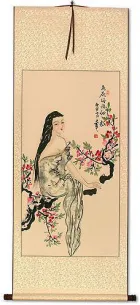
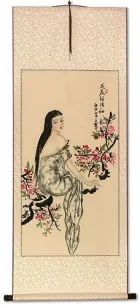
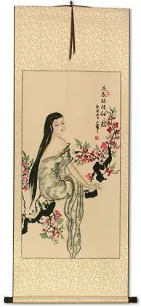
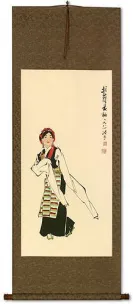
The Distinguished Beauty of China Wall Scroll

57¾"
23¾"
Typical Gallery Price: $180.00
$79.88Sold Out
Sorry you missed it.
• Hand-Painted Artwork.
• Handmade Wall Scroll.
• Money-Back Guarantee.
Approximate Measurements
Artwork Panel: 42.3cm x 91.5cm ≈ 16¾" x 36"
Silk/Brocade: 51.5cm x 147cm ≈ 20¼" x 57¾"
Width at Wooden Knobs: 60.5cm ≈ 23¾"
Information about caring for your wall scroll


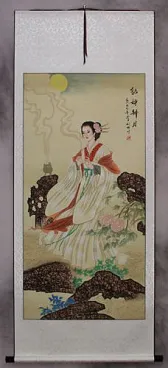
Zhao Jun
The Distinguished Beauty of Ancient China
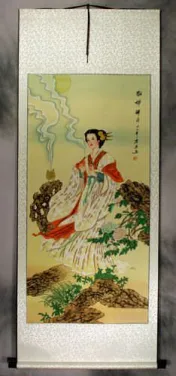
The title suggests that this captures the moment that Zhao Jun left the kingdom forever to become queen of the Monguls.
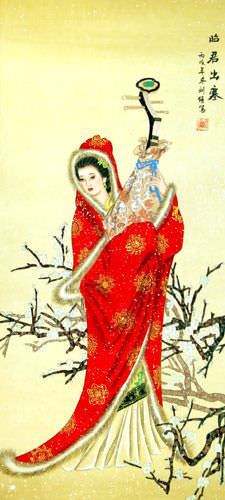
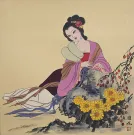
Close up view of the artwork mounted to this silk brocade wall scroll
About the Four Beauties of China
In Chinese culture, there are four famous beautiful woman of China.
They are thought to be the most beautiful and significant woman of China's ancient history.
Although the stories about these woman are based on fact, they are also steeped in legend.
These woman have remained famous through history because of the drastic effects on the emperors, kings, and kingdoms with whom they were bound.
Some of the beauties brought kingdoms and dynasties to their knees.
Most of the beauties had lives that ended in tragedy or mystery.
The legend and history of these woman has inspired Chinese artists for generations to create paintings that depict these four famous beauties of ancient China.
More about the beauty depicted on this scroll:
The woman in this painting is known as "Wang Zhao-Jun"
To break down the meaning:
Wang = Her maiden family name
Zhao-Jun = Distinguished (her given name)
Her Story
History tells us that around 48 B.C. the Emperor of the Han Dynasty (206 B.C. - 220 A.D.) sent out servants to find the most beautiful woman in all of China. These women in turn were selected to be the Emperor's concubines/wives.
The Emperor did not want to go through the pageantry of personally looking over each woman before making his selection of which one would accompany him for evening, so he had an artist paint a picture of each woman. This way, he could choose in private, and have the one of his choosing summoned to his chamber.
Legend has it that because Zhao-Jun was an honest woman, she did not bribe the painter as the other concubines did. So, being snubbed by the artist, her portrait was not as attractive as the portraits of the other women. She was never summoned to the Emperor's chamber.
Years later in 33 B.C., the Han Emperor needed to make a peace-offering to the Hun King (from what is now called Mongolia). The Hun King demanded to marry a princess of the Han-Chinese Empire if peace was to prevail.
The call went out throughout the palace for a woman willing to live in the "barbarian lands" of Mongolia. Only Zhao-Jun volunteered. She was still known to the emperor only by the less-than flattering painting of her. The Emperor having never seen her in person agreed to the exchange.
In much ceremony and fanfare, Zhao-Jun was given to the Hun King. When the Han Emperor saw her for the first time at the ceremony, he realized that he was giving away the most beautiful woman of his entire court. He was angry, but he could not go back on his word and risk war with the Huns.
Upon the departure of the Hun King and his new wife Zhao-Jun, the Emperor summoned his painter and had him executed (Looks CAN kill, even in art).
Zhao-Jun taught the Hun people how to weave and farm. Previously they had been a clan of warriors and hunters and therefore knew very little of agricultural techniques at the time.
During her life, she gave birth to two girls and a boy, and the king was well-pleased.
Zhao-Jun became a very beloved in the Hun Kingdom. She became a symbol of peace, and because of her, battles ceased between the Huns and Han-Chinese for more than 60 years.
No one is certain what happened to her after the king's death. Some believe that she committed suicide to avoid following the levirate tradition of maintaining the royal bloodline by marrying her own son. Others believe that she married a different heir to the throne born by another woman.
There is still a tomb and memorial in Inner-Mongolia that honors her life and the peace that she brought to the region.
About the Artist
This was painted and is signed by 
 (Liu Qian) of Guilin China.
Like many artists in China, she likes to paint images of the Ancient Four Beauties of China.
This painting is titled "Zhao Jun Departs the Border [of the Kingdom]". Along with that title, the rest of the characters include the year painted (Winter 2006) and the artist's signature.
This is painted on xuan paper (rice paper), I later took it back to our workshop in Beijing and had it mounted by hand to a silk wall scroll.
This item was listed or modified
Feb 28th, 2010
Typical Gallery Price: $180.00
$79.88Sold Out
Sorry you missed it.