
Category: Chinese Character & Japanese Kanji Calligraphy Wall Scrolls

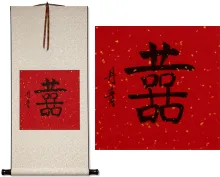
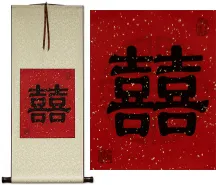
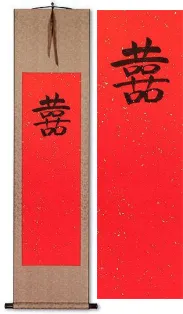
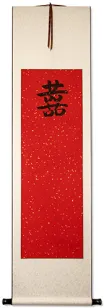
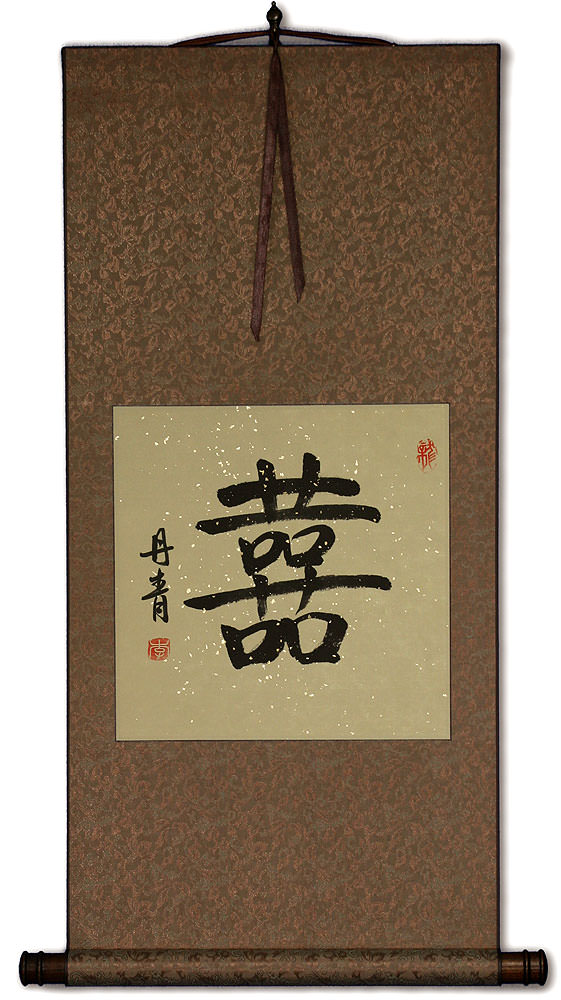
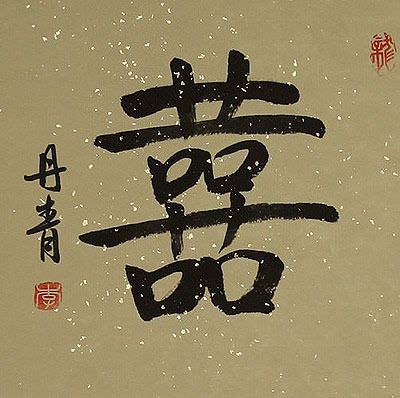
Gold Silk Double Happiness Wall Scroll

Gold Silk Double Happiness Wall Scroll
arrow
87.2cm
34¼"
arrow
line
arrow 49.4cm
19½"
arrow


Typical Gallery Price: $70.00

Your Price: $29.88U.S. Dollars

GBP £19.40British Pounds
Euro €23.28Euro
Canadian $31.57Canadian Dollars
Australian $32.81Australian Dollars


Approximate Measurements

Painting: 31.3cm x 31.4cm  ≈  12¼" x 12¼"

Silk Scroll: 40.4cm x 87.2cm  ≈  16" x 34¼"

Width at Wooden Knobs: 49.4cm  ≈  19½"

Information about caring for your new Wall Scroll

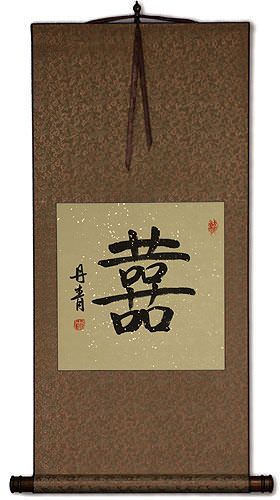
Double Happiness

Chinese Calligraphy Scroll

This is a common gift for Chinese couples getting married or newly married couples, but it appropriate for anyone for whom you wish the greatest of happiness.

As we say in the west, "Two heads are better than one" Well, in the east, two "happinesses" are certainly better than one.

This is not really a character that is pronounced very often - it's almost exclusively used in written form. However, if pressed, most Chinese people will pronounce this "shuang xi" (double happy) although literally there are two "xi" characters combined in this calligraphy (but nobody will say "xi xi").

In Chinese, "xi" is pronounced like "she" but with your tongue sitting in the bottom of your mouth and your teeth slightly open (there is no sound in English exactly like this).


This piece is painted with special Chinese ink on rice paper mounted to a traditional silk scroll.

Chinese Calligraphy is only practiced by those with a keen and agile hand. It is an art that dates back thousands of years, and great artists, writers, and poets are often admired for their calligraphy ability and style.

The artist's name is "Li Dan Qing" who is from Beijing, China. He is an older man with good calligraphy skills.

To create this art, Li Dan Qing used special Chinese ink on thick rice paper. Then I took it to the best painting mounters in Beijing to mount the painting on a silk scroll.

This hanging scroll is really nice since it doesn't require framing. Just hang it on your wall as Chinese people have done for centuries.

The scroll that you receive may vary slightly from the image above, as this series of calligraphy artwork is all handmade to order.


Select

Custom Double Happiness Calligraphy Wall Scrolls & Portraits

Double Happiness

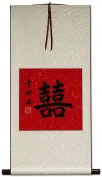
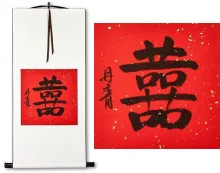
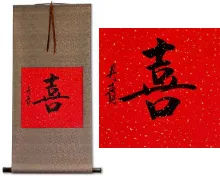
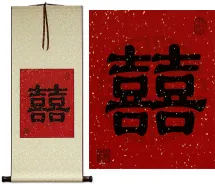
I like the festive red and white double happiness scroll that you see above, but if you want different colors, a larger size, or higher-quality calligraphy...

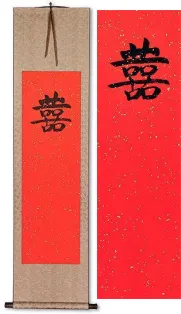
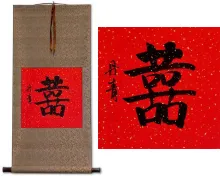
Double Happiness Portrait Tan

We can have a custom Double Happiness wall scroll created for you, simply click on the button above, and start customizing your Double Happiness artwork.

Double Happiness Portrait Red

Custom wall scrolls start at $29.88
and portraits start at $13 less ($16.88).

If you are looking for something very special, we also have investment-quality calligraphy available from a famous master-calligrapher in Beijing for an additional $40 fee.

Click the "Select & Customize" button above to see all the options.


« Previous Artwork | Next Artwork »

Typical Gallery Price: $70.00

Your Price: $29.88U.S. Dollars

GBP £19.40British Pounds
Euro €23.28Euro
Canadian $31.57Canadian Dollars
Australian $32.81Australian Dollars


All orders billed in U.S. Dollars.
Other currencies shown for reference at approximate exchange rates.


Item Location: USA
details


Gary's random little things about China:

Is "Oriental" politically correct?

Everyone is going to hate me for this, but here is the truth:

Some people who currently prefer to call themselves "Asian-Americans" woke up one morning and decided that "Oriental" is now a word to be used only for Oriental rugs, Oriental art and lamps, or any other inanimate object from Eastern Asia.

When I was teaching English in China, many of my students would refer to themselves as "Oriental", and I would correct them and say, It's better to say that you are Asian or Chinese rather than Oriental, but I was at a loss as to explain why.
My Chinese students were very smart, and came back at me with the fact that being from Asia was too broad a term, and asked if Persians and Saudi Arabians should also refer to themselves as "Asian".

I then had to make excuses for my geographically-challenged fellow Americans* who had long ago replaced the correct term of "Oriental" (meaning the bio-geographic region including southern Asia and the Malay Archipelago as far as the Philippines, Borneo and Java), and replaced it with "Asian" which in truth encompasses half the world's population - many of whom do not consider themselves to be of the same race as those from the Orient.
(For those Americans reading this and who've slept through their high school geography class: It's true, the whole Middle East, and half of Russia are located in the Asian continent)

But I admit I am not helping the problem. You see, almost half the people that find our website did so while searching for "Asian art" and I have done a lot to promote our business as "Purveyors of Asian art". So you can blame me too.
To truly be an Asian art gallery, we would have to offer artwork from beyond the Orient, from places like India, Persia (Iran), most Arab nations, and Russia.

Notes:
There are a lot of things that present problems in the English language.
Usually these problems are thanks to mistakes of the past.
That's why we have to say, "He's an Indian from India" versus "He's a Native-American Indian" (Thanks to Mr. Columbus).

Things to learn:
Do not refer to a Persian (Iranian) as Arab.
If you refer to an Arab-American as being Asian, they will look at you funny and possibly be offended.
If you refer to a person from India as Asian, you will mildly amuse them.
If you refer to a Russian as being Asian, they will pour borsch on you (my ex-wife is Russian, so I know this to be true from experience).
Using "Asian" to refer to a person from Singapore is okay, but they will later, as if by accident, mention that they are in fact from the most civilized country in Asia.

*We citizens of the USA call ourselves "Americans" which seems a bit arrogant to our neighbors who reside on the continents of North and South America. Keep in mind, Canadians and Mexicans are also from North America, but refer to themselves in more correct geographic terms.

Artwork Search:

Oriental Outpost Logo FlagTowerwatercolor
ArtPaintingsAsian Art Gallery
Chinese Calligraphy Search
Adventures in Asian Art

Key / Important Pages Information Pages "How To" Pages Search Engine & Tech Stuff
Home About Us Asian Art Questions & Answers How We Make Our Wall Scrolls Site Map
Asian Art Gallery About China How Paintings are Mounted How To Care For Wall Scrolls Asian Language Tools
New Asian Art Arrivals F.A.Q. Asian Art Adventures Framing Suggestions Characters
Love in Chinese/Japanese Gary's Stories Asian Calligraphy Search How To Frame Asian Art Asian Art Index
Strength in Chinese/Japanese Contact Us Japanese Kakejiku   Chinese/Japanese Dictionary

Copyright Oriental Outpost 2002-2010   -   All Rights Reserved
Image Use Policy | Privacy Policy