Category: Chinese Character & Japanese Kanji Calligraphy Wall Scrolls

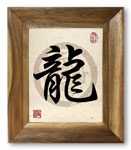
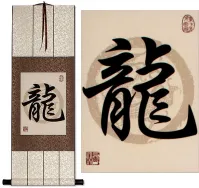
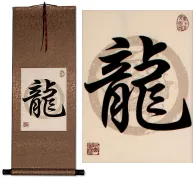
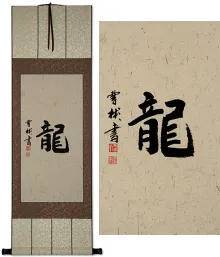
DRAGON Chinese / Japanese Calligraphy Wall Scroll

DRAGON Chinese / Japanese Calligraphy Wall Scroll
arrow
34½"
(88cm)
arrow
line
arrow 19¼"
(49cm)
arrow


Typical Gallery Price: $65.00

Your Price:
US$29.88U.S. Dollars

GBP £18.13British Pounds
Euro €20.17Euro
Canadian $32.02Canadian Dollars
Australian $32.87Australian Dollars


Approximate Measurements:
Painting: 12¼" x 12¼"   (31.1cm x 31cm)
Silk Scroll: 15¾" x 34½"   (40cm x 88cm)
Width of Wooden Scroll Roller: 19¼"   (49cm)

Information about caring for your new Wall Scroll


Dragon Symbol

Chinese Calligraphy Wall Scroll

"Dragon" Japanese / Chinese Character

A quick lesson in Chinese Hanzi and Japanese Kanji

The three boxes in the middle below are all forms of
Traditional Chinese Characters often referred to as Hanzi in Chinese, and Kanji in Japanese.


Simplified Character

Printed Calligraphy

Typical Calligraphy

Typical Handwriting

Ancient
Official Script

If you want to open your mind to more, read below...

Examples of the earliest pictographs or hieroglyphics in China date back almost 5000 years. The area now known as China was a fragmented region with various kingdoms rising and falling. Each kingdom or nationality in China had it's own writing system, and could not effectively communicate with people of other kingdoms.

Finally, in about 221 B.C. the Qin Dynasty unified all of China. One of the Qin Emperor's goals was to standardize the writing system across all of his empire.
The official script was the second-generation of writing approved during Qin.

This official script was still very complex to write, with the invention of the printing press still thousands of years away, official scribes literally had their hands full as they penned various documents. Historian will argue this point, but the Traditional Chinese Characters that you see today entered a somewhat final lexicon during the Wei kingdom (220-265 A.D.) and the Jin Dynasties (265-420 A.D.)

The adoption of Simplified Chinese Characters happened under Chairman Mao in the early 1950s in an effort to make it easier for under-educated people to learn to write. However, true calligraphers will only write Traditional Chinese Characters. Places like Taiwan, Hong Kong, Singapore, and several other regions in Asia that were unaffected by Chairman Mao's rule still use traditional characters in day to day life.

Traditional Chinese Characters are known in Japanese as Kanji. In Japan, these characters are used every day in newspapers, magazines, documents, and personal letters. However, they are mixed with Japanese-specific characters called Hiragana, which means a Chinese person trying to read a Japanese newspaper can only get the gist of what the story might be about.

In China, people speak all kinds of languages such as Mandarin, Cantonese, Shanghainese, Tibetan and many other regional languages. When two Chinese people meet, they might not be able to understand each other because they speak different Chinese languages. But they can write down what they are trying to say, and be easily understood thanks to the Qin emperor's dream of a standardized writing system.

Think about this fact:
One third of the world's population can understand the Chinese characters shown above, while only 6% of the people in the world can natively understand the English words that I am writing here.

© 2005 OrientalOutpost.com


Japanese Kanji Dragon Symbol

This Chinese character is "long" which means dragon.
(Note: This "long" is not English, so the "o" vowel sound is more like "oh" in English)

In Chinese culture, the dragon represents power and for many generations, only the emperor could dare to wear the symbol of a dragon on their clothing.
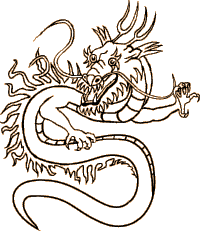
Dragon

If you hang this on your wall, it indicates that you are strong and powerful. A great gift for a corporate executive with a chip on his shoulder - lol.

This is probably the most popular Chinese character for tattoos these days. You'll see it on the shoulders of pro-basketball players, and on the hips of pop star divas. Of course, half of them have no idea what this symbol means, and the other half incorrectly think it directly means "warrior" or "power".

Of course, long before it became a tattoo staple, the mythological dragon roamed the earth - at least in the legends and minds of Asian people.

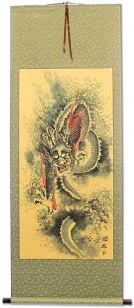
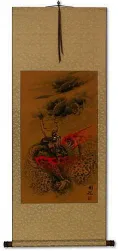
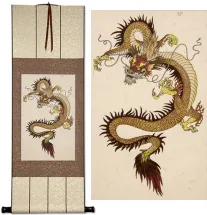
The history of the dragon is hidden deep in myth and history. Drawings and symbols of this mythological animal can be traced back to prehistoric tribal peoples of China. Evidence of the dragon's importance in Chinese culture can be traced to dragon figures and other artifacts unearthed from the Yin Dynasty (3000 years ago).


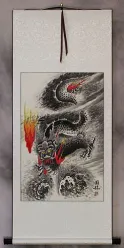
This piece is painted with special Chinese ink on xuan paper (rice paper) mounted to a traditional gold-colored silk scroll.

Chinese Calligraphy is only practiced by those with a keen and agile hand. It is an art that dates back thousands of years, and great artists, writers, and poets are often admired for their calligraphy ability and style.

The artist's name is "Li Dan Qing" who is from Beijing, China. He is an older man with excellent calligraphy skills.

This hanging scroll is really nice since it doesn't require framing. Just hang it on your wall as Chinese people have done for centuries.


« Previous Artwork | Next Artwork »

Typical Gallery Price: $65.00

Your Price:
US$29.88U.S. Dollars

GBP £18.13British Pounds
Euro €20.17Euro
Canadian $32.02Canadian Dollars
Australian $32.87Australian Dollars


All orders billed in U.S. Dollars.
Other currencies shown for reference at approximate exchange rates.


Item Location: USA
details


Gary's random little facts about China:

Where's my fortune cookie?
So after traveling to China, you have just finished your first meal in a real Chinese restaurant.
But the bill comes, and the waiter forgot to bring everyone their fortune cookies!
Well, actually not...
You see, fortune cookies did not come from China (at least not directly).
One legend has it in the late 1800s or early 1900s, a Chinese man running a noodle making shop in San Francisco accidentally mixed a bunch of sugar in his dough, and didn't want to waste it. So he made cookies and stuck papers with people's fortunes on them as a novelty.
In the end, it's really the Chinese visitors to America that are confused when the waiter brings them a blob of sugary noodle dough with a piece of paper stuck in it.

Artwork
Search:

Exact
Phrase

Oriental Outpost LogoFlagTowerwatercolor
Chinese Calligraphy Search
ArtPaintingsAsian Art Gallery

Adventures in Asian Art