Custom Master / Teacher Chinese or Japanese Calligraphy Wall Scroll
We have many options for Master and Teacher-related words or phrases on a wall scroll or portrait in Chinese or Japanese calligraphy.
If you want to create a cool Master wall scroll, this is the place. Below you will find a few Asian symbols that express the idea of Master or Teacher.
1. Fatherly Master / Sifu / Shi Fu / Shifu
2. Teacher / Master / Old Sage
3. Sensei / Master / Teacher / Mister
5. When Three People Gather, One Becomes a Teacher
6. Rank Holder
7. Grand Master / Great Teacher
9. Past experience is the teacher for the future
11. I am the Master of My Destiny
12. Grandmaster / Grand Master
14. Be Master of Mind, Not Mastered by Mind
17. Ronin / Masterless Samurai
18. Senpai / The Elder or Master
19. Always with a Book in Hand
20. Architect
21. Benevolent Heart
23. Broken Hearted
24. Confucius: Universal Education
25. Every Creature Has A Domain
26. The Great Path has No Gate
27. Engineer
28. Even Monkeys Fall From Trees
29. Example is Better than Precept
30. Fighting Spirit
32. Geisha of Unequaled Talent
33. Generosity
35. Happy / Laughter / Cheerful Bliss
37. Ip Man
39. Joshua 24:15
40. Juggernaut
41. Kenpo / Kempo / Quan Fa / Chuan Fa
42. Kiwame
43. We are not born with knowledge, how does one achieve maturity?
46. Kyousei / Kyōsei
47. Mumonkan / The Gateless Gate
48. Naruto
49. Ninja
50. There is No Royal Road to Learning
51. Nothingness
52. The Sea of Knowledge Has No Limits
53. Osu No Seishin
55. Reiki Precepts by Usui Mikao
56. River of Literacy, Sea of Learning
57. The Saint
58. Shidan
59. Shidoin
60. Shidoshi
61. Shihan
62. Siddhartha
63. Si Gung
65. Sword Saint
66. Taekwondo
67. Tolerance
68. Training / Drill
69. Uchi-Deshi
70. There is one single thread binding my Way together
71. It is better to be a warrior in a garden than a gardener in a war
73. Ultimate Loyalty to Your Country
74. Happu Fudo
Fatherly Master / Sifu / Shi Fu / Shifu
Martial Arts Teacher
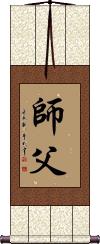
師父 means master in Chinese (occasionally used in Korean Hanja and Japanese). In the context of Martial Arts, this is the master and teacher who instructs students.
The second character by itself means father. Thus, you get the “Fatherly Master” translation. There's an old Chinese saying that goes something like, “One who is your teacher for one day is your father for life.”
Language notes: I've often seen this romanized as “sifu,” this is actually the Cantonese romanization. In Mandarin Chinese, it's “Shifu.” The pronunciation in Mandarin is actually like “sure foo” (using typical English pronunciation). There's an “R-sound” in there, which is not obvious from the romanization. Many martial arts studios incorrectly pronounce this like “she foo” (which is actually the Japanese pronunciation). In Cantonese, it sounds like “Sea foo” (almost like “seafood,” minus the “d” at the end).
師父 is kind of a weird selection for a calligraphy wall scroll; this entry is more for educational purposes. But you are welcome to buy it if it suits your circumstances.
Teacher / Master / Old Sage
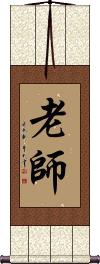
老師 directly translates as “old teacher,” “old master,” or “old sage.”
Together, they are understood as “teacher.” When you think about that, also realize that with age comes respect in Asian cultures. So calling someone old is a term of respect (not like the way we mean it in English). You could replace “old” with “respected” and be closer to how this is meant in Chinese.
Teachers, in general, are more respected by their students and the population in China. When I was a teacher in China, I certainly felt that.
This term is also used for masters of certain fields. For instance, a master calligrapher would respectfully be addressed as a “teacher.” In this case, “master” and “teacher” are synonymous.
Other artists (especially those who are famous or accomplished) should be addressed with this term. Also, some martial arts schools use this term of respect for their masters/teachers/instructors.
This title is recognized in Japanese as "roushi" with the same meaning but it’s rarely used in Japan.
Sensei / Master / Teacher / Mister
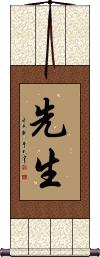
先生 is sensei, which is associated in the west with a master or instructor of karate, aikido, judo, and other Japanese martial arts.
In reality, this is a term of respect for almost any professional or skilled person (doctor, lawyer, teacher, etc.). Sometimes, it is used for musicians and artists who have achieved a certain level of fame, skill, or accomplishment.
It should be noted that this is also a courtesy title in Chinese but more like calling someone “mister” or “gentleman.” It doesn't have the “master” or “teacher” meaning in Chinese - see our Chinese “Master / Sifu / Shi Fu” entry if your audience is Chinese.
In Korean Hanja, this means teacher, instructor, schoolmaster, or schoolmistress.
This entry is for educational purposes. 先生 is kind of a strange thing to put on a wall scroll. It's a title that is used more orally to show respect rather than something written in calligraphy. If you feel it is appropriate in your circumstances, we will create a piece of sensei Japanese calligraphy artwork for you.
Martial Arts Master
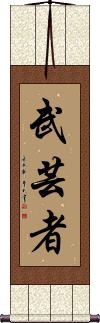
武芸者 is the Japanese Kanji title for “Martial Arts Master.” It suggests that you have reached at least the level of black belt and are probably to the level where you are ready to become an instructor.
Please consider carefully where you stand before ordering this phrase on a wall scroll. If you are not a master, this will make you look a bit foolish.
If you want to get this as a gift for your master at the dojo. Try to discreetly make sure this term is used in your school. Different schools and styles of Japanese martial arts use different terms. You may notice in the Romaji that the last two characters romanize as “geisha” which means “person skilled in arts” (what a geisha girl really is). The title here has the character for “martial,” “warrior,” and/or “military” in front of it. Therefore the literal translation is “martial art person.”
These Kanji are valid Chinese characters and Korean Hanja, but this title does not really make sense in Chinese and is not often used in Korean, though a Chinese or Korean would be able to guess the meaning by looking at the first and last characters.
When Three People Gather, One Becomes a Teacher
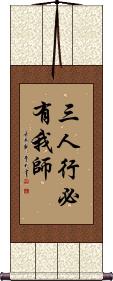
三人行必有我师 means “when three people meet, one becomes the teacher.”
This famous Chinese philosophy suggests that when people come together, they can always learn from each other.
One person must be the teacher and others learn. And in turn, the others become the teachers of the knowledge they possess.
It is important to remember that we all have something to teach, and we all have something to learn as well.
Rank Holder
The one who has achieved rank in martial arts
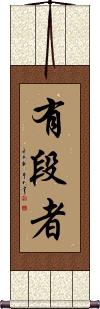
有段者 is a Japanese term for someone who holds rank in karate, judo, etc.
This term theoretically applies to anyone with rank (above a white belt). However, some schools or dojos may reserve this title for a holder of a black belt.
I'd suggest that you only order this phrase if you have honestly reached this level.
This title does kind of make sense in Chinese but only to those Chinese who practice “kong shou dao” (karate) or when used in the context of martial arts.
Grand Master / Great Teacher
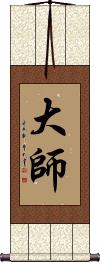
大師 is a way to title a great master, grand master, or great teacher.
This can be used in the context of martial arts or a Buddhist teacher. Thus, it can be used to title a living Buddha, Bodhisattva, or high-ranking monk.
Mentor: Teacher and Friend
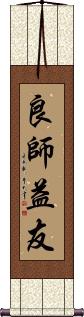
良師益友 is a Chinese proverb or word that means good teacher and helpful friend.
In the most simple translation, these 4 characters mean mentor.
Past experience is the teacher for the future
Past events not forgotten serve as teachers for later events.
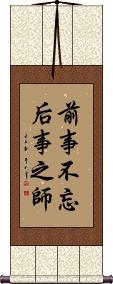
The most literal translation to English of this ancient 前事不忘后事之师 Chinese proverb is:
“Past events not forgotten serve as teachers for later events.”
However, it's been translated several ways:
Don't forget past events, they can guide you in the future.
Benefit from past experience.
Past experience, if not forgotten, is a guide for the future.
Past calamity is my teacher.
A good memory for the past is a teacher for the future.
The remembrance of the past is the teacher of the future.
If one remembers the lessons of the past; They will serve as a guide to avoid mistakes in the future.
The origin:
This proverb comes from the 5th century B.C., just before the Warring States Period in the territory now known as China.
The head of the State of Jin, Zhi Bo, seized power in a coup. He did this with help from the armies of the State of Han and Wei. Instead of being grateful for the help from Han and Wei, he treacherously took the land of Han and Wei. Never satisfied, Zhi Bo employed the armies of Han and Wei to attack and seize the State of Zhao.
The king of Zhao took advice from his minister Zhang Mengtan and secretly contacted the Han and Wei armies to reverse their plans and attack the army of Zhi Bo instead. The plan was successful, and the State of Zhao was not only saved but was set to become a powerful kingdom in the region.
Zhang Mengtan immediately submitted his resignation to a confused king of Zhao. When asked why, Zhang Mengtan said, “I've done my duty to save my kingdom, but looking back at past experience, I know sovereign kings are never satisfied with the power or land at hand. They will join others and fight for more power and more land. I must learn from past experiences, as those experiences are the teachers of future events.”
The king could not dispute the logic in that statement and accepted Zhang Mengtan's resignation.
For generations, the State of Zhao continued to fight for power and land until finally defeated and decimated by the State of Qin (which led to the birth of the Qin Dynasty in 221 B.C.).
Respected Teacher
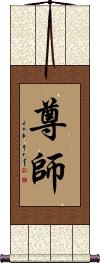
尊師 means “respected teacher,” “revered master,” or “guru” in Japanese and Chinese.
尊師 is a nice gift for a revered teacher in your life whose knowledge and mentoring have meant a lot to you.
I am the Master of My Destiny
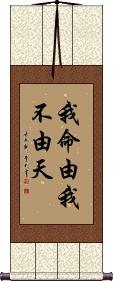
我命由我不由天 is often translated as “The one that shapes my destiny will always be myself rather than the God” or “Rather than Heaven, I am the master of my fate.”
Breaking down the words directly:
我命 = My fate/destiny
由我 = depends (on) me
不 = not
由天 dependant (on) Heaven.
See Also: Choose Your Own Destiny
Grandmaster / Grand Master
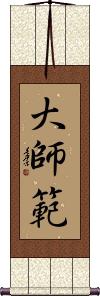
大師範 is a Japanese title for the master, grandmaster, or senior instructor.
This is a bit of an odd selection for a piece of calligraphy artwork, so proceed with caution. Better to find an appropriate phrase or title (such as the name of the martial art) and then add something like “Grandmaster Smith” as a smaller inscription down the side.
Loyalty to Duty or Master
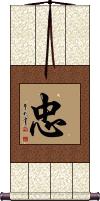
忠 is the simplest way to write the word loyalty in Chinese and Japanese.
A single character like this leaves the meaning open. But alone, a Chinese or Japanese person would think of loyalty to duty or loyalty to one's master (in ancient times). I suppose that it could be loyalty to your boss or company in this day in age.
忠 can also mean fidelity or faithfulness.
This can also be romanized as “chung.”
Be Master of Mind, Not Mastered by Mind
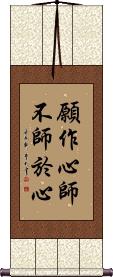
願作心師不師於心 means, “Be master of mind, rather than mastered by mind,” in Chinese.
This is not an ancient Chinese phrase but rather something we added at the request of a customer.
Master / Skilled Worker
Secondary version of Sifu
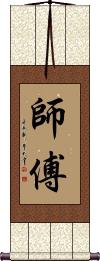
師傅 is “sifu” as in the “master” in the context of martial arts.
But two sifu titles are floating around. This one can simply mean “skilled worker.”
Historically, this term has been used for many things, such as “The tutor of a king or emperor.” But now it's more commonly used to mean master worker or qualified worker.
Currently, within the field of skilled labor, a master (Shifu) is higher than a journeyman and is considered to be one worthy of teaching others.
Note: In the 1970s and 1980s, this term was used as a common form of polite address between people. You might say, “master, do you know where Tian'anmen Square is?” to a person on the street at that time. This usage has almost passed; however, for some reason, people still often refer to taxi cab drivers as “master” in China (though I think/hope this is fading).
In Mandarin Chinese, this is pronounced like “Sure Foo,” and in Cantonese, like “See Foo.”
The second character is the difference between this sifu and the other. In this case, the second character by itself means tutor, instructor, or teacher.
Reiki - Master Symbol
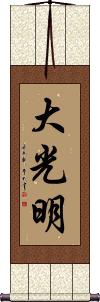
大光明 is the master symbol “Daikomyo” or “Dai Ko Myo,” which is usually associated with the healing practice of Reiki.
This title can be translated as “Great Bright Light.” This symbol, as used in Reiki, alludes to “Enlightened Nature” or the radiance of a purified soul or deity.
Pronunciations in Chinese and Korean are included above but this title has no meaning except when used by a Reiki practitioner. In fact, this title is not that well known by those outside the Reiki community in Japan.
In Chinese, this would be interpreted as “Great Bright Future” (the second two characters alone create a word that means “bright future” in Chinese).
Ronin / Masterless Samurai
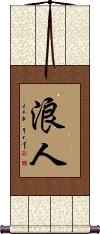
The 浪人 or Ronin have no master - The most famous are the 47 ronin created after their Lord committed suicide. This term was not a positive title for the Samurai of ancient Japan. However, in recent years, movies and video games have glorified the term Ronin.
In Chinese, this term has the original meaning of a hobo, vagabond, or ruffian.
In Korean Hanja, these characters would be read as adventurer, wanderer, someone without a steady job, or someone who is wasting away time.
In modern Japan, this term is used as a nickname for a high school student who has failed a college entry exam (and is trying again).
In Chinese and Korean, the Japanese definition of “Masterless Samurai” is known because of the historical context. Even in Japanese, the literal translation is closer to the Chinese and Korean definitions shown above.
This will make a fine wall scroll if you are a fan of the Ronin or see yourself as a Ronin of sorts. However, please think twice before getting a Ronin tattoo!
Senpai / The Elder or Master
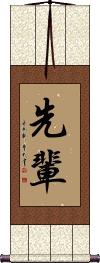
先輩 is a Chinese, Japanese, and old Korean word or title that means elders, senior (at work or school), superior, older graduate, progenitor, or old-timer.
In American dojos, this is sometimes romanized as Sempai.
Always with a Book in Hand
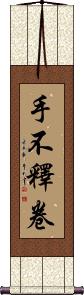
手不釋卷 is a Chinese proverb that literally means “always with a book in hand.”
It's a proverb said of a hardworking scholar or student.
This may refer to a student or scholar who is diligent and hardworking. It's a great gift for a student or scholar who loves books.
Architect
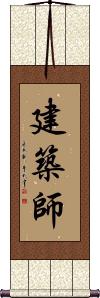
建築師 means Architect in Chinese.
The first two characters mean construction or architecture (of buildings).
The last character means teacher, master, or expert.
Benevolent Heart
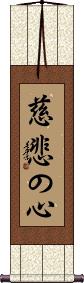
慈悲の心 means benevolent heart, compassionate heart, or merciful heart in Japanese.
This is a Japanese-only phrase and should be ordered from our Japanese master calligrapher. This is because the third character is unique Hiragana.
Chances are you are into Inuyasha and are seeking the title of chapter 471 which is often translated as “Merciful Heart.”
Beware of the Lawyers
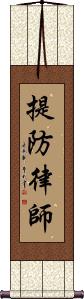
提防律師 is a kind of Chinese joke about lawyers.
The first two characters mean “guard yourself against (an attack)” or “beware.”
The last two characters can be translated as lawyer, attorney, or solicitor.
Separately, those characters mean law/regulation/control and master/expert/teacher. Here, you can see the attorney meaning is pretty clear in the individual characters.
Please note this is Chinese only (it won't make sense in Japanese, and the last two characters are sometimes translated together as “Buddhist Priest” in Japanese).
Broken Hearted
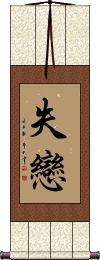
In Chinese, this can mean losing one's love; to breaking up (in a romantic relationship); to feel jilted.
In Japanese Kanji, this means disappointing love, broken heart, unrequited love, or being lovelorn.
失戀 is also valid in old Korean Hanja, which means unrequited love, unreturned love, a disappointment in love, or a broken heart.
Note: In modern Japan, they will tend to write the more simple 失恋 form instead of 失戀. If you order this from the Japanese master calligrapher, expect the more simple modern version to be written (unless you give us instructions to use the older or more traditional version).
Confucius: Universal Education
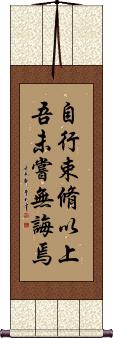
自行束脩以上吾未尝无诲焉 means, for anyone who brings even the smallest token of appreciation, I have yet to refuse instruction.
Another way to put it is: If a student (or potential student) shows just an ounce of interest, desire, or appreciation for the opportunity to learn, a teacher should offer a pound of knowledge.
This quote is from the Analects of Confucius.
This was written over 2500 years ago. The composition is in ancient Chinese grammar and phrasing. A modern Chinese person would need a background in Chinese literature to understand this without the aid of a reference.
Every Creature Has A Domain
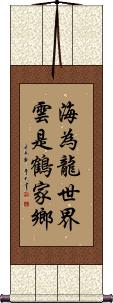
海為龍世界雲是鶴家鄉 is a somewhat poetic way to say that everyone and everything has its place in the world.
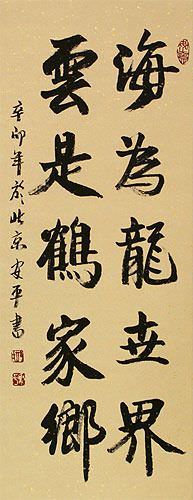 The first line (which is the column on the right) says, “The Ocean is the World of the Dragon.” The next column says, “The Clouds are the Domain of the Cranes.”
The image to the right is what this calligraphy can look like in xing-kaishu style by a Master Calligrapher.
The Great Path has No Gate
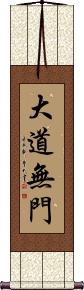
大道無門 is a Buddhist proverb that means “The Great Way has no entrance,” “The Great Way is gateless,” or “The Great Path lacks a gate.”
This can be translated in many other ways.
This concept was authored within a long sacred text by 無門慧開 (known as Wúmén Huìkāi in Chinese or Mumon Ekai in Japanese). He was a Chinese Chan Master (in Japanese, a Zen Master) who lived between 1183 and 1260 AD. His most famous work was a 48-koan collection titled “The Gateless Barrier” or “The Gateless Gate” (無門關 Wú Mén Guān in Chinese, or 無門関 Mu Mon Kan in Japanese). This calligraphy title is a notable line from this collection.
I like this reference to the source of this proverb: The Gateless Gate 無門關
Engineer
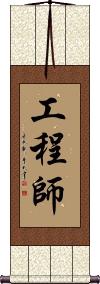
工程師 is the occupational title of an engineer in Chinese.
In China, an engineer might have a sign on his desk or a name badge with his/her name on it and this title. It's not too common to see this on a wall scroll in China, but you are allowed to take such liberties in the west.
Note that in China, a wall scroll like this is sometimes given to a teacher who builds (engineers) the spirits of their students. It's a way to honor a teacher, and in this case, the meaning departs from an occupational title.
Even Monkeys Fall From Trees
Meaning: Anyone can make a mistake
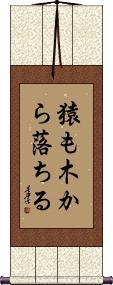
猿も木から落ちる is the Japanese proverb, “Even monkeys fall from trees.”
It suggests that even the most skilled, can make a mistake in something they should be a master of. Or, to put it simply, “Anyone can make a mistake.”
Note: Because this selection contains some special Japanese Hiragana characters, it should be written by a Japanese calligrapher.
Example is Better than Precept
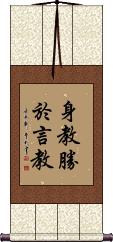
Tell somebody how to do something and they might get it.
Show them how to do it, and they will master it in no time.
身教勝於言教 can also be translated as “Behavior teaches more than words.”
See Also: Wisdom
Fighting Spirit
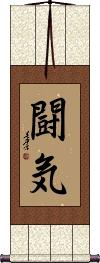
闘気 is an alternate Japanese title for “fighting spirit.”
This one is more like “fighting energy.” The second character is “ki,” the same “ki” in Aikido. This “ki” is the spiritual energy that all martial arts practitioners must master and focus on.
Begging Forgiveness
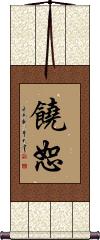
饒恕 is a Chinese word that is a kind of forgiveness that you would beg for like a servant begging a master.
This can also be the forgiveness that a person would beg from the king or God.
This word suggests that this is forgiveness for something really bad (a terrible crime or sin).
Geisha of Unequaled Talent
(Danger: Can mean prostitute!)
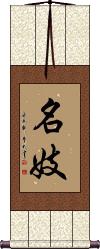
In Japanese, 名妓 means “distinguished/talented/beautiful geisha.”
The meaning in Chinese (and the deeper meaning in Japanese) would be “distinguished/talented/beautiful prostitute.”
I am not sure that our master calligrapher will even write this, so please note that fact if you decide to place the order. Of course, we'll refund your money if he refuses.
Generosity
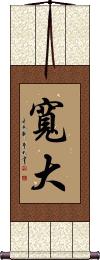
寬大 is a Chinese, Japanese, and Korean word that means Generosity.
Generosity is giving and sharing. You share freely, not with the idea of receiving something in return. You find ways to give others happiness and give just for the joy of giving. Generosity is one of the best ways to show love and friendship.
寬大 can also be translated as charitable, magnanimity, liberality, or in some contexts, broad-mindedness.
Note: There is a tiny deviation in the first character when written in Japanese. If you choose our Japanese master calligrapher, the little dot on the lower right of the first character will be omitted. With or without the dot, this can be read in Chinese, Japanese Kanji, and old Korean Hanja.
See Also: Benevolence | Altruism | Charity
Allah / God of Islam
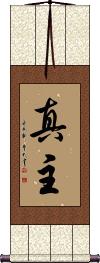
真主 is how Chinese Muslims refer to God (it literally means “True Master”).
Oddly, in China, two different names for God have emerged. Even though Muslims, Christians, and Jews all worship the same God of Abraham.
In Arabic, the word Allah is just the Arabic way to say, God. Arab Christians pray to Allah, just like Arab Muslims. Somehow in China, the title of God diverged.
If you are curious, there are millions of Muslims throughout China but especially in the northwest portion of China known as Xinjiang. Here you will find descendants of Turkmen, Persian, Arab, and other ethnicities. Some are mixed with Han-Chinese blood; others appear to be pure Turkmen. Many have fair complexions, green eyes, and light hair but all are citizens of China. A visit to Xinjiang will shift your paradigm and blow away all of your stereotypes about what it means to be Chinese.
Happy / Laughter / Cheerful Bliss
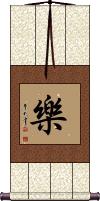
樂 is a single-character form of happiness or bliss that holds the ideas of laughing and having a good time.
This can also be translated as happy, glad, enjoyable, fun, and sometimes, music.
This a really good character if your audience is Chinese.
This is not a word seen alone very often in Korean.
 In Japanese, this character is written like the image shown to the right. If you order this from the Japanese master calligrapher, it will look like this instead of the character shown above.
Note: In Japanese, this has a meaning of comfort, ease, and enjoyment.
See Also: Joyfulness
Hunter / Huntsmen
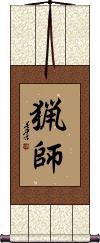
猟師 is hunter or huntsman in Japanese Kanji.
There are several ways to say “hunter” in Japanese, but this is probably the most common.
The first Kanji means hunting or game.
The second Kanji means master, specialist, or teacher. In this case, it will be read as “master.” So this is also “game master” or “hunt master.”
Ip Man
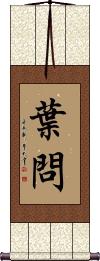
葉問 is the name of “Ip Man” or “Yip Man” (1893-1972).
He was a martial arts practitioner and master. He is perhaps most famous for being the master of Bruce Lee.
Isshin Ryu Karate Do
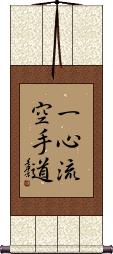
一心流空手道 is the full title for Isshin-Ryu Karate-Do.
The literal meaning is “one heart method empty hand way.”
There are other ways to translate this, but if you are looking for this title, you already know that.
This would make a great wall scroll for your dojo or private studio if you study this form of Japanese (technically from Okinawa) Karate.
Because this is a specifically-Japanese title, I strongly recommend that you select our Japanese Master Calligrapher to create this artwork.
Joshua 24:15
This House Serves the LORD
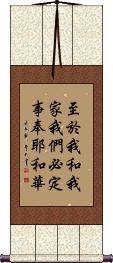
至於我和我家我們必定事奉耶和華 is the last sentence of Joshua 24:15 in Chinese.
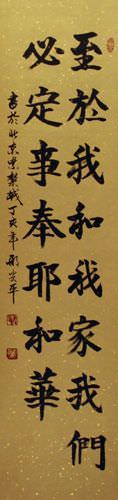
What your
calligraphy
might look like
from our
Chinese Master
Calligrapher
Joshua 24:15 (KJV) ...as for me and my house, we will serve the LORD.
Joshua 24:15 (NIV) ...as for me and my household, we will serve the LORD.
We used the only official Christian Chinese Bible that I know of so that the translation would be as accurate and standard as possible. Any Chinese Christian worth their salt will easily be able to identify this verse from the Chinese words on this scroll.
I think it is a bit like having a secret code on your wall that quietly expresses to whom you are faithful.
A great gift for your devout Christian or Jewish friend if they happen to be fond of Asian art.
Or perhaps a wonderful “conversation starter” for your own home.
Note: If you are curious, the last three characters represent the way “LORD” is used in most English Bibles. In Chinese, this is actually the phonetic name from Mandarin Chinese for “Jehovah.”
Juggernaut
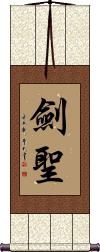
劍聖 is about the closest you can get to juggernaut in Chinese.
This more literally means “Sage of the Sword,” “Master Swordsman,” or “Sword Saint.” In Chinese terms, such a person with a divine mastery of the sword is unstoppable. Thus, the meaning of juggernaut can be derived from this term.
There is a very similar Japanese word (a slight variation on the first character) that means “Sword Saint” or “Kensei.”
Kenpo / Kempo / Quan Fa / Chuan Fa
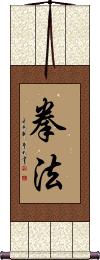
拳法 is a form of martial arts that can be translated in several ways.
Some will call it “fist principles,” “the way of the fist,” or even “law of the fist.” The first character literally means fist. The second can mean law, method, way, principle, or Buddhist teaching.
Kempo is really a potluck of martial arts. Often a combination of Chinese martial arts such as Shaolin Kung Fu with Japanese martial arts such as Karate, Jujutsu (Jujitsu), Aikido, and others. You may see the term “Kempo Karate,” which basically means Karate with other disciplines added. In this way, Kempo becomes an adjective rather than a title or school of martial arts.
These facts will long be argued by various masters and students of Kempo. Even the argument as to whether it should be spelled “kenpo” or “Kempo” ensues at dojos around the world (the correct Romaji should actually be “kenpou” if you precisely follow the rules).
The benefit of Kempo is that the techniques are easier to learn and master than pure Kung Fu (wu shu). Students are often taught basic Karate moves, kicks, and punches before augmenting the basic skills with complex Kung Fu techniques. This allows students of Kempo to achieve a level where they can defend themselves or fight in a relatively short amount of time (a few years rather than a decade or more).
Because the definition of this word is so fluid, I should make some notes here:
1. Purists in Okinawa will claim that “Okinawa Kenpo” or “Ryukyu Hon Kenpo” is the original and true version of this martial art from the old kingdom. It is actually little or no connection between Okinawa Kenpo and the way the word is used elsewhere.
2. In Chinese, where these characters are pronounced “quan fa” (sometimes Romanized as “chuan fa” because the Chinese-pinyin “q” actually sounds like an English “ch” sound), these characters do not hold the connotation of being a mixed martial art. It is simply defined as “the law of the fist.”
3. My Japanese dictionary oddly defines Kenpo as the “Chinese art of self-defense.” I personally don't feel this is the most common way that people perceive the word but just something you should know.
Kiwame
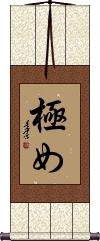
極め is a transitive verb that means to carry to extremes, to go to the end of something, to investigate thoroughly, or to master.
Kiwame is a strange selection for calligraphy artwork, but many were searching for it. 極め (or just 極 without め) is used “off-definition” for some video games.
We are not born with knowledge, how does one achieve maturity?
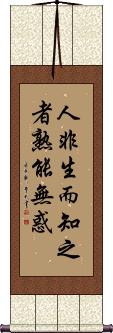
This figuratively means “Without a teacher, how can we learn/mature?”
人非生而知之者熟能無惑 is a philosophic pondering by Han Yu, a Tang Dynasty essayist, and philosopher (618-907 A.D.). This is a Chinese proverb that can be translated as “Knowledge is not innate to man, how can we overcome doubt?” or, “We are not born with knowledge, how does one achieve maturity?.”
This infers that we need the guidance of a teacher if we wish to learn, mature, and become better.
Korean CKD Virtues
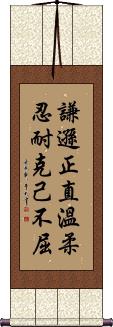
谦逊正直温柔忍耐克己不屈 are the virtues used by Choi Kwang Do Martial Arts.
| English | Hanja | Hangul | Pronunciation |
| 1. Humility (Humble / Modesty) | 謙遜 | 겸손 | gyeom son |
| 2. Honesty (Integrity) | 正直 | 정직 | jeong jig |
| 3. Gentleness | 溫柔 | 온유 | on yu |
| 4. Perseverance (To Endure) | 忍耐 | 인내 | in nae |
| 5. Self-Control (Self-Restraint) | 克己 | 극기 | geug gi |
| 6. Unbreakable Spirit (Unyielding / Unbending) | 不屈 | 불굴 | bur gur |
The characters shown here are in the ancient Korean Hanja form of writing. If you wish for a Korean Hangul form of these tenets, we can arrange that with our Master Calligrapher Xing An-Ping (click on the Hangul next to the South Korean flag above to order this in Hangul).
Kung Fu / Gong Fu
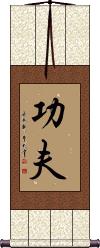
功夫 or Kung Fu is one of the most famous types of martial arts in the world - and not just because of Bruce Lee.
Some translate the meaning as “Accomplishment by Great Effort.” I think this is partially true, but directly translated, it literally means “Merit/Achievement/Accomplishment Man.” The word “fu” can sometimes mean “husband” or “porter,” but in this case, it can only mean “man.” However, few in China will think “man” when they hear the word “Gong Fu” spoken.
This term is also used for things other than martial arts. In fact, it's used to refer to a person with excellent skills in crafts that require a lot of effort to master, such as cooking, tea ceremonies, and calligraphy.
What a lot of people don't know is that the spelling of “Kung Fu” was actually taken from the old Wade Giles form of Romanization. Using this method, the sounds of the English “G” and “K” were both written as “K” and an apostrophe after the “K” told you it was supposed to sound like a “G.” Nobody in the west knew this rule, so most people pronounce it with a “K-sound.” And so, Gong Fu will always be Kung Fu for most westerners.
Also, just to educate you a little more, the “O” in “Gong” has a sound like the English word “oh.”
The popular Chinese dish “Kung Pao Chicken” suffers from the same problem. It should actually be “Gong Bao Chicken.”
Historical note: Many will claim that Kung Fu was invented by the monks of the Shaolin monastery. This fact is argued in both directions by scholars of Chinese history. Perhaps it is more accurate to say that the Shaolin Monks brought the original fame to Kung Fu many generations ago.
Japanese note: While most Japanese martial artists will recognize these characters, Katakana is more often used to approximate the pronunciation of "Kung Fu" with "カンフー." Some will argue as to whether this should be considered a Japanese word at all.
See Also: Bruce Lee
Kyousei / Kyōsei
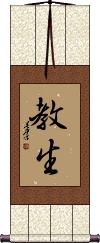
教生 is a Japanese name that can be romanized as Norio, Kyousei, or Atsuo.
These Kanji are sometimes an abbreviation for “student teacher.”
Mumonkan / The Gateless Gate
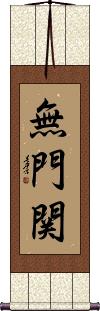
無門関 is the specifically Japanese title for “The Gateless Barrier.”
This has both direct meaning and is the title of a 13th-century collection of koans, compiled by Zen Master Mumon (actually a Chinese Chan Master known as Wumen in China).
The original title is 無門關, but the last Kanji was simplified to 関 in modern Japan.
Naruto
Japanese Anime Series
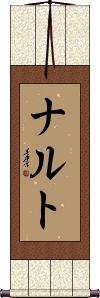
ナルト is the title “Naruto” from the Japanese animation series. See Naruto Anime Series.
Because of the unique Japanese character set used to write this title, it can only be written by the Japanese master calligrapher. Do not try to order it from one of my Chinese calligraphers.
Please note that while this is the correct title for this anime series, it can also mean the “@” sign or “at” in Japanese under a different context (a Japanese person not familiar with the series may be confused by your wall scroll).
Note: Because this title is entirely Japanese Katakana, it should be written by a Japanese calligrapher.
Ninja
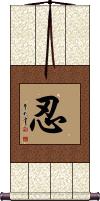
忍 is just the first character of “Ninja.”
It means to beat, to endure, or to tolerate.
Some use this as the short form of “Ninja” but it would be more correct to use the two-character version in most cases (and for clarity). Other definitions of this Kanji include: to bear, put up with, conceal, spy, or sneak. It is also a character in Korean Hanja and Chinese but not well-known with this meaning but rather a definition like “patience.” Note that when writing this as Kanji, Japanese will tend to write it in the form shown to the right. If you select our Japanese master calligrapher, please expect this Kanji form (yes, it's just one stroke that is slightly different in location, crossing another stroke in the Japanese Kanji form).
There is No Royal Road to Learning
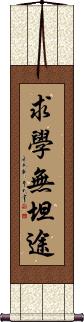
求學無坦途 is a Chinese proverb that translates as “There is no royal road to learning.”
This suggests that the path of learning can never be smooth, there will be difficulties and troubles along the way.
See Also: Learning is Eternal
Nothingness
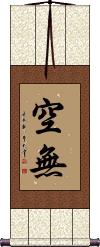
空無 is “nothingness” in a Buddhist context.
The first character means empty but can also mean air or sky (air and sky have no form).
The second character means have not, no, none, not, or to lack.
Together these characters reinforce each other into a word that means “absolute nothingness.”
I know this is a term used in Buddhism, but I have not yet figured out the context in which it is used. I suppose it can be the fact that Buddhists believe that the world is a non-real illusion, or perhaps it's about visualizing yourself as “nothing” and therefore leaving behind your desire and worldliness.
Buddhist concepts and titles often have this element of ambiguity or, rather, “mystery.” Therefore, such ideas can have different meanings to different people, and that's okay. If you don't get it right in this lifetime, there will be plenty more lifetimes to master it (whatever “it” is, and if “it” really exists at all).
Soothill defines this as “Unreality, or immateriality, of things, which is defined as nothing existing of independent or self-contained nature.”
The Sea of Knowledge Has No Limits
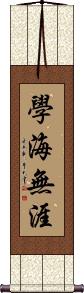
學海無涯 is a Chinese proverb that reads, “sea of learning, no horizon.”
Colloquially, it means there are no limits to what one still has left to learn.
This would be the Chinese equivalent to the quote from Hippocrates, “ars longa, vita brevis,” meaning “it takes a long time to acquire and perfect one's expertise.”
See Also: Learning is Eternal
Osu No Seishin
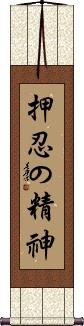
押忍の精神 is the name Osu No Seishin or “Spirit of Osu” in Japanese.
This Spirit of Osu is an essential concept in Karate. You will hear “Osu!” shouted in every Karate dojo which is not just a sign of respect and obedience to the Sensei but also means patience, determination, and perseverance. Shouting “Osu!” serves as a reminder to embody these qualities.
Patience / Perseverance
忍 contains the ideas of patience, equanimity, perseverance, forbearance, and endurance. Alone, this single character can be a bit ambiguous or flexible. It can also mean to endure, to bear, to put up with, or to conceal. If you want to simply decide what this character means to you within the general meaning but keep it a mystery to others, this is a good choice.
If you want to be more direct, you may want to choose one of our other selections that mean perseverance or patience (you will see this character within those larger words/phrases).
There is a secondary meaning in Japanese since this is the first character of the word ninja.Note that when writing this as Kanji, Japanese will tend to write it in the form shown to the right. If you select our Japanese master calligrapher, please expect this Kanji form (yes, it's just one stroke that is slightly different in location, crossing another stroke in the Japanese Kanji form).
See Also: Perseverance | Patience | Tenacious
Reiki Precepts by Usui Mikao (Alternate)
Alternate Version
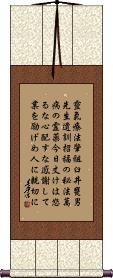
靈氣療法肇祖臼井甕男先生遺訓招福の秘法萬病の霊薬今日丈けは心配すな感謝して業を励げめ人に親切に is an alternate version of the precepts or tenets of Reiki by Usui Mikao.
It is impossible to be sure which version or versions were actually written by Usui Mikao. This is the less common of the three versions that you might see in the wild.
Here is a breakdown of the characters and a rough translation:
靈氣 療法 肇祖 臼井甕男。
Reiki therapy founder Mikao Usui
先生 遺訓。
Teacher's testament
招福の秘法, 萬病の霊薬。
Invite blessings of [the] secret method, 10,000 illnesses of spiritual medicine.
今日丈けは: 怒るな, 心配すな, 感謝して, 業をはげめ, 人に親切に。
At least for today: Do not be angry, do not worry, be grateful, work with diligence, [and] be kind to people.
Note: Because this selection contains some special Japanese Hiragana characters, it should be written by a Japanese calligrapher.
River of Literacy, Sea of Learning
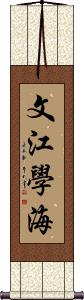
文江學海 is a Chinese proverb that reads, “river of literacy, a sea of learning”
This suggests that there is a lot to learn in the world, with an eternal amount of reading and things to study.
文江學海 is one way to translate the quote from Hippocrates, “ars longa, vita brevis,” meaning “it takes a long time to acquire and perfect one's expertise.”
See Also: Learning is Eternal
The Saint
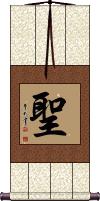
聖 is the simple, single-character religious form of “saint” in Chinese (also holds the same meaning in Japanese and Korean, though rarely used alone like this).
This can also mean holy, sage, master, or priest.
Note: 聖 is often used in compound words (words of more than one character) to create further meanings. In compounds, it can mean holy, sacred, or divine.
聖 is also used as the first word for Spanish and English place names such as “San Diego” and “St. Louis” in Chinese (not Japanese).
In the Buddhist context, this can represent ārya or sādhu. And mean a sage; wise and good; upright, or correct in all his character; sacred, holy, or saintly.
Shidan
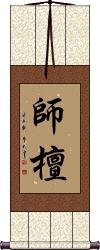
This can means teacher, monk, or patron/donor.
Shidoin
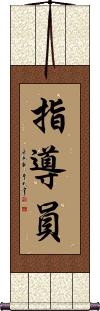
指導員 means instructor, coach, or advisor.
指導員 is similar to Sensei but not a typical choice for custom calligraphy.
Shidoshi
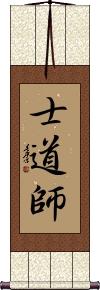
A shidōshi or 士道師, translated directly, is a teacher of the chivalrous way or samurai code.
Practitioners from the Bujinkan school of martial arts use this term (in lieu of “sensei”) for licensed teachers.
Shihan
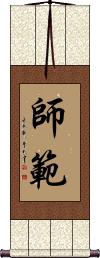
師範 or Shihan is a Japanese term, often used in Japanese martial arts.
In typical Japanese language, it can refer to a teacher or instructor. However, in martial arts, it's often an honorific title for an expert or master instructor.
Example: In Aikido the title can refer to someone with the rank of 7th dan. But other schools use it to mean a master who has earned the right to award black belts.
This term is also used in Chinese, where it refers to teacher-training or the art of teaching by example. It's used within the proper name of certain types of universities in China.
Siddhartha
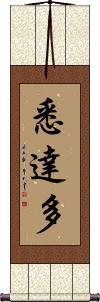
悉達多 is the name Siddhartha (as in Siddhartha Gautama), the personal name for Śākyamuni.
This same Buddha is also known as “Shakyamuni Gautama,” “Gotama Buddha,” or “Tathagata.”
Siddhartha Gautama was a spiritual teacher in the northern region of the Indian subcontinent who founded Buddhism. He is generally seen by Buddhists as the Supreme Buddha (Sammāsambuddha) of known human history.
The actual meaning of this name in Chinese is the realization of all aims, or simply being prosperous.
This name is sometimes romanized from the original Sanskrit or Pali as Siddhattha (from Siddhattha Gotama), Siddharth, Siddhārtha, or Sarvāthasiddha.
Siddhārtha or Sarvāthasiddha can also be written as 悉達, 悉多, 悉多頞他, or 悉陀.
Si Gung
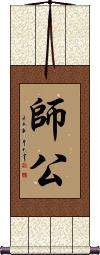
This is a term for “teacher” that is primarily used in Wing Chun martial arts schools.
In very old Buddhist context this can be “thaumaturge” meaning a worker of wonders and/or performer of miracles.
Perseverance is the Key
Skills cannot be perfected without perseverance in practice
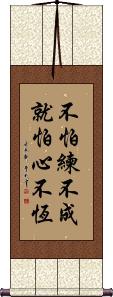
不怕练不成就怕心不恒 literally translates as: Do not worry about not being able to master [a skill]; What [one should] be concerned about is lack of perseverance.
Figuratively, this means: One's skills cannot be perfected without perseverance in practice.
For me, I've learned that you can only get so much from school or studying. You've really got to do “on-the-job training” to perfect your ability and skill.
For martial arts students: You can read about a kick in a book, or someone can tell you about a certain kick but until you practice the kick, there's no way you'll master it.
Sword Saint
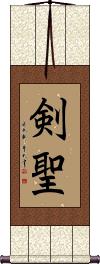
剣聖 can be translated as “Sword Saint,” “God of the Sword,” or “Saint of the Sword.” This is an ancient Japanese title bestowed on a master with the greatest of skills in swordsmanship.
Keep in mind that this is an antiquated term. It will only be understood in the context of martial arts. The pronunciation “kensei” also applies to other words like “constitutional government” and power (these words have different kanji and are completely unrelated).
Notes: This is sometimes Romanized as “kensei,” “ken sei,” and incorrectly as “Kensai.”
Chinese Note: This title is pronounceable in Chinese but seldom, if ever, used in Chinese. Also, the first character is an alternate character form for a sword, currently only used in Japan.
Taekwondo
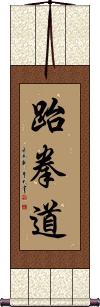
跆拳道 is one of the most widespread types of martial arts in the world as well as being an Olympic sport. Taekwondo was born in Korea with influences of Chinese and Japanese styles combined with traditional Korean combat skills. Some will define it as the “Korean art of empty-handed self-defense.”
In the simplest translation, the first character means “kick,” the second character can mean either “fist” or “punching,” and the third means “way” or “method.” Altogether, you could say this is the “Kick Punch Method.” When heard or read in various Asian languages, all will automatically think of this famous Korean martial art. It is written the same in Japanese Kanji, Chinese, and Korean Hanja characters - so the appearance of the characters is universal. However, you should note that there is another way to write this in modern Korean Hangul characters, which looks like the image to the right. 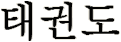
We suggest the original Korean Hanja (Chinese characters) for a wall scroll, but if you need the Hangul version, you must use master calligrapher Cao Bin: Order Taekwondo in Korean Hangul
Note: Taekwondo is sometimes Romanized as Tae-Kwondo, Tae Kwon Do, Taekwon-do, Taegwondo, Tae Gweon Do, Tai Kwon Do, Taikwondo, Taekwando, Tae Kwan Do and in Chinese Taiquandao, Tai Quan Dao, Taichuando, or Tai Chuan Tao.
Tolerance
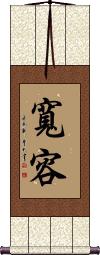
Being tolerant is accepting differences. You don't expect others to think, look, speak or act just like you. You are free of prejudice, knowing that all people have feelings, needs, hopes, and dreams. Tolerance is also accepting things you wish were different with patience and flexibility.
寬容 can also be translated as magnanimity, generosity, or leniency.
Note: There is a tiny deviation in the first character when written in Japanese. If you choose our Japanese master calligrapher, the little dot on the lower right of the first character will be omitted. With or without the dot, this can be read in Chinese, Japanese, and old Korean.
See Also: Patience
Training / Drill
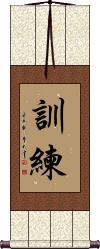
If training or drill is important to you (especially for military drill and training), 訓練 might be just the thing for a drill master to hang behind his/her desk.
This term is universal in Chinese, Japanese Kanji, and old Korean Hanja. It can also mean practice or exercise, depending on context.
Uchi-Deshi

内弟子 is a Japanese term for a live-in student, pupil, or apprentice.
In the context of martial arts, it is an apprentice who trains under and assists a sensei on a full-time basis.
There is one single thread binding my Way together
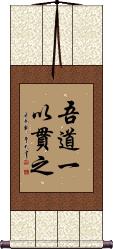
吾道一以貫之 is a phrase from the Analects of Confucius that translates as “My Way has one thread that runs through it.”
Other translations include:
My Way is penetrated by a single thread.
There is one single thread binding my Way together.
My Way is run through with a unifying thread.
My Way is Consistent.
And sometimes poetic license is taken, and it is translated as:
My Way is the only one; I'll treasure it and stick to it with humility until the end.
After this was said, some 2500+ years ago, another disciple of Confucius clarified the meaning by stating, “Our master's Way is to be loyal and have a sense of reciprocity.”
In Japanese, this is purported to be romanized as “Waga michi ichi wo motte kore wo tsuranuku,” though some will argue the true pronunciation.
Note: Sometimes written 吾道以一貫之 instead of 吾道一以貫之 with no difference in meaning.
It is better to be a warrior in a garden than a gardener in a war
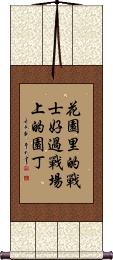
花園里的戰士好過戰場上的園丁 is the Chinese for the phrase, “It is better to be a warrior in a garden than a gardener in a war.”
This proverb is purported to come from the following exchange:
A student approaches his samurai master and says,
“Teacher, you instruct me how to fight, yet you preach to me about peace. How do I reconcile the two?”
The samurai responds,
“Because it is better to be a warrior in a garden than a gardener in a war.”
The Gateless Gate
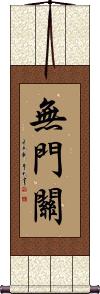
無門關 is the ancient title for “The Gateless Barrier.”
This has both direct meaning and is the title of a 13th-century collection of koans, compiled by a Chinese Chan Master known as Wumen in China (known in Japan as Zen Master Mumon).
While this is the original title, you may see this written as 無門関 in Japan, where the last character, 關, was simplified to 関 after 1945.
Ultimate Loyalty to Your Country
The most famous tattoo in Chinese history
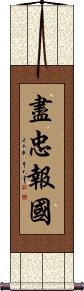
盡忠報國 is a proverb that is the tattoo worn on the back of Yue Fei, a famous Chinese warrior who lived until 1142 A.D.
The tattoo can be translated as “Serve the country with the utmost loyalty.” More literally, it means “[The] Ultimate Loyalty [is too] Duty [of] Country.”
Legend has it that this tattoo once saved his life when he was accused of treason.
The first two characters have come to create a word that means “serve the country faithfully” or “die for the country.” Note: It's more a willingness to die for one's country than the actual act of dying.
The last two characters have come to mean “Dedicate oneself to the service of one's country.”
Both of these words are probably only in the Chinese lexicon because of this famous tattoo.
If you break it down, character-by-character, here is what you get:
1. To the utmost, to the limit of something, the ultimate.
2. Loyalty or duty (a sense of duty to one's master, lord, country, or job).
3. Report, recompense, give back to (in this case, you are giving yourself to your country as payback).
4. Country, state, nation, kingdom.
Happu Fudo
Unmoved by the Eight Winds

八風不動 is the short version, popularized in Japanese Zen Buddhism, of the original Chinese phrase 八風吹不動.
Literal meaning: “Unmoved by the Eight Winds”
The origin is Chinese, but it was later adopted into Japanese Zen. Here’s a little backstory:
The original famous anecdote is from Song Dynasty China, involving the poet-official 蘇東坡 (Su Dongpo / Su Shi, 1037–1101) and Zen master 佛印 (Foyin).
Su Dongpo wrote 八風吹不動,一屁打過江
“The Eight Winds cannot move me; Yet one fart blows me across the river.”
Foyin’s irreverent reply exposed Su Dongpo’s ego, which is kind of a classic Zen teaching story.
Unmoved by the Eight Winds

八風吹不動 is an ancient Buddhist phrase from about 1000 years ago.
Literal meaning: “The Eight Winds cannot move [me].”
The original famous anecdote is from Song Dynasty China, involving the poet-official 蘇東坡 (Su Dongpo / Su Shi, 1037–1101) and Zen master 佛印 (Foyin).
Su Dongpo wrote 八風吹不動,一屁打過江
“The Eight Winds cannot move me; Yet one fart blows me across the river.”
Foyin’s irreverent reply exposed Su Dongpo’s ego, which is kind of a classic Zen/Chan teaching story.
利 gain
衰 loss
毀 disgrace
譽 praise
稱 honor
譏 ridicule
苦 suffering
樂 pleasure
“The Eight Winds cannot move [him / the mind].”
“Unmoved by the Eight Winds.”
“The Eight Winds do not move me.”
“Not moved by the Eight Winds.”
“Unshaken by the Eight Winds.”
“Unaffected by the Eight Winds.”
“Unmoved by worldly forces.”
“Steadfast against the Eight Winds.”
“Remaining unmoved amid the Eight Winds.”
There is a shorter Japanese Zen version, 八風不動, which drops the middle character. Often romanized as happū fudō. The romanization of 八風吹不動 is arguably happū fukedomo ugokazu or happū sui fudō.
Daodejing / Tao Te Ching - Chapter 27
The Mastery of Effortless Skill

Chapter 27 of the Daodejing reveals a profound truth about mastery: the highest skill leaves no trace, requires no force, and appears almost invisible.
善行無轍跡,
善言無瑕謫,
善數不用籌策,
善閉無關鍵而不可開,
善結無繩約而不可解。
是以聖人常善救人,
故無棄人;
常善救物,
故無棄物。
是謂襲明。
故善人者,不善人之師;
不善人者,善人之資。
不貴其師,不愛其資,
雖智大迷,
是謂要妙。
The sage moves through life with such natural harmony that nothing seems imposed; doors need no locks, knots require no rope, and actions leave no mark behind.
This is the essence of wúwéi (effortless action), where true ability arises from deep alignment with the Tao rather than deliberate effort.
At its heart, this chapter teaches compassion without exception. The sage “abandons no one and nothing,” recognizing value in all people and all things. Even those who seem flawed or unrefined are not rejected, but understood as part of a greater whole with each person both a student and a teacher in the unfolding of life.
Laozi reminds us that wisdom is not about perfection or control, but about subtle awareness. The truly skilled individual does not rely on tools, rules, or rigid structures; instead, they embody an intuitive understanding that makes their actions naturally complete.
In this way, excellence becomes quiet, effortless, and beyond imitation.
This teaching also reflects a deeper philosophical insight: Opposites are interdependent. The “good” person learns from the “not good,” and the “not good” provides the material for growth. To reject either is to misunderstand the balance of existence itself.
As calligraphy, Daodejing Chapter 27 serves as a reminder to cultivate inner mastery rather than outward display. It is a meditation on refinement, humility, and the quiet power of skill perfected through harmony with the natural order.
Note: The Chinese text used here is based on the early Mawangdui silk manuscript tradition (2nd century BCE). The Guodian manuscripts do NOT preserve Chapter 27 in full form.
This in-stock artwork might be what you are looking for, and ships right away...


Gallery Price: $71.00
Your Price: $39.00


Gallery Price: $72.00
Your Price: $39.88

Gallery Price: $61.00
Your Price: $33.88

Gallery Price: $61.00
Your Price: $33.88

Gallery Price: $61.00
Your Price: $33.88

Gallery Price: $61.00
Your Price: $33.88

Gallery Price: $61.00
Your Price: $33.88
Gallery Price: $200.00
Your Price: $79.88
The following table may be helpful for those studying Chinese or Japanese...
| Title | Characters | Romaji (Romanized Japanese) | Various forms of Romanized Chinese | |
| Fatherly Master Sifu Shi Fu Shifu | 師父 师父 | shi fu / shifu | shī fù / shi1 fu4 / shi fu / shifu | shih fu / shihfu |
| Teacher Master Old Sage | 老師 老师 | lǎo shī / lao3 shi1 / lao shi / laoshi | lao shih / laoshih | |
| Sensei Master Teacher Mister | 先生 | sen sei / sensei | xiān shēng xian1 sheng1 xian sheng xiansheng | hsien sheng hsiensheng |
| Martial Arts Master | 武芸者 | bugeisha | wǔ yún zhě wu3 yun2 zhe3 wu yun zhe wuyunzhe | wu yün che wuyünche |
| When Three People Gather, One Becomes a Teacher | 三人行必有我師 三人行必有我师 | sān rén xíng bì yǒu wǒ shī san1 ren2 xing2 bi4 you3 wo3 shi1 san ren xing bi you wo shi sanrenxingbiyouwoshi | san jen hsing pi yu wo shih sanjenhsingpiyuwoshih |
|
| Rank Holder | 有段者 | yuu dan sha yuudansha yu dan sha | yǒu duàn zhě you3 duan4 zhe3 you duan zhe youduanzhe | yu tuan che yutuanche |
| Grand Master Great Teacher | 大師 大师 | daishi | dà shī / da4 shi1 / da shi / dashi | ta shih / tashih |
| Mentor: Teacher and Friend | 良師益友 良师益友 | liáng shī yì yǒu liang2 shi1 yi4 you3 liang shi yi you liangshiyiyou | liang shih i yu liangshihiyu |
|
| Past experience is the teacher for the future | 前事不忘后事之師 前事不忘后事之师 | qián shì bú wàng hòu shí zhī shī qian2 shi4 bu2 wang4 hou4 shi2 zhi1 shi1 qian shi bu wang hou shi zhi shi | ch`ien shih pu wang hou shih chih shih chien shih pu wang hou shih chih shih |
|
| Respected Teacher | 尊師 尊师 | son shi / sonshi | zūn shī / zun1 shi1 / zun shi / zunshi | tsun shih / tsunshih |
| I am the Master of My Destiny | 我命由我不由天 | wǒ mìng yóu wǒ bù yóu tiān wo3 ming4 you2 wo3 bu4 you2 tian1 wo ming you wo bu you tian womingyouwobuyoutian | wo ming yu wo pu yu t`ien womingyuwopuyutien wo ming yu wo pu yu tien |
|
| Grandmaster Grand Master | 大師範 | daishihan | ||
| Loyalty to Duty or Master | 忠 | chuu / chu | zhōng / zhong1 / zhong | chung |
| Be Master of Mind, Not Mastered by Mind | 願作心師不師於心 愿作心师不师于心 | yuàn zuò xīn shī bù shī yú xīn yuan4 zuo4 xin1 shi1 bu4 shi1 yu2 xin1 yuan zuo xin shi bu shi yu xin yuanzuoxinshibushiyuxin | yüan tso hsin shih pu shih yü hsin | |
| Master Skilled Worker | 師傅 师傅 | shī fu / shi1 fu / shi fu / shifu | shih fu / shihfu | |
| Reiki - Master Symbol | 大光明 | dai kou myou daikoumyou dai ko myo | dà guāng míng da4 guang1 ming2 da guang ming daguangming | ta kuang ming takuangming |
| Ronin Masterless Samurai | 浪人 | rou nin / rounin / ro nin | làng rén / lang4 ren2 / lang ren / langren | lang jen / langjen |
| Senpai The Elder or Master | 先輩 先辈 | sen pai / senpai | xiān bèi / xian1 bei4 / xian bei / xianbei | hsien pei / hsienpei |
| Always with a Book in Hand | 手不釋卷 手不释卷 | shǒu bù shì juàn shou3 bu4 shi4 juan4 shou bu shi juan shoubushijuan | shou pu shih chüan shoupushihchüan |
|
| Architect | 建築師 建筑师 | jiàn zhù shī jian4 zhu4 shi1 jian zhu shi jianzhushi | chien chu shih chienchushih |
|
| Benevolent Heart | 慈悲の心 | ji hi no kokoro jihinokokoro | ||
| Beware of the Lawyers | 提防律師 提防律师 | xiǎo xīn lǜ shī xiao3 xin1 lv4 shi1 xiao xin lv shi xiaoxinlvshi | hsiao hsin lü shih hsiaohsinlüshih |
|
| Broken Hearted | 失戀 失恋 | shitsuren | shī liàn / shi1 lian4 / shi lian / shilian | shih lien / shihlien |
| Confucius: Universal Education | 自行束脩以上吾未嘗無誨焉 (note 嘗 = 嚐) 自行束脩以上吾未尝无诲焉 | zì xíng shù xiū yǐ shàng wú wèi cháng wú huì yān zi4 xing2 shu4 xiu1 yi3 shang4 wu2 wei4 chang2 wu2 hui4 yan1 zi xing shu xiu yi shang wu wei chang wu hui yan | tzu hsing shu hsiu i shang wu wei ch`ang wu hui yen tzu hsing shu hsiu i shang wu wei chang wu hui yen |
|
| Every Creature Has A Domain | 海為龍世界雲是鶴家鄉 海为龙世界云是鹤家乡 | hǎi wéi lóng shì jiè yún shì hè jiā xiāng hai3 wei2 long2 shi4 jie4 yun2 shi4 he4 jia1 xiang1 hai wei long shi jie yun shi he jia xiang | hai wei lung shih chieh yün shih ho chia hsiang | |
| The Great Path has No Gate | 大道無門 大道无门 | dai dou mu mon daidoumumon dai do mu mon | dà dào wú mén da4 dao4 wu2 men2 da dao wu men dadaowumen | ta tao wu men tataowumen |
| Engineer | 工程師 工程师 | gōng chéng shī gong1 cheng2 shi1 gong cheng shi gongchengshi | kung ch`eng shih kungchengshih kung cheng shih |
|
| Even Monkeys Fall From Trees | 猿も木から落ちる | saru mo ki kara ochiru sarumokikaraochiru | ||
| Example is Better than Precept | 身教勝於言教 身教胜于言教 | shēn jiào shèng yú yán jiào shen1 jiao4 sheng4 yu2 yan2 jiao1 shen jiao sheng yu yan jiao shenjiaoshengyuyanjiao | shen chiao sheng yü yen chiao | |
| Fighting Spirit | 闘氣 闘気气 | tou ki / touki / to ki | ||
| Begging Forgiveness | 饒恕 饶恕 | ráo shù / rao2 shu4 / rao shu / raoshu | jao shu / jaoshu | |
| Geisha of Unequaled Talent | 名妓 | mei gi / meigi | míng jì / ming2 ji4 / ming ji / mingji | ming chi / mingchi |
| Generosity | 寬大 宽大 | kandai | kuān dà / kuan1 da4 / kuan da / kuanda | k`uan ta / kuanta / kuan ta |
| Allah God of Islam | 真主 | zhēn zhǔ / zhen1 zhu3 / zhen zhu / zhenzhu | chen chu / chenchu | |
| Happy Laughter Cheerful Bliss | 樂 / 楽 乐 | raku | lè / le4 / le | |
| Hunter Huntsmen | 猟師 | ryou shi / ryoushi / ryo shi | ||
| Ip Man | 葉問 叶问 | yè wèn / ye4 wen4 / ye wen / yewen | yeh wen / yehwen | |
| Isshin Ryu Karate Do | 一心流空手道 | i sshin ryuu kara te dou isshinryuukaratedou i shin ryu kara te do | ||
| Joshua 24:15 | 至於我和我家我們必定事奉耶和華 至于我和我家我们必定事奉耶和华 | zhì yú wǒ hé wǒ jiā wǒ men bì dìng shì fèng yē hé huá zhi4 yu2 wo3 he2 wo3 jia1 wo3 men bi4 ding4 shi4 feng4 ye1 he2 hua2 zhi yu wo he wo jia wo men bi ding shi feng ye he hua | chih yü wo ho wo chia wo men pi ting shih feng yeh ho hua | |
| Juggernaut | 劍聖 剑圣 | jiàn shèng jian4 sheng4 jian sheng jiansheng | chien sheng chiensheng |
|
| Kenpo Kempo Quan Fa Chuan Fa | 拳法 | kenpou / kenpo | quán fǎ / quan2 fa3 / quan fa / quanfa | ch`üan fa / chüanfa / chüan fa |
| Kiwame | 極め | kiwa me / kiwame | ||
| We are not born with knowledge, how does one achieve maturity? | 人非生而知之者熟能無惑 | rén fēi shēng ér zhī zhī zhě shú néng wú huò ren2 fei1 sheng1 er2 zhi1 zhi1 zhe3 shu2 neng2 wu2 huo4 ren fei sheng er zhi zhi zhe shu neng wu huo | jen fei sheng erh chih chih che shu neng wu huo | |
| Korean CKD Virtues | 謙遜正直溫柔忍耐克己不屈 谦逊正直温柔忍耐克己不屈 | qiān xùn zhèng zhí wēn róu rěn nài kè jǐ bù qū qian1 xun4 zheng4 zhi2 wen1 rou2 ren3 nai4 ke4 ji3 bu4 qu1 qian xun zheng zhi wen rou ren nai ke ji bu qu | ch`ien hsün cheng chih wen jou jen nai k`o chi pu ch`ü chien hsün cheng chih wen jou jen nai ko chi pu chü |
|
| Kung Fu Gong Fu | 功夫 | kan fu / ku fu kanfu / kufu | gōng fu / gong1 fu / gong fu / gongfu | kung fu / kungfu |
| Kyousei Kyōsei | 教生 | norio / kyousei norio / kyosei | ||
| Mumonkan The Gateless Gate | 無門関 | mu mon kan / mumonkan | ||
| Naruto | ナルト | na ru to / naruto | ||
| Ninja | 忍 | nin | rěn / ren3 / ren | jen |
| There is No Royal Road to Learning | 求學無坦途 求学无坦途 | qiú xué wú tǎn tú qiu2 xue2 wu2 tan3 tu2 qiu xue wu tan tu qiuxuewutantu | ch`iu hsüeh wu t`an t`u chiuhsüehwutantu chiu hsüeh wu tan tu |
|
| Nothingness | 空無 空无 | kuu mu / kuumu / ku mu | kōng wú / kong1 wu2 / kong wu / kongwu | k`ung wu / kungwu / kung wu |
| The Sea of Knowledge Has No Limits | 學海無涯 学海无涯 | xué hǎi wú yá xue2 hai3 wu2 ya2 xue hai wu ya xuehaiwuya | hsüeh hai wu ya hsüehhaiwuya |
|
| Osu No Seishin | 押忍の精神 | o su no sei shin osunoseishin | ||
| Patience Perseverance | 忍 | nin | rěn / ren3 / ren | jen |
| Reiki Precepts by Usui Mikao (Alternate) | 靈氣療法肇祖臼井甕男先生遺訓招福の秘法萬病の霊薬今日丈けは怒るな心配すな感謝して業を励げめ人に親切に | reiki ryouhou chouso usui mikao sensei ikun shoufuku no hihou yorozu byou no reiyaku kyou take ke wa oko ru na shinpai suna kansha shite gou o hagemu ge me hito ni shinsetsu ni reiki ryoho choso usui mikao sensei ikun shofuku no hiho yorozu byo no reiyaku kyo take ke wa oko ru na shinpai suna kansha shite go o hagemu ge me hito ni shinsetsu ni | ||
| River of Literacy, Sea of Learning | 文江學海 文江学海 | wén jiāng xué hǎi wen2 jiang1 xue2 hai3 wen jiang xue hai wenjiangxuehai | wen chiang hsüeh hai wenchianghsüehhai |
|
| The Saint | 聖 圣 | sei | shèng / sheng4 / sheng | |
| Shidan | 師檀 师檀 | shidan | shī tán / shi1 tan2 / shi tan / shitan | shih t`an / shihtan / shih tan |
| Shidoin | 指導員 指导员 | shidouin / shidoin | zhǐ dǎo yuán zhi3 dao3 yuan2 zhi dao yuan zhidaoyuan | chih tao yüan chihtaoyüan |
| Shidoshi | 士道師 士道师 | shi dou shi shidoushi shi do shi | ||
| Shihan | 師範 师范 | shi han / shihan | shī fàn / shi1 fan4 / shi fan / shifan | shih fan / shihfan |
| Siddhartha | 悉達多 悉达多 | shiddatta / shiddaruta | xī dá duō xi1 da2 duo1 xi da duo xidaduo | hsi ta to hsitato |
| Si Gung | 師公 师公 | shi kou / shikou / shi ko | shī gōng / shi1 gong1 / shi gong / shigong | shih kung / shihkung |
| Perseverance is the Key | 不怕練不成就怕心不恆 不怕练不成就怕心不恒 | bú pà liàn bù chéng jiù pà xīn bù héng bu2 pa4 lian4 bu4 cheng2 jiu4 pa4 xin1 bu4 heng2 bu pa lian bu cheng jiu pa xin bu heng | pu p`a lien pu ch`eng chiu p`a hsin pu heng pu pa lien pu cheng chiu pa hsin pu heng |
|
| Sword Saint | 剣聖 / 剣聖 剣圣 | kensei | jiàn shèng jian4 sheng4 jian sheng jiansheng | chien sheng chiensheng |
| Taekwondo | 跆拳道 | te kon do / tekondo | tái quán dào tai2 quan2 dao4 tai quan dao taiquandao | t`ai ch`üan tao taichüantao tai chüan tao |
| Tolerance | 寬容 宽容 | kanyou / kanyo | kuān róng kuan1 rong2 kuan rong kuanrong | k`uan jung kuanjung kuan jung |
| Training Drill | 訓練 训练 | kunren | xùn liàn / xun4 lian4 / xun lian / xunlian | hsün lien / hsünlien |
| Uchi-Deshi | 内弟子 | uchideshi | ||
| There is one single thread binding my Way together | 吾道一以貫之 吾道一以贯之 | ware dou tsurayuki waredoutsurayuki ware do tsurayuki | wú dào yī yǐ guàn zhī wu2 dao4 yi1 yi3 guan4 zhi1 wu dao yi yi guan zhi wudaoyiyiguanzhi | wu tao i i kuan chih wutaoiikuanchih |
| It is better to be a warrior in a garden than a gardener in a war | 花園里的戰士好過戰場上的園丁 花园里的战士好过战场上的园丁 | huā yuán lǐ de zhàn shì hǎo guò zhàn chǎng shàng de yuán dīng huā yuán lǐ de zhàn shì hǎo guò zhàn chǎng shàng de yuán dīng ài wēng huā yuán lǐ de zhàn shì hǎo guò zhàn chǎng shàng de yuán dīng hua1 yuan2 li3 de zhan4 shi4 hao3 guo4 zhan4 chang3 shang4 de yuan2 ding1 hua1 yuan2 li3 de zhan4 shi4 hao3 guo4 zhan4 chang3 shang4 de yuan2 ding1 ai4 weng1 hua1 yuan2 li3 de zhan4 shi4 hao3 guo4 zhan4 chang3 shang4 de yuan2 ding1 hua yuan li de zhan shi hao guo zhan chang shang de yuan ding hua yuan li de zhan shi hao guo zhan chang shang de yuan ding ai weng hua yuan li de zhan shi hao guo zhan chang shang de yuan ding | hua yüan li te chan shih hao kuo chan ch`ang shang te yüan ting hua yüan li te chan shih hao kuo chan ch`ang shang te yüan ting ai weng hua yüan li te chan shih hao kuo chan ch`ang shang te yüan ting hua yüan li te chan shih hao kuo chan chang shang te yüan ting hua yüan li te chan shih hao kuo chan chang shang te yüan ting ai weng hua yüan li te chan shih hao kuo chan chang shang te yüan ting |
|
| The Gateless Gate | 無門關 无门关 | mu mon kan / mumonkan | wú mén guān wu2 men2 guan1 wu men guan wumenguan | wu men kuan wumenkuan |
| Ultimate Loyalty to Your Country | 盡忠報國 尽忠报国 | jìn zhōng bào guó jin4 zhong1 bao4 guo2 jin zhong bao guo jinzhongbaoguo | chin chung pao kuo chinchungpaokuo |
|
| Happu Fudo | 八風不動 八风不动 | happuu fudou happuufudou hapu fudo | bā fēng bù dòng ba1 feng1 bu4 dong4 ba feng bu dong bafengbudong | pa feng pu tung pafengputung |
| Unmoved by the Eight Winds | 八風吹不動 八风吹不动 | happuu sui fudou happuusuifudou hapu sui fudo | bā fēng chuī bù dòng ba1 feng1 chui1 bu4 dong4 ba feng chui bu dong bafengchuibudong | pa feng ch`ui pu tung pafengchuiputung pa feng chui pu tung |
| Daodejing Tao Te Ching - Chapter 27 | 善行無轍跡善言無瑕謫善數不用籌策善閉無關鍵而不可開善結無繩約而不可解是以聖人常善救人故無棄人常善救物故無棄物是謂襲明故善人者不善人之師不善人者善人之資不貴其師不愛其資雖智大迷是謂要妙 善行无辙迹善言无瑕谪善数不用筹策善闭无关键而不可开善结无绳约而不可解是以圣人常善救人故无弃人常善救物故无弃物是谓袭明故善人者不善人之师不善人者善人之资不贵其师不爱其资虽智大迷是谓要妙 | shàn xíng wú zhé jì shàn yán wú xiá zhé shàn shù bù yòng chóu cè shàn bì wú guān jiàn ér bù kě kāi shàn jié wú shéng yuē ér bù kě jiě shì yǐ shèng rén cháng shàn jiù rén gù wú qì rén cháng shàn jiù wù gù wú qì wù shì wèi xí míng gù shàn rén zhě bù shàn rén zhī shī bù shàn rén zhě shàn rén zhī zī bù guì qí shī bù ài qí zī suī zhì dà mí shì wèi yào miào shan4 xing2 wu2 zhe2 ji4 shan4 yan2 wu2 xia2 zhe2 shan4 shu4 bu4 yong4 chou2 ce4 shan4 bi4 wu2 guan1 jian4 er2 bu4 ke3 kai1 shan4 jie2 wu2 sheng2 yue1 er2 bu4 ke3 jie3 shi4 yi3 sheng4 ren2 chang2 shan4 jiu4 ren2 gu4 wu2 qi4 ren2 chang2 shan4 jiu4 wu4 gu4 wu2 qi4 wu4 shi4 wei4 xi2 ming2 gu4 shan4 ren2 zhe3 bu4 shan4 ren2 zhi1 shi1 bu4 shan4 ren2 zhe3 shan4 ren2 zhi1 zi1 bu4 gui4 qi2 shi1 bu4 ai4 qi2 zi1 sui1 zhi4 da4 mi2 shi4 wei4 yao4 miao4 shan xing wu zhe ji shan yan wu xia zhe shan shu bu yong chou ce shan bi wu guan jian er bu ke kai shan jie wu sheng yue er bu ke jie shi yi sheng ren chang shan jiu ren gu wu qi ren chang shan jiu wu gu wu qi wu shi wei xi ming gu shan ren zhe bu shan ren zhi shi bu shan ren zhe shan ren zhi zi bu gui qi shi bu ai qi zi sui zhi da mi shi wei yao miao | shan hsing wu che chi shan yen wu hsia che shan shu pu yung ch`ou ts`e shan pi wu kuan chien erh pu k`o k`ai shan chieh wu sheng yüeh erh pu k`o chieh shih i sheng jen ch`ang shan chiu jen ku wu ch`i jen ch`ang shan chiu wu ku wu ch`i wu shih wei hsi ming ku shan jen che pu shan jen chih shih pu shan jen che shan jen chih tzu pu kuei ch`i shih pu ai ch`i tzu sui chih ta mi shih wei yao miao shan hsing wu che chi shan yen wu hsia che shan shu pu yung chou tse shan pi wu kuan chien erh pu ko kai shan chieh wu sheng yüeh erh pu ko chieh shih i sheng jen chang shan chiu jen ku wu chi jen chang shan chiu wu ku wu chi wu shih wei hsi ming ku shan jen che pu shan jen chih shih pu shan jen che shan jen chih tzu pu kuei chi shih pu ai chi tzu sui chih ta mi shih wei yao miao |
|
| In some entries above you will see that characters have different versions above and below a line. In these cases, the characters above the line are Traditional Chinese, while the ones below are Simplified Chinese. | ||||



