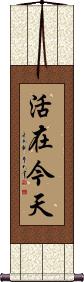
We have many options to create artwork with the Chinese characters / Asian symbols / Japanese Kanji for Live For Today on a wall scroll or portrait.
If you want to create a cool Live For Today Asian character tattoo, you can purchase that on our Chinese and Japanese Tattoo Image Service page and we'll help you select from many forms of ancient Asian symbols that express the idea of Live For Today.
Quick links to words on this page...


This is not really an eastern concept, so it does not translate into a phrase that seems natural on a wall scroll. However, if this is your philosophy, the characters shown here do capture your idea of living for today or living in the moment. These characters literally say "Live in today" and they are grammatically correct in Chinese.
Note: This kind of makes sense in Korean Hanja, but the grammar is Chinese, so it's not that natural in Korean.


This is the word that means alive, as in the state of living or being alive (Chinese only).

This Chinese word means "to be born" and "to give birth". Also it's often used to refer to life itself, and sometimes "to grow".
This character is used in a lot of compound words such as "yi sheng", which means "doctor" (literally "healer of life"), "sheng ri" which means "birthday" (literally "birth day") and "xue sheng" which means student (literally "studying life" or "learner [about] life"). Few Chinese people will think of the literal meaning when this use words like doctor and student - but it is interesting to note.
This character has the same root meaning in Korean Hanja and Japanese. However, in Japanese, there are many possible pronunciations, and this can be used to mean "raw" or "unprocessed" (as in draft beer). Therefore, not be the best if your audience is Japanese.
See Also... Life Force | Vitality


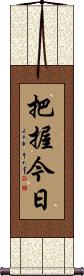
This is the closest and most natural way to express this idea in Chinese.
The first two characters mean "to seize" but can also be translated as "take control of".
The last two characters mean "today".


This simply means everyday life or regular life. You can also translate it as "Living day to day".


This means immortal or immortality in Chinese, Japanese Kanji and old Korean Hanja.
The literal translation is "without decay" or "never rotting". Basically this title speaks of something or someone who never dies and thus never rots or decays.
This can also be translated as everlasting, eternal or imperishable.


This is a kind of complex ten-character proverb composed by Zhuge Liang about 1800 years ago. The proverb means "Leading a simple life will yield a clear mind, and having inner peace will help you see far (into the world)".
What I have translated as "simple life" means NOT being materialistic and NOT competing in the rat race.
The last word means "far", but the deeper meaning is that you will surpass what you can currently see or understand. Perhaps even the idea of opening up vast knowledge and understanding of complex ideas.
The whole phrase has a theme that suggests if you are NOT an aggressive cut-throat person who fights his way to the top no matter how many people he crushes on the way, and instead seek inner peace, you will have a happier existence and be more likely to understand the meaning of life.
See Also... Serenity


This Chinese, Korean and Japanese word means "life force" or simply "life". The first character means "life" or "birth". The second means "life" or "fate". Together they create the meaning of "life force", though some will translate this as "existence" and sometimes "vitality".


No matter what happens, life goes on. For better or worse, life goes one. This is the basic idea behind this modern Chinese phrase which literally says "Life goes on" in these five characters.
A further explanation of this phrase can now be found on our forum here: Life Goes On in Chinese, explained.


Characters shown
above are read
vertically, starting
from the right
This means, "A life of happiness and prosperity" or "A life of happiness and success". It's a great and very positive and inspirational wall scroll selection.
See Also... Prosperity


Characters shown
above are read
vertically, starting
from the right
This phrase means "Life is a Journey".
If this matches your philosophy, this might be the perfect Chinese calligraphy for you.


Characters shown
above are read
vertically, starting
from the right
This literally translates as: [Even a] hundred-year-old [person] is [just a] traveler passing by.
The simple message is, "Human life is short". Of course, there is an unspoken suggestion that you should make the best of the time you have here on earth.


This means life, living, to live, or the state of being alive. It can also refer to your daily existence or livelihood.
This is also the term used in other titles such as "healthy living" or Lance Armstrong's "Livestrong" campaign (Chinese title for Livestrong only).
If you need a reminder that you are alive, and to take a breath, this might be the perfect wall scroll for you.


This came from a customer's request, but it's not too bad. These three simple characters suggest that you are born, you learn to love, and then exit the world.


In English, the word order shown in the title is the most natural or popular. In Chinese, the natural order is a little different:
The first character means laugh (sometimes means smile).
The second character means love.
The last two characters mean "live" as in "to be alive" or "pursue life".
Please note: This is not a normal phrase, in that it does not have a subject, verb, and object. It is a word list. Word lists are not common in Asian languages/grammar (at least not as normal as they are in English). We only added this entry because so many people requested it.
We put the characters in the order shown above, as it almost makes a single word with the meaning, "A life of laughter and love". It's a made-up word, but it sounds good in Chinese.


Characters shown
above are read
vertically, starting
from the right
This means, "live in prosperity". It's kind of a suggestion to be prosperity the center of your world.
This is the way some people want to live (and you should always live for what you love). However, this phrase does not suggest a peaceful life - rather one that is always busy. It's not for everyone, but it might be for you.
See Also... Prosperity


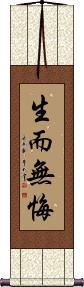
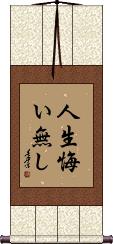
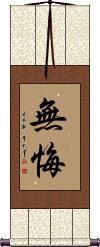
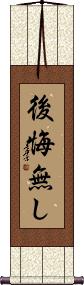
This is how to say "live without regrets" in Mandarin Chinese. This also makes sense in Japanese, but I don't yet have the pronunciation info.


While hard to translate directly, this is the best way to write "Live Strong" in Chinese. If you are a cancer survivor, or simply support Lance Armstrong's ideas, this is a nice selection for a wall scroll.
The first two characters mean strong or staunch. The last two mean living or life (daily existence). While the Chinese version is the reverse order of "Live Strong" it is the only way to write it in a natural form that is also grammatically correct.
Note that we are in no way affiliated or connected to Lance, nor his foundation. This translation is offered because of multiple requests from customers whose philosophies or ideas match those of the Live Strong idea.
See Also... Strength | Vitality | Health | Determination | Discipline


This is the most common way to express "survivor" in Chinese. It literally means "lucky/fortunate surviving person".
This is kind of an odd selection for a wall scroll, but there is no better way to say survivor in Chinese calligraphy.


This word is hard to define. One dictionary defines this as, "acceptance of fate and happy about it". There is one rare English word equivalent which is sanguinity.
You can also say that this means, "Be happy with whatever Heaven provides", or "Find happiness in whatever fate Heaven bestows upon you". This is kind of a way to suggest being an optimist in life.
Note: This is sometimes used as a given name in China.


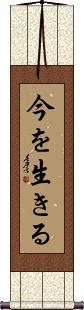
This Japanese phrase can be translated as "live for the day", "live for the moment", "seize the day", or "make the most of the present".


This is a very short way to write "live in the moment" or "live in the now" in Japanese.
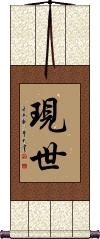
This short word is open to interpretation. It's used in Japanese Buddhism to mean "the current epoch" or "the current age" (the current age is but a brief moment in the greater scope of existence). When used in that context, this is pronounced "utsushiyo" or "ustusiyo" in Japanese. Otherwise, it's pronounced "gensei" in Japanese.
Other translation possibilities include:
Live for now
Earthly world
This world
This life
Earthly life
Present life
Present generation
Present incarnation
Current age
This existence
This (momentary) reality
Note: This is also a word in Chinese and old Korean Hanja. While the meaning is more or less the same, this is not recommended for a wall scroll if your audience is Chinese or Korean. This selection is best if your audience is Japanese.

This is the character which means "heaven" or "sky" in Chinese, Japanese Kanji, and old Korean Hanja.
Context of how this character is used determines if you are talking about heaven or the sky above (often they are the same concept anyway).
When combined with other characters, words like "today" and "tomorrow" are created. While sometimes the character for "sun" is used to mean "day", often "sky" represents "day" in Asian languages.
Example: "this sky" = "today", "next sky" = "tomorrow" in modern Chinese and Japanese (they also use "sun" in the same way - but the use of the "sun" character in words like today and tomorrow feels more ancient).
In Chinese culture, regardless of which religion, it's almost always assumed that God (and any other deities) live up above in the sky. This is probably how the idea of heaven being associated with this character began.
The equation goes something like this: God's domain is the sky, thus, the sky is heaven.
Note: As a single character, this is a little ambiguous, so you might want to choose our Kingdom of Heaven selection instead.
Wall scroll artwork shown on this page is priced as follows:
1 character $29.88 each
2-3 characters $39.88 each
4 characters $49.88 each
5-10 characters $59.88 each
After you select your calligraphy, our website will take you through the process of customizing your artwork.
Options for other mounting such as portraits are available for $13 less.
We also offer the services of a famous master calligrapher for a $40 fee on any scroll if you are looking for investment-quality calligraphy.
If you chose our famous master-calligrapher, you also get more choices for silk and paper colors and the option for larger artwork.
All of our calligraphy is completely done by hand in the ancient way.
When the calligrapher finishes creating your artwork, it is taken to our art mounting workshop in Beijing where a wall scroll is made by hand from a combination of silk, rice paper, and wood.
After we create your wall scroll, it takes at least two weeks for air mail delivery from Beijing to you.
Therefore, allow at least 3 weeks for delivery from the time you place your order.
When you select your calligraphy, you'll be taken to another page where you can choose various custom options.
The scroll that I am holding in this picture is a "regular size"
4-character wall scroll.
As you can see, it is a great size to hang on your wall.
(We also offer custom wall scrolls in larger sizes)
Professional calligraphers are getting to be hard to find these days.
Instead of drawing characters by hand, the new generation in China merely type roman letters into their computer keyboards and pick the character that they want from a list that pops up.
There is some fear that true Chinese calligraphy may become a lost art in the coming years. Many art institutes in China are now promoting calligraphy programs in hopes of keeping this unique form
of art alive.
Even with the teachings of a top-ranked calligrapher in China, my calligraphy will never be good enough to sell. I will leave that to the experts.
The same calligrapher who gave me those lessons also attracted a crowd of thousands and a TV crew as he created characters over 6-feet high. He happens to be ranked as one of the top 100 calligraphers in all of China. He is also one of very few that would actually attempt such a feat.
The following table is only helpful for those studying Chinese (or Japanese), and perhaps helps search engines to find this page when someone enters Romanized Chinese or Japanese
| Title | Characters Simplified Traditional |
Japanese Romaji (Romanized Japanese) | Various forms of Hanyu-Pinyin (Romanized Chinese) | |||
| Live For The Day | 活在今天 活在今天 | n/a | huó zài jīn tiān huo zai jin tian | huo2 zai4 jin1 tian1 huozaijintian | ||
| Alive | 活着 活著 | n/a | huó zhe huo zhe | huo2 zhe huozhe | ||
| Birth / Life | 生 生 | shou / iku shou/iku sho / iku | shēng sheng | sheng1 sheng | ||
| Carpe Diem / Seize the Day | 把握今日 把握今日 | n/a | bǎ wò jīn rì ba wo jin ri | ba3 wo4 jin1 ri4 bawojinri | ||
| Everyday Life | 日常生活 日常生活 | nichi jou sei katsu nichijouseikatsu nichi jo sei katsu | rì cháng shēng huó ri chang sheng huo | ri4 chang2 sheng1 huo2 richangshenghuo | ||
| Immortal / Immortality | 不朽 不朽 | fukyuu fukyu | bù xiǔ bu xiu | bu4 xiu3 buxiu | ||
| A Life of Serenity Yields Understanding | 淡泊以明志宁静而致远 淡泊以明志寧靜而致遠 | n/a | dàn bó yǐ míng zhì, níng jìng ér zhì yuǎn dan bo yi ming zhi, ning jing er zhi yuan | dan4 bo2 yi3 ming2 zhi4, ning2 jing4 er2 zhi4 yuan3 | ||
| Life Force | 生命 生命 | seimei / inochi seimei/inochi | shēng mìng sheng ming | sheng1 ming4 shengming | ||
| Life Goes On | 生活在继续 生活在繼續 | n/a | shēng huó zài jì xù sheng huo zai ji xu | sheng1 huo2 zai4 ji4 xu4 shenghuozaijixu | ||
| A Life of Happiness and Prosperity | 幸福而成功的一生 倖福而成功的一生 | n/a | xìng fú ér chéng gōng de yì shēng xing fu er cheng gong de yi sheng | xing4 fu2 er2 cheng2 gong1 de yi4 sheng1 | ||
| Life is a Journey | 人生是一段旅程 人生是一段旅程 | n/a | rén shēng shì yí duàn lǚ chéng ren sheng shi yi duan lv cheng | ren2 sheng1 shi4 yi2 duan4 lv3 cheng2 renshengshiyiduanlvcheng | ||
| Life is Short | 百岁光阴如过客 百歲光陰如過客 | n/a | bǎi suì guāng yīn rú guò kè bai sui guang yin ru guo ke | bai3 sui4 guang1 yin1 ru2 guo4 ke4 baisuiguangyinruguoke | ||
| Life / Living / Live | 生活 生活 | sei katsu seikatsu | shēng huó sheng huo | sheng1 huo2 shenghuo | ||
| Live Love Die | 生爱死 生愛死 | sei ai shi seiaishi | shēng ài sǐ sheng ai si | sheng1 ai4 si3 shengaisi | ||
| Live Laugh Love | 笑爱生活 笑愛生活 | shou ai sei katsu shouaiseikatsu sho ai sei katsu | xiào ài shēng huó xiao ai sheng huo | xiao4 ai4 sheng1 huo2 xiaoaishenghuo | ||
| Live in Prosperity | 生活于繁荣中 生活于繁榮中 | n/a | shēng huó yú fán róng zhōng sheng huo yu fan rong zhong | sheng1 huo2 yu2 fan2 rong2 zhong1 shenghuoyufanrongzhong | ||
| Live Without Regret | 生而无悔 生而無悔 | n/a | shēng ér wú huǐ sheng er wu hui | sheng1 er2 wu2 hui3 shengerwuhui | ||
| Live Strong | 坚强生活 堅強生活 | n/a | jiān qiáng shēng huó jian qiang sheng huo | jian1 qiang2 sheng1 huo2 jianqiangshenghuo | ||
| Survivor | 幸存者 倖存者 | n/a | xìng cún zhě xing cun zhe | xing4 cun2 zhe3 xingcunzhe | ||
| Acceptance of Fate / Happy With Your Fate | 乐天 樂天 | n/a | lè tiān le tian | le4 tian1 letian | ||
| Live For The Day / Seize The Day | 今を生きる 今を生きる | ima wo i ki ru imawoikiru | n/a | |||
| Live In The Moment / Live In The Now | 现世 現世 | gen sei gensei | xiàn shì xian shi | xian4 shi4 xianshi | ||
| Heaven / Sky | 天 天 | ten | tiān tian | tian1 tian | ||
| If you have not set up your computer to display Chinese, the characters in this table probably look like empty boxes or random text garbage.
This is why we spent hundreds of hours making images so that you could view the characters in the "Live For Today" listings above. If you want your Windows computer to be able to display Chinese characters you can either head to your Regional and Language options in your Win XP control panel, select the [Languages] tab and click on [Install files for East Asian Languages]. This task will ask for your Win XP CD to complete in most cases. If you don't have your Windows XP CD, or are running Windows 98, you can also download/run the simplified Chinese font package installer from Microsoft which works independently with Win 98, ME, 2000, and XP. It's a 2.5MB download, so if you are on dial up, start the download and go make a sandwich. | ||||||
All custom calligraphy items are made-to-order in our little Beijing artwork-mounting workshop.
Please note: Rush service can be as fast as two weeks, but regular service is over a month for delivery.
Copyright Oriental Outpost 2002-2009 - All Rights Reserved
Image Use Policy | Privacy Policy