Buy a wall scroll with Bruce in Chinese or Japanese.
Learn how the name Bruce is written in Chinese and Japanese. Decorate your home with a cool wall scroll that says Bruce.
2. Bruce
3. Bruce Lee
4. The key to immortality is first living a life worth remembering
5. Ip Man
6. Jeet Kune Do
8. Leanna
9. Lee / Plum
10. Little Dragon
Be Like Water
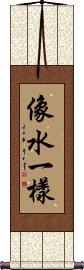
像水一樣 is a short quote from a much longer statement by Bruce Lee.
He summarized how people should be flexible to all circumstances, attacks, or situations. In the end, he exclaims, “Be like water, my friend.” 像水一樣 is the “Be like water” part alone since that seems to be what most people want.
Bruce
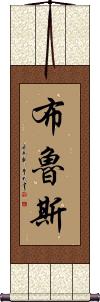
布魯斯 is the name Bruce in Chinese (Mandarin).
Bruce
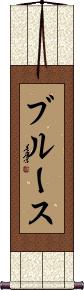
ブルース is the name Bruce in Japanese.
Note: Because this title is entirely Japanese Katakana, it should be written by a Japanese calligrapher.
Bruce Lee
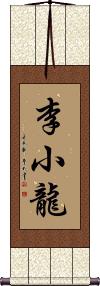
李小龍 is the real full name of Bruce Lee.
 Many people have no idea that Bruce Lee had a “real” Chinese name. In Mandarin and Cantonese, he is known as “Lǐ XiǎoLóng” and “Léi SíuLùng” respectively.
He kept his family name pronunciation (Li = Lee). 李 is a common family name that also means “plum.”
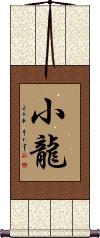
His given name 小龍 (Xiao-Long), literally means “little dragon.” 李小龍 is why you often see the character for dragon associated with Bruce Lee on various posters etc.
For a pronunciation lesson, the “X” in Romanized Mandarin is pronounced like a “sh” sound but with your tongue at the bottom of your mouth. The vowel sound in “Long” is like the English “oh,” not like the “ah” sound in the English word “long.”
If you are a big Bruce Lee fan, you should know this information, and you should have this wall scroll hanging in your room or martial arts studio.
Note: Japanese use these same Chinese characters / Kanji to write Bruce Lee's real name (with different pronunciation - which is a bit like how the name “Bruce Lee” sounds in English).
See Also: Kung Fu | Martial Arts
The key to immortality is first living a life worth remembering
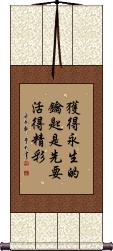
獲得永生的鑰匙是先要活得精彩 is a famous quote from Bruce Lee.
However, when quoted, he was speaking in English. So this is a translation of his English quote into Chinese. Since Bruce spoke both Chinese and English, his quotes sometimes go both ways.
Ip Man
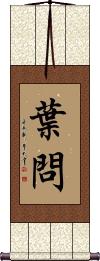
葉問 is the name of “Ip Man” or “Yip Man” (1893-1972).
He was a martial arts practitioner and master. He is perhaps most famous for being the master of Bruce Lee.
Jeet Kune Do
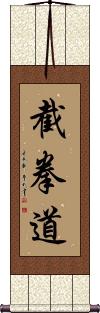
In Cantonese, 截拳道 is Jeet Kune Do. Often it is explained as the “Way of the Intercepting Fist.”
截拳道 is a martial art style founded by Bruce Lee.
The first character means to cut off or sever.
The second character is a fist.
The last character means way or method.
See Also: Bruce Lee
Kung Fu / Gong Fu
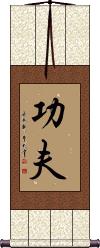
功夫 or Kung Fu is one of the most famous types of martial arts in the world - and not just because of Bruce Lee.
Some translate the meaning as “Accomplishment by Great Effort.” I think this is partially true, but directly translated, it literally means “Merit/Achievement/Accomplishment Man.” The word “fu” can sometimes mean “husband” or “porter,” but in this case, it can only mean “man.” However, few in China will think “man” when they hear the word “Gong Fu” spoken.
This term is also used for things other than martial arts. In fact, it's used to refer to a person with excellent skills in crafts that require a lot of effort to master, such as cooking, tea ceremonies, and calligraphy.
What a lot of people don't know is that the spelling of “Kung Fu” was actually taken from the old Wade Giles form of Romanization. Using this method, the sounds of the English “G” and “K” were both written as “K” and an apostrophe after the “K” told you it was supposed to sound like a “G.” Nobody in the west knew this rule, so most people pronounce it with a “K-sound.” And so, Gong Fu will always be Kung Fu for most westerners.
Also, just to educate you a little more, the “O” in “Gong” has a sound like the English word “oh.”
The popular Chinese dish “Kung Pao Chicken” suffers from the same problem. It should actually be “Gong Bao Chicken.”
Historical note: Many will claim that Kung Fu was invented by the monks of the Shaolin monastery. This fact is argued in both directions by scholars of Chinese history. Perhaps it is more accurate to say that the Shaolin Monks brought the original fame to Kung Fu many generations ago.
See Also: Bruce Lee
Leanna
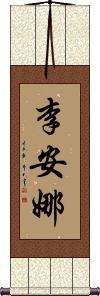
This is another transliteration to Mandarin Chinese for the name Leanna.
The first character is the only difference. Both ways, the first character is pronounced like “lee” but this one happens to be the same “lee” as in “Bruce Lee” - it also means plum.
Lee / Plum
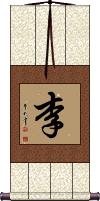
This is the most common Chinese character which sounds like “Lee” or “Li” and is used as a surname / family name in China.
李 actually means “Plum.” So it's really Mr. Plum and Mrs. Plum if you translated the name instead of romanizing.
This is not the only character in Chinese that can be romanized as “Lee” or “Li.” If your family name is “Lee” or “Li” please be sure this is the correct character before you order this scroll (look at your grandparents' Chinese passports or other documents if you are an ABC and are trying to create a heritage wall scroll).
Famous people with this surname include Bruce Lee (Li Xiao-Long), Minister Li Peng, and famous Tang Dynasty poet Li Bai.
In Korea, this is the original character for a surname that romanizes as “Yi.”
Little Dragon
Unbreakable / Indestructible
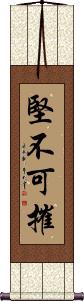
堅不可摧 means “unbreakable” in Chinese.
It can also mean invulnerable, indestructible, or impregnable.
You may be searching for this because you like the 2000 film, Unbreakable, starring Bruce Willis. This is the title of that film in Chinese.
The following table may be helpful for those studying Chinese or Japanese...
| Title | Characters | Romaji (Romanized Japanese) | Various forms of Romanized Chinese | |
| Be Like Water | 像水一樣 | xiàng shuǐ yí yàng xiang4 shui3 yi2 yang4 xiang shui yi yang xiangshuiyiyang | hsiang shui i yang hsiangshuiiyang |
|
| Bruce | 布魯斯 布鲁斯 | bù lǔ sī bu4 lu3 si1 bu lu si bulusi | pu lu ssu pulussu |
|
| Bruce | ブルース | buruusu / burusu | ||
| Bruce Lee | 李小龍 李小龙 | bu ruu su ri buruusuri bu ru su ri | lǐ xiǎo lóng li3 xiao3 long2 li xiao long lixiaolong | li hsiao lung lihsiaolung |
| The key to immortality is first living a life worth remembering | 獲得永生的鑰匙是先要活得精彩 获得永生的钥匙是先要活得精彩 | huò dé yǒng shēng de yào shí shì xiān yào huó dé jīng cǎi huo4 de2 yong3 sheng1 de yao4 shi2 shi4 xian1 yao4 huo2 de2 jing1 cai3 huo de yong sheng de yao shi shi xian yao huo de jing cai | huo te yung sheng te yao shih shih hsien yao huo te ching ts`ai huo te yung sheng te yao shih shih hsien yao huo te ching tsai |
|
| Ip Man | 葉問 叶问 | yè wèn / ye4 wen4 / ye wen / yewen | yeh wen / yehwen | |
| Jeet Kune Do | 截拳道 | sekken dou / sekkendou / seken do | jié quán dào jie2 quan2 dao4 jie quan dao jiequandao | chieh ch`üan tao chiehchüantao chieh chüan tao |
| Kung Fu Gong Fu | 功夫 | kan fu / ku fu kanfu / kufu | gōng fu / gong1 fu / gong fu / gongfu | kung fu / kungfu |
| Leanna | 李安娜 | lǐ ān nà li3 an1 na4 li an na lianna | ||
| Lee Plum | 李 | ri / sumomo | lǐ / li3 / li | |
| Little Dragon | 小龍 小龙 | xiǎo lóng xiao3 long2 xiao long xiaolong | hsiao lung hsiaolung |
|
| Unbreakable Indestructible | 堅不可摧 坚不可摧 | jiān bù kě cuī jian1 bu4 ke3 cui1 jian bu ke cui jianbukecui | chien pu k`o ts`ui chienpukotsui chien pu ko tsui |
|
| In some entries above you will see that characters have different versions above and below a line. In these cases, the characters above the line are Traditional Chinese, while the ones below are Simplified Chinese. | ||||



